Raytac MDBT40 / MDBT40-P 仕様変更の通知

Raytac Corporation

Bluetooth Module Maker based on Nordic nRF51 & nRF52 Solution

((Nordic nRF51822 & nRF51422 & nRF52832)
Bluetooth Specification Version: BT4.0 & BT4.1 & BT4.2
Tel: +886.2.3234.0208
email: service@raytac.com
日本での代理店への連絡は下記の通り。
株式会社フクミ (Fukumi corporation)
消費材企画開発Gr. LBTチーム (Consumer Products R&D Group, LBT team)
榊 和優 (Kazumasa Sakaki)
Tel : 03-5687-2890 (+81-3-5687-2890)
Mail : lbt_bt@fukumi.co.jp
 
ブログから引用。詳細は下記Link先へ。
BLEモジュールのRaytacよりMDBT40 / MDBT40-P (Nordic nRF51 SoC)シリーズの
仕様変更(Product Change Notice : PCN)がありましたので、
当ブログにて共有します。
お客様各位
RaytacはMDBT40 / MDBT40-PシリーズのPCNを連絡いたします。
韓国の電波安全認証KCCの承認により、
モジュールシールドケースにマークの表示が必要になりましたので、
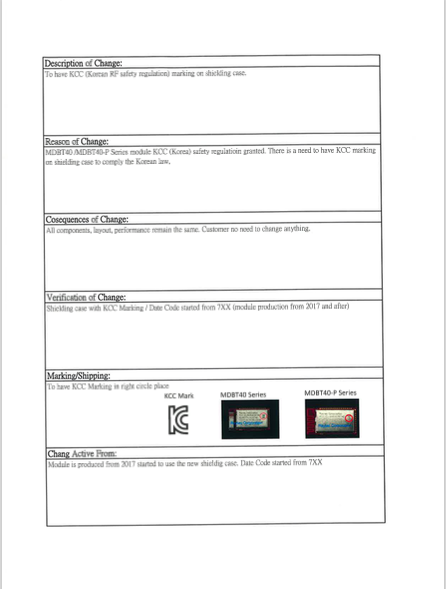
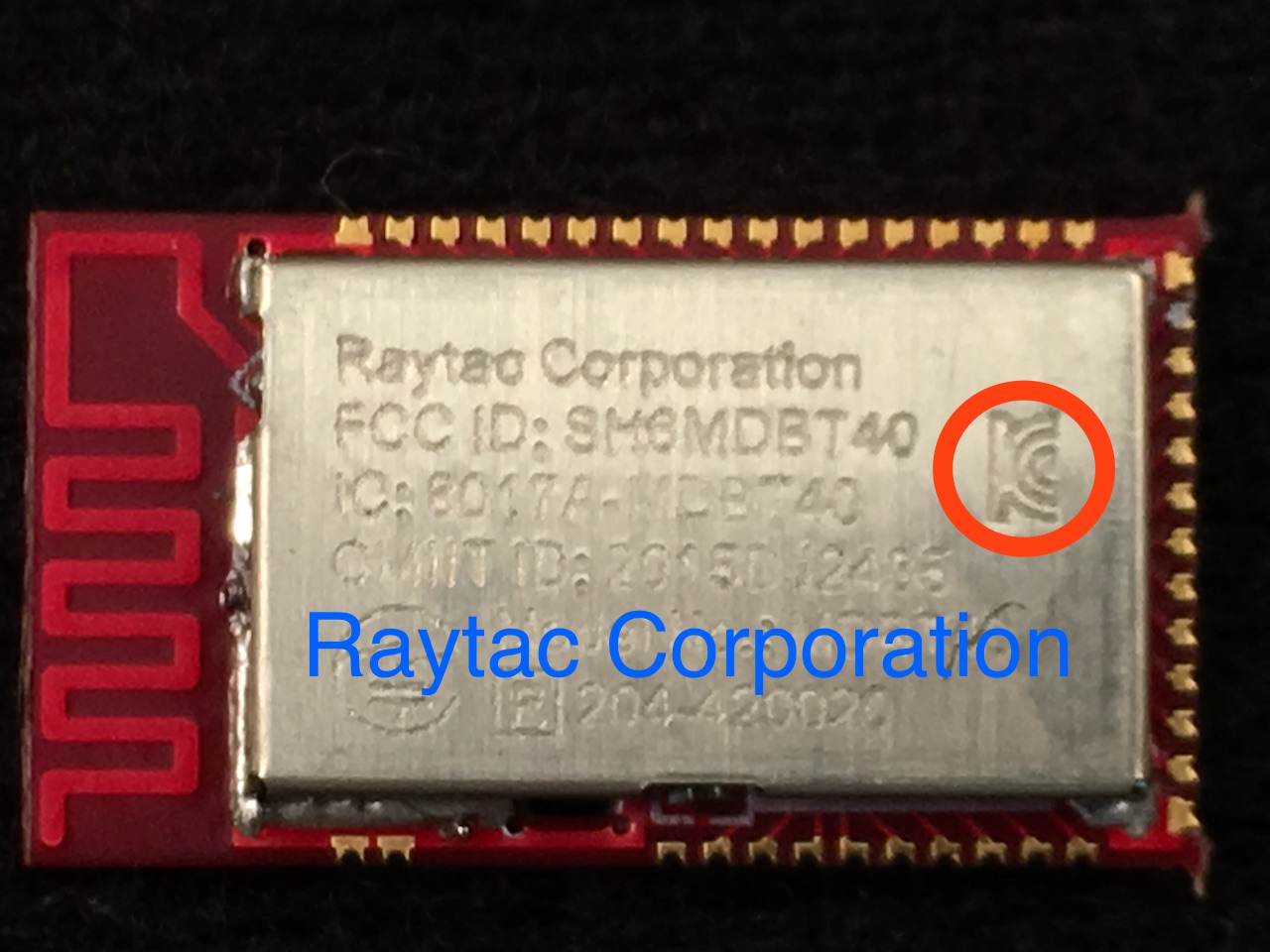
KCCマークの印字を追加いたします。
*下記参照
kcc-mark-mdbt40
kcc-mark-mdbt40-p
変更点はこれだけです。
その他に関しては今までと変更が有りませんので、
既にご利用頂いているお客様の方で特別手続きを行ってい頂く必要は御座いません。
変更時期は2017年以降の製造分より(製造番号は7XX以降)
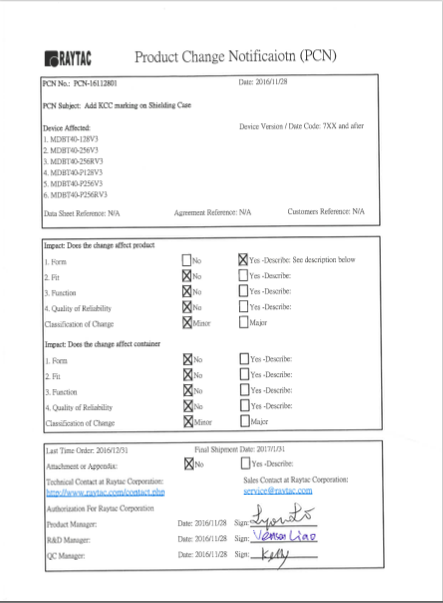
下記はRaytacの公式PCNとなります。
参照まで。
以上、引き続きRaytac BLEモジュールを宜しくお願いします。
2016年12月01日(木)
株式会社フクミ

Raytac Product Change Notice (PCN) Announced for MDBT40 / MDBT40-P Series Module

Raytac Corporation
A BT4.1 & BT4.2 module maker based on Nordic nRF51 & nRF52 solution 
(nRF51822 & nRF51422 & nRF52832 & nRF51802)
Tel: +886.2.3234.0208
email: service@raytac.com  
Dear Customers,
Raytac would like to announce Product Change Notice (PCN) for MDBT40 & MDBT40-P series module.
As MDBT40 /MDBT40-P Series module KCC (Korea) safety regulation granted. 
There is a need to have KCC marking on shielding case to comply the Korean law.
 
 
All components, layout, performance remain the same. Customer no need to change anything.
The only changing is to have KCC (Korean RF safety regulation) marking onto shielding case.
The change started from module produced from 2017 (Date Code started from 7XX)

Nordic Release Mesh Sample Code To Make Development Easy

Raytac Corporation

A BT4.1 & BT4.2 module maker based on Nordic nRF51 & nRF52 solution 

(nRF51822 & nRF51422 & nRF52832 & nRF51802)

Tel: +886.2.3234.0208

email: service@raytac.com  

Mesh Network is future of IoT, also an issue that raised most interests among developers.

With the official Bluetooth Mesh nearing release by SIG, Nordic offers nRF Connect Mesh to provide a solid tools for developers to create mesh-enabled projects.

For more detail, pls click below link 

Developers also can access the sample code from below link


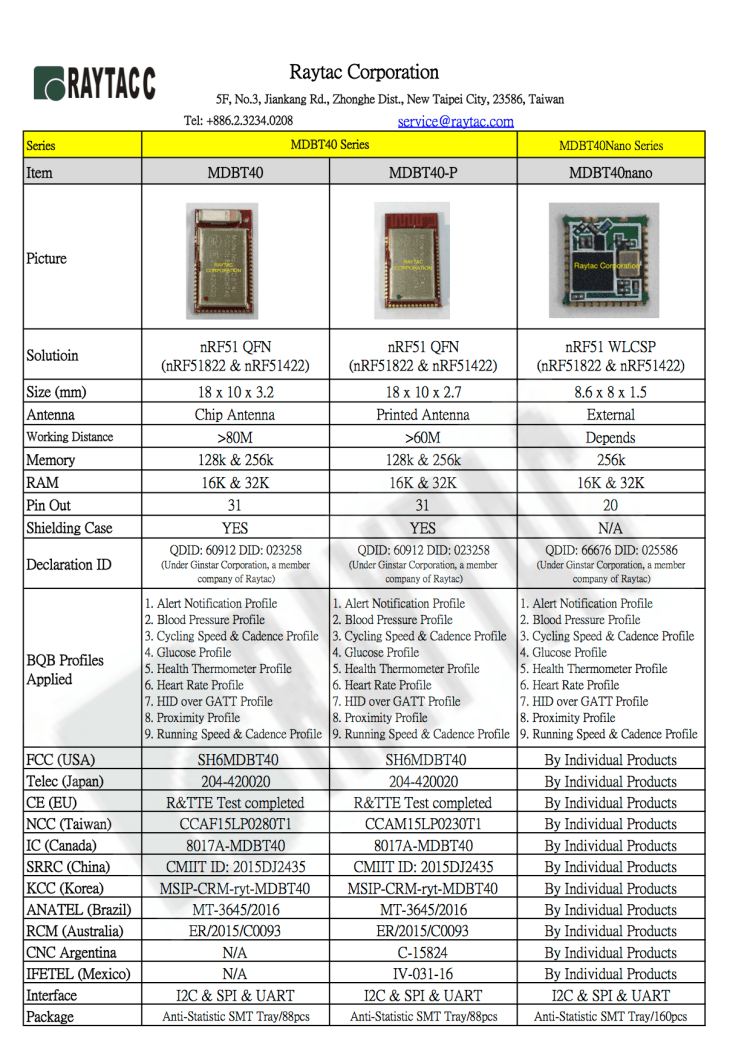
Nordic nRF51 Module Product Line Up (Raytac MDBT40 Series)

Raytac Corporation

A BT4.1 & BT4.2 module maker based on Nordic nRF51 & nRF52 solution

(nRF51822 & nRF51422 & nRF52832 & nRF51802)

www.raytac.com

Tel: +886.2.3234.0208

email: service@raytac.com

http://raytaccorp.blogspot.jp/2016/11/nordic-nrf51-module-product-line-up.html


MDBT40&MDBT40-P Spec Sheet (nRF51822)

http://www.raytac.com/download/MDBT40/MDBT40%20spec-Version%20A4.pdf

MDBT40&MDBT40-P Design & Layout Guide

(Pls change the footprint file name from .li to .lib to open it)

https://mega.nz/#!B04BmS7A!xop-1C1ynsjHXe_kDodIH8QXJn0UWtY6gZ7zHxSg8Oo

raytac-nrf51-ble-module-20161006

DID 023258.png


DIY開発キット発売予告

Raytac Corporation

A BT4.1 & BT4.2 module maker based on Nordic nRF51 & nRF52 solution 
(nRF51822 & nRF51422 & nRF52832 & nRF51802)
Tel: +886.2.3234.0208
email: service@raytac.com
日本での代理店への連絡は下記の通り。
株式会社フクミ (Fukumi corporation)
消費材企画開発Gr. LBTチーム (Consumer Products R&D Group, LBT team)
榊 和優 (Kazumasa Sakaki)
Tel : 03-5687-2890 (+81-3-5687-2890)
Mail : lbt_bt@fukumi.co.jp
 
ブログから引用。詳細は下記Link先へ。
 
近々当ブログ運営の株式会社フクミより
台湾Raytac BLEモジュールを積んだコーディング不要のDIY用開発キットの取り扱いを
始める予定です。
今回はその商品の概要並びに予告となります。
■概要
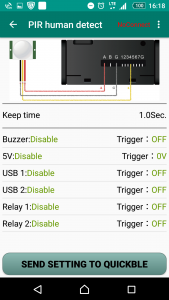
台湾VierMTech社が提供するQuick BLEはAPP コンフィグで簡単接続と設定が出来る
DIY向けの開発キットです。
台湾RaytacのBLEモジュールを使用しているので、
電波法も取得済みですので、日本国内で問題なく利用することが出来ます。
■特徴
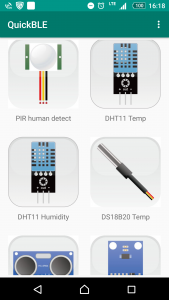
・8種類のセンサーがセットになったパッケージです。
-照度センサー
-温湿度センサー
-防水温度センサー
-土壌水分センサー
-超音波距離センサー
-赤外線測距センサー
-赤外線人感センサー
-拍手音センサー
*センサーは随時追加される予定です。
・モバイルAPPでリアルタイムモニタリング可能
・USB2.0ポートx2 / リレー x 2 / 5Vポート x 1


nRF51 Raytac Module Reflow Profile Reference (MDBT40 / MDBT40-P)

To help customers to proceed the SMT process, Raytac provides the Reflow Profile reference.

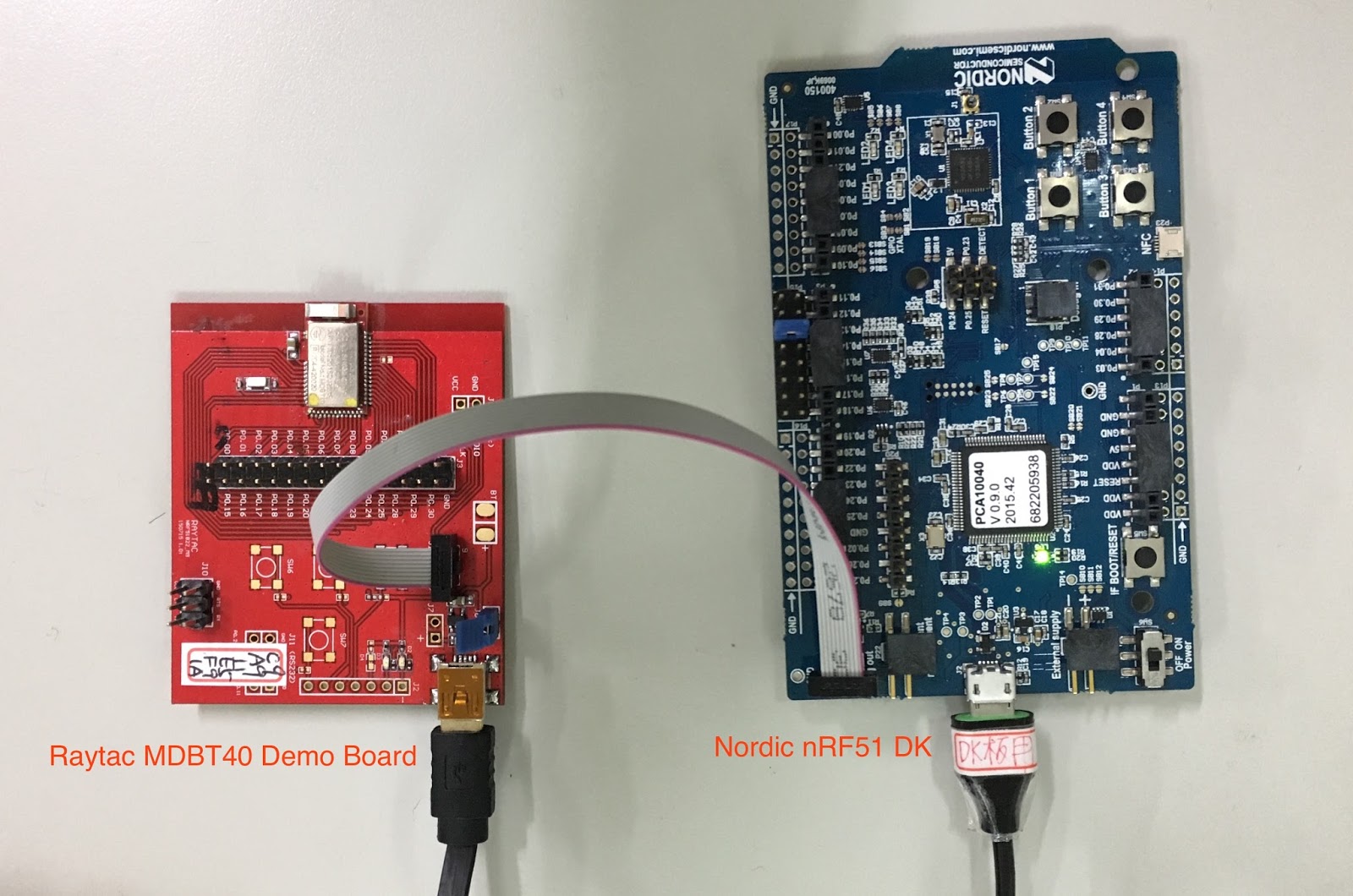
How to use Raytac MDBT40 & MDBT42Q Demo Board


Many customers are using Raytac’s Demo board for firmware development and debug.

Here we provide easy setup way for customer reference.

Programming software: Nordic nRFgo

MDBT40 Series


MBT40 Demo Board Schematic (Click picture to retrieve clear image)


MDBT42Q Series


MDBT42Q Demo Board Schematic(Click picture to retrieve clear image)


Raytac Corporation 勁達國際電子有限公司
A BT5.2 & BT5.1 & BT5 module maker based on Nordic nRF53 & nRF52 solution 
(nRF5340 & nRF52840 & nRF52833 & nRF52832 & nRF52820 & nRF52811 & nRF52810 & nRF52805)
www.raytac.com email: service@raytac.com Tel: +886.2.3234.0208

Bluetooth プロトコルスタックについて

Raytac Corporation

A BT4.1 & BT4.2 module maker based on Nordic nRF51 & nRF52 solution 
(nRF51822 & nRF51422 & nRF52832 & nRF51802)
Tel: +886.2.3234.0208
email: service@raytac.com
日本での代理店への連絡は下記の通り。
株式会社フクミ (Fukumi corporation)
消費材企画開発Gr. LBTチーム (Consumer Products R&D Group, LBT team)
榊 和優 (Kazumasa Sakaki)
Tel : 03-5687-2890 (+81-3-5687-2890)
Mail : lbt_bt@fukumi.co.jp
 
ブログから引用。詳細は下記Link先へ。
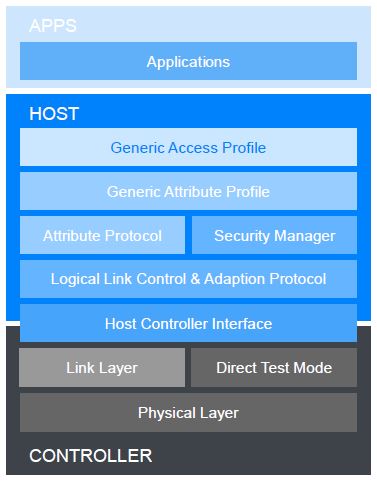
Bluetooth(BLE)の通信を実現するプロトコルスタックは
下記のような階層構造となっています。
今回はこの中でも開発者が良く触る「GAP」「GATT」「ATT」について
簡易にその役割をまとめます。
■GAP(Generic Access Profile)
ここではBluetoothデバイス間の通信制御の仕様を規定しています。
・デバイスの発見及び認証
・Bluetoothデバイス間の通信の確立及び暗号化
BLE仕様においては最上位となる定義であり、すべてのBLEデバイスがこの定義に準拠、
またサポート・実装していなければならないです。
■GATT(Generic Attribute Profile)
ここではBluetoothデバイス間のデータ交換における論理的な仕様を規定しています。
・データ要素の検索方法、書き込み・読み出し・プッシュ
・サービス・キャラクタリスティック・ディスクリプタ―
(Services・Characteristics・Descriptors)
すべてのBLEデバイスは、GATTで定義されている仕様のもとにデータのやり取りをおこないます。
■ATT(Attribute Protocol)
ここではGATT通信を実現する通信手順の仕様を規定しています。
・属性情報の交換
以上、非常に簡易では御座いますが、
一部BLEプロトコルの説明でした。

Raytac’s nRF51 Module (MDBT40/MDBT40-P) Bluetooth QDID information

Raytac Corporation

A BT4.1 & BT4.2 module maker based on Nordic nRF51 & nRF52 solution 

(nRF51822 & nRF51422 & nRF52832 & nRF51802)

Tel: +886.2.3234.0208

Bluetooth products must purchase DID and submit the testing evidence issued by BQE to completed the SIG registration and activate the DID

Only products’s DID been activated then allowed to use Bluetooth logo.

Developer’s who built the products based on Raytac module is allow to relable Raytac’s DID to easy the process.

Simply purchase their own DID from SIG, and relabel Raytac’s DID then can completethe Bluetooth activation process.

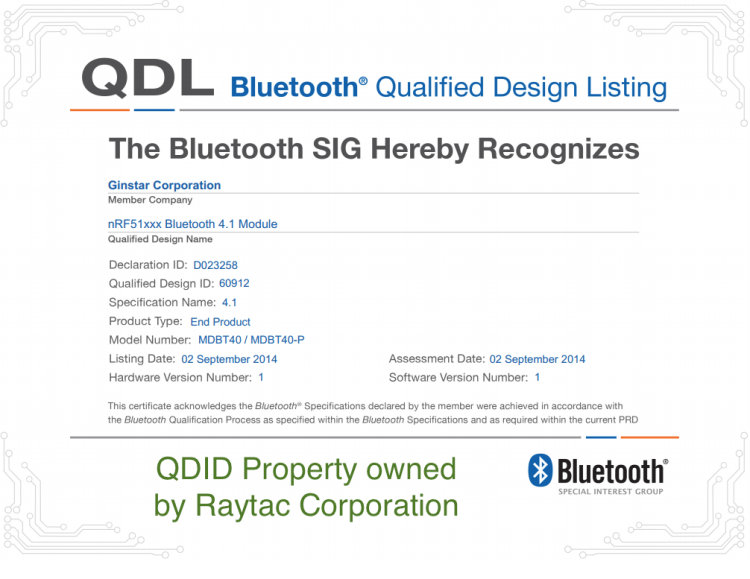
Raytac’s MDBT40/MDBT40-P QDID/DID is applied by subsidiary of Ginstar Corporation.

The QDID is 60912 / D023258

We welcome all Raytac’s customers to relabel the QDID as long as product built by MDBT40/MDBT40-P. As such, the Bluetooth process becomes simple and cost effective.

What is the AQL?

Raytac Corporation
A BT4.1 & BT4.2 module maker based on Nordic nRF51 & nRF52 solution 
(nRF51822 & nRF51422 & nRF52832 & nRF51802)
Tel: +886.2.3234.0208
Quoted from
 
The “AQL tables" are statistical tools at the disposal of product inspections. They help determine two key elements:
  • How many samples should be inspected?
  • Where is the limit between acceptability and refusal, when it comes to defective products?
The need for an objective measurement of quality
In virtually every production batch, there will be defective products. It is true even after the manufacturer has checked each individual product and has repaired the defective ones.
Thus, in a supplier/buyer relationship, the supplier cannot be expected to deliver defect-free goods. However, the buyer wants to control the quality of purchased goods, since he does not want too many defects. But what does “too many" mean?
How to set the limit between acceptability and refusal in a way that can be agreed upon and measured?

Definition and application of ‘AQL’
The limit, as described above, is called the ‘AQL’. It stands for ‘Acceptance Quality Limit’, and is defined as the “quality level that is the worst tolerable" (ISO 2859 standard).
For example: “I want no more than 1.5% defective items in the whole order quantity" means the AQL is 1.5%.
In practice, three types of defects are distinguished. For most consumer goods, the limits are:
  • 0% for critical defects (totally unacceptable: a user might get harmed, or regulations are not respected).
  • 2.5% for major defects (these products would usually not be considered acceptable by the end user).
  • 4.0% for minor defects (there is some departure from specifications, but most users would not mind it).
These proportions vary in function of the product and its market. Components used in building an airplane are subject to much lower AQL limits.

Getting familiar with the AQL tables
Before using the AQL tables, you should decide on three parameters:
  • The ‘lot size’. If you ordered different products, the quantity of each product is a lot size, and separate inspections should be carried out for each lot. If you ordered only one product, the lot size is your total order quantity.
  • The inspection level. Different inspection levels will command different number of samples to inspect. In this article, we will stick to the so-called “level II", under “normal severity".
  • The AQL level appropriate for your market. If your customers accept very few defects, you might want to set a lower AQL for both major and minor defects.
There are basically two tables. The first one tells you which ‘code letter’ to use. Then, the code letter will give you the sample size and the maximum numbers of defects that can be accepted.
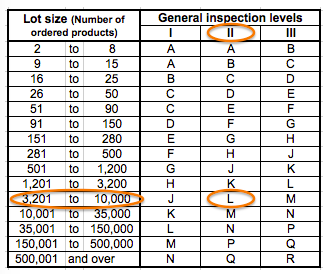
First table: sample size code letters
How to read this table? It is very easy.
If you follow my example, I assume your ‘lot size’ is comprised between 3,201pcs and 10,000pcs, and that your inspection level is ‘II’. Consequently, the code letter is “L".
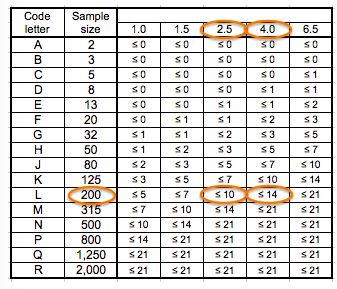
Second table: single sampling plans for level II inspection (normal severity)
How to read this table?
Your code letter is “L", so you will have to draw 200pcs randomly from the total lot size.
Besides, I assume you have set your AQL at 2.5% for major defects and 4.0% for minor defects. Therefore, here are the limits: the products are accepted if NO MORE than 10 major defects AND NO MORE than 14 minor defects are found.
For example, if you find 15 major defects and 12 minor defects, the products are refused. If you find 3 major defects and 7 minor defects, they are accepted.
Frequently asked questions about AQL
“What are the reduced and tightened inspection severities?"
They are designed to be used in very specific situations, when a producer is particularly reliable, or on the contrary fails too often. In practice, these severities are used in less than 1% of QC inspections.
The normal severity already allows for a good variation of sample sizes. In the vast majority of cases, third-party inspectors follow only the normal severity.

“So, basically I have to authorize the factory to produce some defects?"
Yes, some defects, since a factory cannot reasonably be expected to turn out 100% good quality.
However, it does not mean the buyer tolerates everything as long as the number of defects are below the AQL limits. Please see below the note issued in the ISO2859 standard:
“Although individual lots with quality as bad as the acceptance quality limit may be accepted with fairly high probability, the designation of an acceptance quality limit does not suggest that this is a desirable quality level. Sampling schemes […] are designed to encourage suppliers to have process averages consistently better than the AQL."