Criteria for Choosing Internal or External Oscillator (Crystal)

Bluetooth modules typically have options for a 32MHz Internal Oscillator (or some called internal crystal oscillator) and a 32.768KHz External Oscillator. The choice between the two is often influenced by specific application requirements, power consumption, accuracy, and cost considerations. Here are some basic differences between Internal and External Oscillators:

  • Internal Oscillator: (32MHz)
  • Function: The internal oscillator is embedded within the module and generates the clock signal for the Bluetooth module. This internal oscillator is typically smaller, lightweight, and reduces dependence on external components.
  • Advantages: Simplifies design, saves space, and reduces costs.
  • Disadvantages: Some applications may require higher clock stability, which the internal oscillator may not provide to the desired level of precision.
  • External Oscillator: (32.768KHz)
  • Function: An external oscillator is an independent oscillator externally connected to the module, offering higher clock stability and accuracy.
  • Advantages: Provides higher clock stability, suitable for applications with stricter timing requirements.
  • Disadvantages: Requires additional components, may occupy more space, and increases costs.

Criteria for choosing Internal or External Oscillator:

  • If the application has modest clock precision requirements, and cost and space are critical factors, choosing the internal oscillator may be suitable.
  • If the application demands higher timing precision, an external oscillator should be considered for its enhanced clock stability.

Benefits from switching between external and internal oscillator:

  • Increased Performance Requirements: If the application’s performance requirements increase, a higher-precision oscillator, such as an external oscillator, may be needed.
  • Insufficient Clock Stability: If timing stability issues arise during Bluetooth communication, upgrading to an external oscillator can provide better clock stability.

Followings are the instructions we can use to switch between internal oscillator and external oscillator for nRF5 SDK (v17.10) and NCS SDK (v2.5.2).

Keil (Keil μVision) and SES (Segger Embedded Studio) are another method commonly used Integrated Development Environments (IDEs) in the field of embedded systems development.

Choosing to use the internal crystal oscillator requires program modifications. Please refer to the following instructions for making these changes in the Keil and SES development environments.


Keil

SES


Edited by Sales Manager: Ms. Mandy Chao

Raytac Corporation 勁達國際電子股份有限公司
Bluetooth & WiFi module maker based on Nordic nRF54, nRF53, nRF52, nRF7002 solution
BT5.4 &BT5.3 & BT5.2 & BT5.1 Qualified, FCC/IC/CE/Telec/KC/RCM/SRRC/NCC Pre-Certified. Bluetooth Solution: nRF54, nRF5340, nRF52840, nRF52833, nRF52832, nRF52820, nRF52811, nRF52810, nRF52805, nRF51822 WiFi Solution: nRF7002
www.raytac.com
email:service@raytac.com
Tel: +886.2.3234.0208

New Distribution Partnership in India Region – Millennium Semiconductors

Raytac Corporation, a globally recognized third-party Bluetooth module supplier endorsed by Nordic Semiconductor, has announced a strategic collaboration with Millennium Semiconductor, a specialized electronic agent, starting from November 2023. The establishment of this partnership aims to jointly expand into the Indian market and provide comprehensive services to customers in different regions. Raytac Corporation has consistently focused on the wireless field, earning a reputation as a leading provider of Bluetooth Low Energy modules with outstanding technological capabilities. Additionally, Raytac offers the latest WiFi + BLE modules and a complete range of solutions from Nordic.

The product lineup includes series such as nRF54, nRF5340, nRF52840, nRF52833, nRF52832, nRF52820, nRF52811, nRF52810, nRF52805, nRF51822, all of which have obtained qualifications for BT5.4, BT5.3, BT5.2, and BT5.1. Furthermore, the nRF7002 represents the first device in our array of distinct Wi-Fi products, seamlessly combining with Nordic’s established ultra-low power technologies. Raytac Corporation’s modules have received Bluetooth (QDID/DID/BQB) and regulatory certifications from various countries and regions, including FCC (USA), CE (Europe), IC (Canada),TELEC (Japan), KC (Korea), SRRC (China), NCC (Taiwan), RCM (Australia/New Zealand), and others.

In addition to delivering excellent performance and transmission distances, Raytac Corporation’s modules are relatively compact in size, offering a diverse range of module series choices. This flexibility empowers developers to design without being constrained by module dimensions. Furthermore, the inclusion of AT Command by Raytac facilitates a quick entry for developers into the realms of Bluetooth and the Internet of Things.

Millennium Semiconductors India Private Limited, 

17/18/19, 2nd Floor, Mahalaxmi Heights, Mumbai-Pune Road, Pimpri, Pune 411 018, Maharashtra, INDIA.

+91 20 67177100 / 151, +91 9130015701

info@millenniumsemi.com

Edited by Sales Manager: Ms. Mandy Chao

Raytac Corporation

勁達國際電子股份有限公司
Bluetooth & WiFi module maker based on Nordic nRF54, nRF53, nRF52, nRF7002 solution
BT5.4 &BT5.3 & BT5.2 & BT5.1 Qualified, FCC/IC/CE/Telec/KC/RCM/SRRC/NCC Pre-Certified. Bluetooth Solution: nRF54, nRF5340, nRF52840, nRF52833, nRF52832, nRF52820, nRF52811, nRF52810, nRF52805, nRF51822 WiFi Solution: nRF7002
www.raytac.com
email:service@raytac.com
Tel: +886.2.3234.0208

Important Notice:Upcoming price increase in Bluetooth SIG Membership Fees and DID

The Bluetooth SIG Board of Directors(BoD) has granted its approval for a 15% increase in member fees, effective from January 1,2024. This decision comes after careful consideration of the organization’s financial situation and the need to cover the rising costs of current and futrue member services throughout 2024.

Bluetooth

Feel free to explore the mission and operations of the Bluetooth SIG by visiting the provided web pages below:

Raytac Corporation 勁達國際電子有限公司
A Bluetooth & WiFi module maker based on Nordic nRF53, nRF52, nRF70 solution 
www.raytac.com email: service@raytac.com Tel: +886.2.3234.0208           

Bluetooth – Current and soon-to-perish versions

Bluetooth has been around for quite some time, but that doesn’t mean that no one is a beginner when it comes to developing Bluetooth-based products. In fact, due to their recent updates, Bluetooth is becoming increasingly popular as demand for power efficient gadgets and wireless technology is increasing. Smart watches is just one of the many examples out there.

For each and every single one of these devices, you’ll first have to register your new product with Bluetooth-functions built in on Bluetooth SIG’s website. You will eventually register (and pay for) your product based on what version of the Bluetooth protocol that you’re using in the product and do so by purchasing a so called Declaration ID (DID).

Yes, a little exaggeration in the title, but that’s essentially what it comes down to. Bluetooth SIG is doing some major updates and changes to the Bluetooth protocol which includes getting rid of the more outdated versions.

There are quite a few versions of the Bluetooth protocol out there, but nowadays you will basically be advised to choose from 2 versions:
v.4.2 or v.5.0
These two versions would be, as I mentioned in the title, the two current versions of Bluetooth.

Although it might seem very simple at first, there are a few things that you need to understand the content of the announcements to fully grasp what these updates and changes mean. That, my friends, is today’s topic of this post.

Archived specifications

Deprecated and Withdrawn Specifications

When a specification reaches the end of its useful life, the Bluetooth® SIG may choose either to deprecate the specification, ending maintenance and restricting its use, or to withdraw the specification from use.

Bluetooth SIG – https://www.bluetooth.com/specifications/archived-specifications

What has changed recently is nothing new, but it’s big. What I mean is that similar changes have been done in the past, but since the market is more dependent on the technology now than before, it matters far more for people when the Bluetooth SIG do the same changes nowadays. Those changes are as follows:

On 01/28/2019, the following policy changes will be enacted:
– Creating new designs that implement deprecated or withdrawn specifications will not be permitted
– New products cannot be added to designs that implement withdrawn specifications
– You cannot pay a $25,000 fee to qualify a new design that implements a deprecated specification
– Purchased but unused $25,000 Declaration IDs will no longer be valid and the cost of any unused $25,000 Declaration IDs will be credited to your account


Bluetooth SIG – bluetooth.com

This piece of information tells us that the process of withdrawing specifications comes down to two different steps, namely deprecation and withdrawal.
While deprecation literally means “to stop use", it is in this case the first step in the process of making a certain Bluetooth specification obsolete.
Then there’s a time gap between a certain specification gets deprecated until it’s withdrawn. During this gap, as mentioned above, no new designs can be paid for and/or registered and unused DID’s will be invalid. This is only to prevent new devices with deprecated Bluetooth specifications from being produced. To stop the “bloodline" of those specifications if you will. During this gap, however, you are still able to add new products that implement the same fundamental design (e.g. version updates) as you wish.

After this gap is over, when the specification in question is actually withdrawn, you will not be able to add any new products to any existing designs.

Got it? No? It’s alright. In fact, there’s a lot of information and it’s hard to put into context right away. Just to make things clear, let’s make an example:
Company R is currently developing a new device called RIC which implements Bluetooth 4.0 specifications. For now, everything’s alright and Company R can go right ahead with their developments.
When the Bluetooth core specification 4.0 becomes deprecated in Jan 28th, Company R can no longer come up with new product designs such as RIC-2 since that would count as a new design, but Company R can update their original device RIC as long as they don’t change the physical design.
Then, when the Bluetooth core specification 4.0 is finally withdrawn, Company R cannot update their product RIC anymore AND they cannot register new designs under Bluetooth core specification 4.0.

If you’re a developer who is very familiar with Bluetooth already, this information might already be, as certain people refer it as, “peanuts". If you’re new to the Bluetooth world, however, this is a lot to take in and you might want to read up more about it. We hope this explanation made things clearer for you though 🙂

You can find more info at:
Bluetooth SIG – https://www.bluetooth.com/specifications/archived-specifications

Don’t forget that Raytac Corporation’s modules are all pre-certified with FCC, TELEC, IC, CE, RCM, KC and SRRC. The best part is that more is yet to come!
Take a look at our modules on our website: http://www.raytac.com


nRF52840 Module MDBT50Q Series Bluetooth & RF Safety Certification Granted

Following Raytac’s Easy Employ Policy (EE), we are glad to announce that Raytac’s nRF52840 modules, MDBT50Q series have completed not only Bluetooth BQB certified, but also most popular countries’s safety regulation granted.

With the effort to provide a most coverage of the regulation compliance, developers who build up the IoT project by Raytac modules can be easier to develop without worry for product testing and manage the budget of development.

MDBT50Q
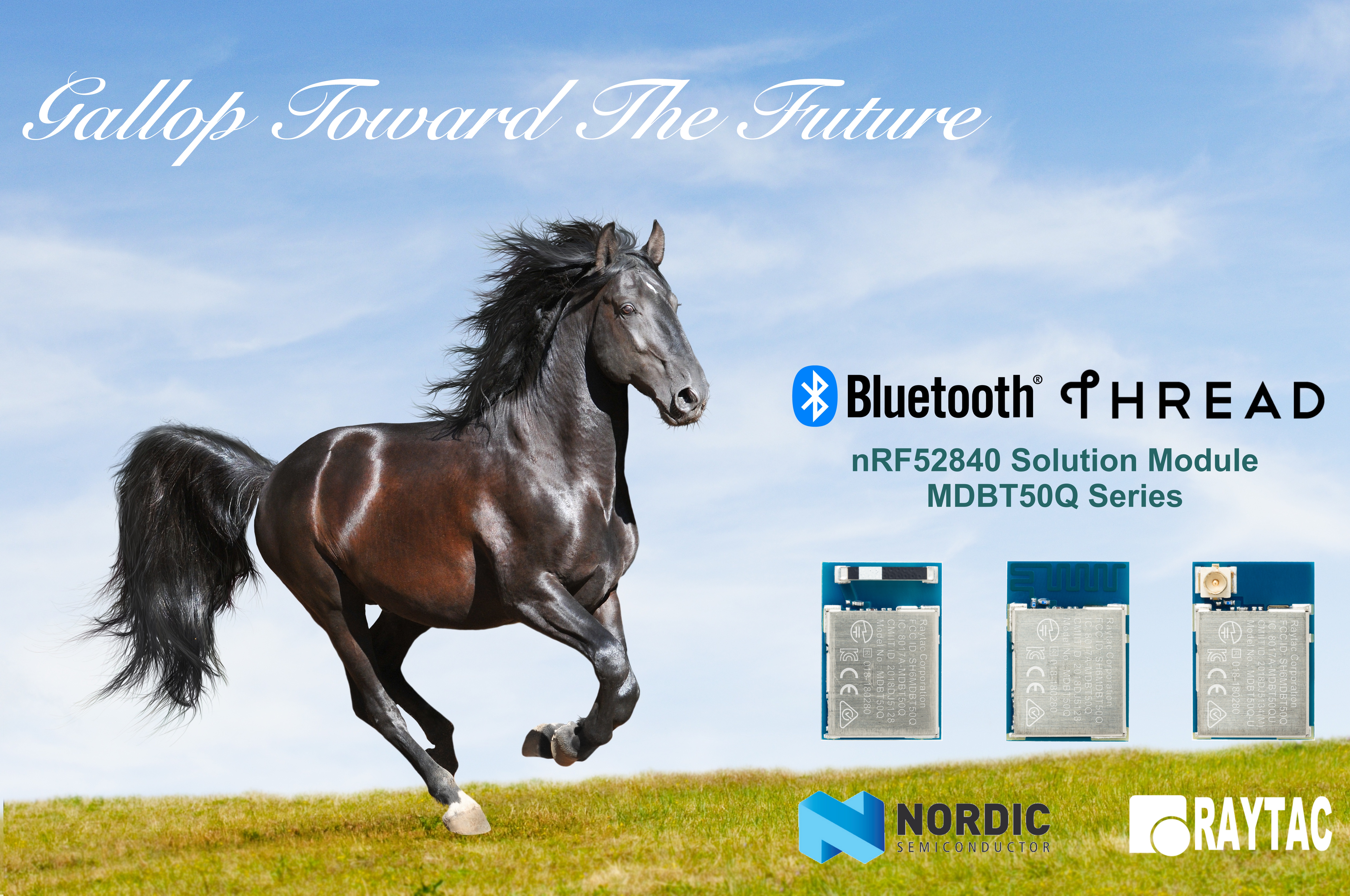
MDBT50Q powered by Nordic nRF52840 solution is a multi-protocol Bluetooth 5, Thread, IEEE 802.15.4, Zigbee, ANT+ solution incorporated 1MB flash memory, 256K RAM, built-in USB interface, supporting 5.5V DC/DC supply which is an edge cutting, ultra lower power solution ideal for all IoT applications. With completed pre-certified coverage, it bring the benefit for customers by reducing the design complexity, BOM cost and faster the Time-To-Market efficiency.

Nordic introduced nRF5 SDK for Bluetooth Mesh Networking

The Bluetooth organization, SIG, recently released mesh networking specifications. It is the solution which define the requirements to implement many-to-many mesh networking based on Bluetooth Low Energy, as known as BLE.

Module Line

Nordic Release Mesh Sample Code To Make Development Easy

Raytac Corporation

A BT4.1 & BT4.2 module maker based on Nordic nRF51 & nRF52 solution 

(nRF51822 & nRF51422 & nRF52832 & nRF51802)

Tel: +886.2.3234.0208

email: service@raytac.com  

Mesh Network is future of IoT, also an issue that raised most interests among developers.

With the official Bluetooth Mesh nearing release by SIG, Nordic offers nRF Connect Mesh to provide a solid tools for developers to create mesh-enabled projects.

For more detail, pls click below link 

Developers also can access the sample code from below link


Raytac’s nRF51 Module (MDBT40/MDBT40-P) Bluetooth QDID information

Raytac Corporation

A BT4.1 & BT4.2 module maker based on Nordic nRF51 & nRF52 solution 

(nRF51822 & nRF51422 & nRF52832 & nRF51802)

Tel: +886.2.3234.0208

Bluetooth products must purchase DID and submit the testing evidence issued by BQE to completed the SIG registration and activate the DID

Only products’s DID been activated then allowed to use Bluetooth logo.

Developer’s who built the products based on Raytac module is allow to relable Raytac’s DID to easy the process.

Simply purchase their own DID from SIG, and relabel Raytac’s DID then can completethe Bluetooth activation process.

Raytac’s MDBT40/MDBT40-P QDID/DID is applied by subsidiary of Ginstar Corporation.

The QDID is 60912 / D023258

We welcome all Raytac’s customers to relabel the QDID as long as product built by MDBT40/MDBT40-P. As such, the Bluetooth process becomes simple and cost effective.

What is the difference between BT4.1 & BT4.2

Raytac Corporation
A BT4.1 & BT4.2 module maker based on Nordic nRF51 & nRF52 solution 
(nRF51822 & nRF51422 & nRF52832 & nRF51802)
Tel: +886.2.3234.0208
What is BT4.1 and 4.2~ That is a frequent question for our customers.
Here, we quoted some information from SIG to help readers have easy understanding between different Bluetooth version.

BT4.1

This updated specification aims to improve consumer usability with increased co-existence support for LTE,  efficient data exchange rates, and aid developer innovation by allowing devices to support multiple roles simultaneously.
  • Improving Usability—extends the brand promise to consumers with an “it just works” experience. This spec is engineered with several new features to make it work seamlessly with popular cell technologies like LTE, maintain connections with less frequent manual reconnection, and deliver a more efficient data exchange.
  • Empowering Developer Innovation—provides developers with greater flexibility to create innovative Bluetooth products and solutions through dual-mode topology and link-layer topology software features.
  • Enabling the Internet of Things—lays the groundwork for IP-based connections by allowing devices to setup a dedicated communication channel in the future thereby extending the central position for Bluetooth technology in the Internet of Things.

BT4.2

Key updates in 4.2 improve privacy and increase speed, and a soon-to-be ratified profile will enable IP connectivity.
  • Privacy and Security

Bluetooth 4.2 introduces industry-leading privacy settings that lowers power consumption and builds upon the government-grade security features of the Bluetooth specification. The new privacy features put control back into the hands of the consumer by making it difficult for eavesdroppers to track a device through its Bluetooth connection without permission. For example, when shopping in a retail store with beacons, unless you’ve enabled permission for the beacon to engage with your device, you can’t be tracked.

  • Speed

Bluetooth 4.2 increases the speed and reliability of data transfers between Bluetooth Smart devices. By increasing the capacity of Bluetooth Smart packets, devices transfer data up to 2.5 times faster than with previous versions. Increased data transfer speeds and packet capacity reduces the opportunity for transmission errors to occur and reduces battery consumption, resulting in a more efficient connection.

  • Internet Connectivity

Building on the capabilities released earlier with Bluetooth 4.1 and the new features released in 4.2, the Internet Protocol Support Profile (IPSP) will allow Bluetooth Smart sensors to access the Internet directly via IPv6/6LoWPAN. IP connectivity makes it possible to use existing IP infrastructure to manage Bluetooth Smart “edge” devices. This is ideal for connected home scenarios that need both personal and wide area control. This profile will be ratified by the end of the year.

About Bluetooth 5

Raytac Corporation

A BT4.1 & BT4.2 module maker based on Nordic nRF51 & nRF52 solution 

(nRF51822 & nRF51422 & nRF52832 & nRF51802)

Tel: +886.2.3234.0208

Simple Summary

Scheduled to be released in end or 2016 or early 2017

1.Quadruples range

Extending range will deliver robust, reliable Internet of Things (IoT) connections that make full-home and building and outdoor use cases a reality. The expect power consumption of BT5  is expected to remain the same level as BT4.2. 

BT4.2: 10~100M

BT5.X: Upto 400M

2.Doubles speed

Higher speeds will send data faster and optimize responsiveness. Increasing broadcast capacity will propel the next generation of “connectionless” services like beacons and location-relevant information and navigation.

BT4.2: 1M bit/Sec

BT5.X: 2M bit/Sec

3. Data broadcasting capacity by 800%

Bluetooth 5,will quadruple range and double speed of low energy connections while increasing the capacity of connectionless data broadcasts by 800%. 

According to SIG’s news press

 “Increasing operation range will enable connections to IoT devices that extend far beyond the walls of a typical home, while increasing speed supports faster data transfers and software updates for devices. And now with the ability to broadcast a much richer set of information, Bluetooth 5 will make beacons, location awareness, and other connectionless services an even more relevant part of an effortless and seamless IoT experience” 

“With the major boost in broadcast messaging capacity, the data being transferred will be richer, more intelligent. This will redefine the way Bluetooth devices transmit information, moving away from the app-paired-to-device model to a connectionless IoT where there is less need to download an app or connect the app to a device."

To redefine the behavior of moving away from app-paired-to-device model must bring a revolutionary user behavior and environment from 2017. That is the most critical point for all product design or related Bluetooth industry need to pay highly attention!