AN54LQ-X05 Series (nRF54L05, red PCB): Product page
Just like traffic lights that direct every journey safely and efficiently, Raytac’s nRF54L series modules guide your wireless development—keeping you on the right path with cutting-edge performance and exceptional power savings.
🚦 Each light signals a different member of the nRF54L15 / nRF54L10 / nRF54L05 module family—showcasing a clear path for your Bluetooth Low Energy (LE) applications, no matter which industry you’re from and where you’re headed.
These modules are now available for your design-in, offering: ✅ Powerful performance ✅ Ultra-low power consumption ✅ Compact footprints ✅ Full Global certifications: FCC/IC/CE/UKCA/Telec/KC/NCC/SRRC/RCM/WPC ✅ BT 6.0 certified ✅ Full Nordic nRF54 Series compatibility ✅ Pin-to-pin compatible amongst AN54LQ series
Whether you’re building for consumer IoT, industrial sensors, healthcare, or wearables—Raytac’s modules deliver the reliability you need and the efficiency you expect.
We are thrilled to announce that Raytac Corporation will be participating in Embedded World 2025 from March 11 to March 13, 2025, at the Nuremberg Exhibition Centre in Germany.
IoT and Wireless technologies such as Bluetooth Low Energy (BLE), Wi-Fi, and LoRa…etc. continue to reshape industries worldwide, that’s why Raytac is at the forefront, providing cutting-edge solutions that accelerate product development. Together with our partner, Nordic Semiconductor, we offer a comprehensive range of modules designed to meet the increasing demands of today’s connected world.
This year, we have exciting innovations to showcase:
Unveiling our new service: Customized OEM/ODM designing for customers.
These are just a few of the groundbreaking solutions we’ll be unveiling. You won’t want to miss the chance to experience these with us!
What to Expect at Our Booth:
Live demonstrations showing how Raytac’s modules can be implemented in multiple industries.
Discover how our modules can reduce development time and costs, making your projects more efficient.
One-on-one consultations with our experts to help you find the right solutions for your needs.
Stop by and visit us at: HALL 3 Booth 3-111 M2M Area
We would love to connect with you and discuss how Raytac can support your next project. Whether you’re an engineer, developer, or business decision-maker, we have something for everyone at Embedded World 2025.
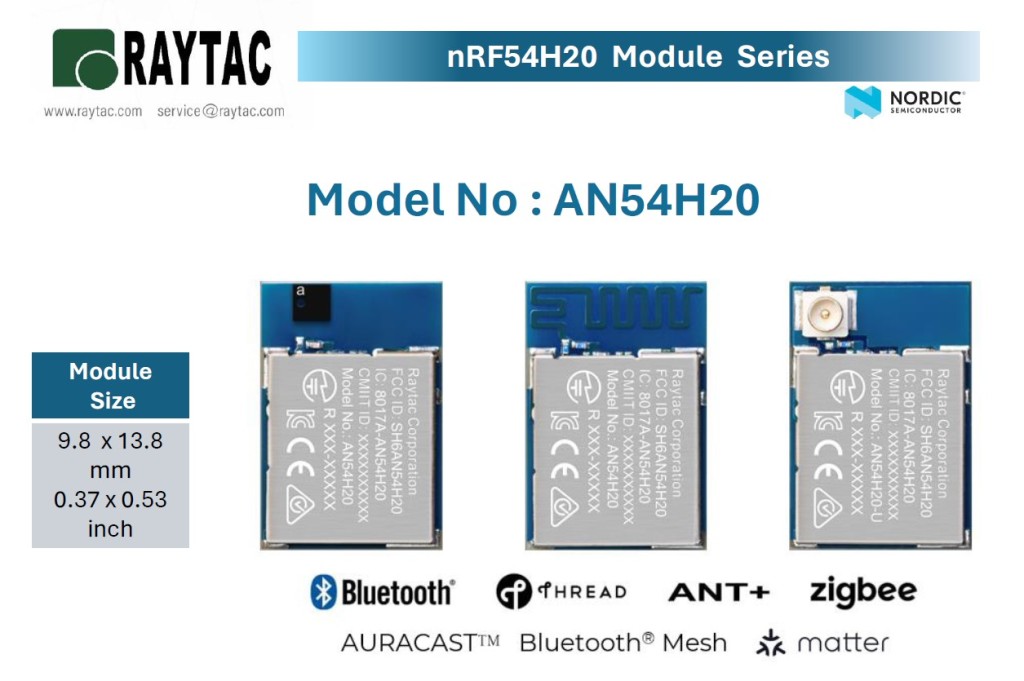
Raytac Corporation, a Nordic-recommended third-party module manufacturer based in Taiwan, today announces the upcoming release of the AN54H20 modules, which are built on the base of Nordic’s nRF54H20 SoC.
The AN54H20 module comes in a 9.8 x 13.8 x 1.8mm (0.37 by 0.53 by 0.07 inches) dimension factor and offers 3 versions of high-performance antennas, including ceramic chip antenna, PCB-mounted antenna, and uFL connector for external antenna. Output power is adjustable up to +10 dBm and data rate is adjustable up to 4Mbps to maximize RF performance.
Powered by multiple processors, AN54H20 modules provide the IoT field with access to a whole set of improved features, including 2MB flash memory/1MB RAM and bigger processing power for more complicated computations. It also enhances protection against security threats, providing developers with protection while building technologically advanced IoT applications.
Hardware wise, AN54H20 inherits nRF54H20’s set of versatile, advanced, and low-power peripherals alongside DMA support, including high-speed USB, CAN-FD controller, 14-bit ADC, 2 x I3C and plenty more. What’s more revolutionary is that AN54H20 brings power efficiency to a whole new level through accurately controlling currency consumptions under various modes, allowing smaller batteries to be implemented in the applications while increasing its life expectancy.
“We see the AN54H20 series as a potential market changer. The compact size gives developers a seamless switch from the previous generation modules to AN54H20, and the remarkable power efficiency and characteristics AN54H20 brings will offer a magnificent effect to the inescapable hot trend of IoT and other various industries." – Lyon Liu, President of Raytac Corporation.
Thread Group(https://www.threadgroup.org/)Founded on July 15, 2014 by Apple, Amazon, Google and six companies member. As a non-profit organization, Thread Group focuses on promoting the application of Thread in the field of Internet of Things, training developers and consumers, introducing thread technology and its advantages, and providing strict product certification tests to ensure the optimized user experience.
What is Thread?
Thread is a secure wireless mesh networking protocol. Thread solving new needs that in building a network of smart home products. Thread is based on 6LoWPAN of structure, making full use of open standards and IPv6 technology. Compared with other wireless standards, Thread has many technical advantages: safe and reliable, no single point connection failure in network, more simple connection, and low power consumption. Product developers and consumers can easily and securely form more than 250 devices into a low-power wireless Mesh network through Thread, and each device in the network can connect to the Internet and access cloud services. The Thread protocol stack is an open standard built on a series of existing standards of the Institute of Electrical and Electronics Engineers (IEEE) and the Internet Engineering Task Force (IETF), rather than a new standard (see the figure below).
Figure 1. Overview of the Thread protocol stack
General characteristics of Thread
The Thread protocol stack supports IPv6 addresses, and it can realize low-cost bridging with other IP networks. It is the best choice for low-power/battery-powered operation and communication between wireless devices. The Thread protocol stack is designed for smart home and business applications based on IP networks and can be matched with various application layers on the protocol stack.
The general characteristics of the Thread protocol stack are as follows:
• Simple and convenient network installation, start-up, and operation: Thread protocol stack supports various network topologies. It can be installed via smartphone, tablet or computer, and the installation is simple and convenient. Product installation codes ensure that only authorized devices can join the network. When arise out of routing problems, simple protocols for building and joining networks enable the system to configure itself and fix those problems.
• Security: Devices cannot join the network unless authorized, and all communications are encrypted and protected. Security protection can be used at the network layer as well as at the application layer. All Thread networks are encrypted with an authentication scheme and Advanced Encryption Standard (AES). The Thread network is more secure than any other wireless network the Thread Group has evaluated.
• Can accommodate the needs of home networks of various sizes: The number of devices in different home networks varies greatly, ranging from a few to hundreds. Network layer design aims to optimize network operation for its intended use.
• Applicable to large commercial networks: For large commercial networks, a single Thread network is not enough to meet the requirements of all applications, systems and networks. The Thread domain model allows scaling up to 10,000 Thread devices in a single deployment, achieved through the combined use of different connectivity technologies (Thread, Ethernet, Wi-Fi, etc.).
• Two-way communication for service discovery and connection: Multicast and broadcast are inefficient for wireless mesh networks. For communication with the outside world of the Mesh network, Thread provides a communication registration service, and the device can register whether it is available and whether it can provide communication services, and the client can use unicast queries to find registered services.
• Wide coverage: The coverage of a typical Thread device is usually sufficient for the average household. A design with a power amplifier can greatly improve coverage. In the physical layer (PHY), the distributed spread spectrum technology can better improve the anti-interference ability. For commercial networks, the Thread domain model allows multiple Thread networks to communicate with each other through the backbone network, so it can be expanded to cover multiple Mesh subnets.
•Designed with no single point of failure: The Thread protocol stack is designed to operate safely and reliably, even in the event of a single device failure or absence. Thread devices can also incorporate IPv6-based links (such as Wi-Fi and Ethernet) into the topology to reduce the possibility of multiple Thread partitions. This allows Thread devices to take advantage of the higher throughput, greater channel capacity and wider coverage of these infrastructure links, while still supporting low-power devices.
• Low Power Consumption: Devices communicate efficiently and have an expected lifetime of several years under normal battery usage, resulting in an improved user experience. With the right duty cycle, the device can typically run for years on AA-size batteries.
• Cost-effective: Compatible chipsets and software stacks from multiple vendors are priced for mass deployment and designed for ultra-low power consumption.
Thread home network architecture
Users communicate with the home Thread network via Wi-Fi on their home area network (HAN) or from their own device (smartphone, tablets or computer) using a cloud-based application. The figure below illustrates the main device types in the Thread network architecture.
Figure 2. Thread home network architecture
• Border Router: supports the network connection between the 802.15.4 network and other adjacent physical layers (Wi-Fi, Ethernet, etc.). The border router provides services for devices in the 802.15.4 network, including routing services and service search in the case of offline operation. There can be one or more border routers in a Thread network.
• Leader: located in the Thread network, responsible for managing the allocation and registration of router IDs, and accepting requests from terminal devices (REEDs) that meet the requirements of routers to become routers. The Leader decides which devices should be routers, and, like all routers in the Thread network, the Leader can also have sub-devices. Leader also assigns and manages router addresses through CoAP (Constrained Application Protocol). However, all information contained in the Leader is also stored in other Thread routers. Therefore, if the Leader fails or loses connection to the Thread network, another Thread router can be elected as the Leader without user intervention.
• Thread Router: Provides routing services for network devices. Thread routers also provide joining and security services for devices attempting to join the network. Thread routers cannot sleep and can also be REED by downgrading their functionality.
• REED: It can be a Thread router or a Leader, but not necessarily a border router with special attributes (such as multiple interfaces). Depending on the network topology or other specific circumstances, REED cannot be a router. REED does not relay messages, nor does it provide joining or security services to other devices on the network. If necessary, the network manages router-eligible devices and upgrades them to routers without user intervention.
• End Device: The end device that does not meet the router conditions can be FED (full end device) or MED (minimum end device). The MED does not need to be synchronized with the parent device to communicate.
• Sleepy End Device (SED): communicates only through the Thread router parent device and cannot relay messages for other devices.
• Synchronous Sleeping End Device (SSED): A type of Sleeping End Device that uses CSL in IEEE 802.15.4-2015 to keep synchronized with a parent device without using regular data requests.
Thread business network architecture
The Thread business networking model takes the same major device types as home networking and introduces new concepts. Users communicate with the business network through devices (smartphones, tablets, or computers) via Wi-Fi or the corporate network. The following figure illustrates the business network topology.
Figure 3. Thread business network architecture
Concept of business network architecture:
• The Thread domain model supports seamless integration of multiple Thread networks, and also supports seamless connection with non-Thread IPv6 networks. The main advantage of the Thread domain is that the device can flexibly join the available Thread network configured with the public Thread domain to a certain extent, and when the network scale expands or the data volume expands, this will reduce the manual planning of the network or reduce the cost of High costs for manual reconfiguration.
• Backbone Border Router (BBR) is a kind of border router used in commercial networks, it can promote the synchronization of Thread domains in multiple network sagments, and allow large-scale multicast transmission in and out of each individual network in the Thread domain. Thread networks that are part of a larger domain must have at least one “primary" BBR, and can have multiple “secondary" BBRs for failsafe redundancy. Each BBR communicates with each other through the backbone network connecting all Thread networks.
Figure 4. Thread domain model
no single point of failure
The Thread protocol stack is designed to avoid single points of failure. Although there are many devices in the system that perform special functions, the Thread network enables these devices to be replaced without affecting the network or the continued operation of the devices. For example, if a dormant end device needs a parent device to communicate, then that parent device becomes a single point of failure for communication. However, in a Thread network, a dormant end-device can choose another parent when its parent is unavailable. And this conversion process is invisible to the user.
Although the Thread system adopts a no-single-point-of-failure design, in some topologies, individual devices do not have backup functions. For example, in a system configured with a single border router, if the border router loses power, there is no way to fail over to the backup border router. In this case, the border router must be reconfigured.
With Thread Specification 1.3.0, border routers that share infrastructure links can facilitate designs with no single point of failure across media such as Wi-Fi or Ethernet by leveraging Thread Radio Encapsulation Links (TREL). With this function, the possibility of forming Thread partitions across links is reduced.
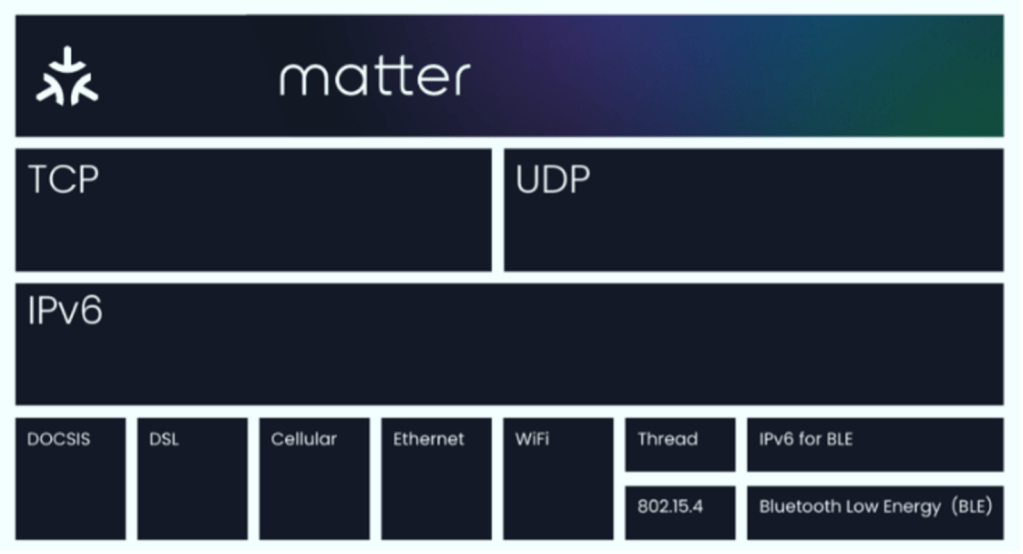
Matter aims to build a universal IPv6-based communication protocol to make it easier for smart home devices to communicate with each other. The protocol defines the application layer that will be deployed on devices as well as the different link layers to help maintain interoperability. Matter protocol built from the best pieces of existing trustworthy protocols, including Google Weave, Apple HomeKit, and Zigbee.
Matter is using Thread, Wi-Fi, and Ethernet for transport and Bluetooth Low Energy (BLE) for device commissioning to support a host of smart home devices. Any smart home gadgets you have that use these technologies should be able to be bridged into Matter.
Overall, Matter 1.0 simplifies the process of connecting smart home devices and enables seamless communication between them, regardless of their brand or manufacturer.
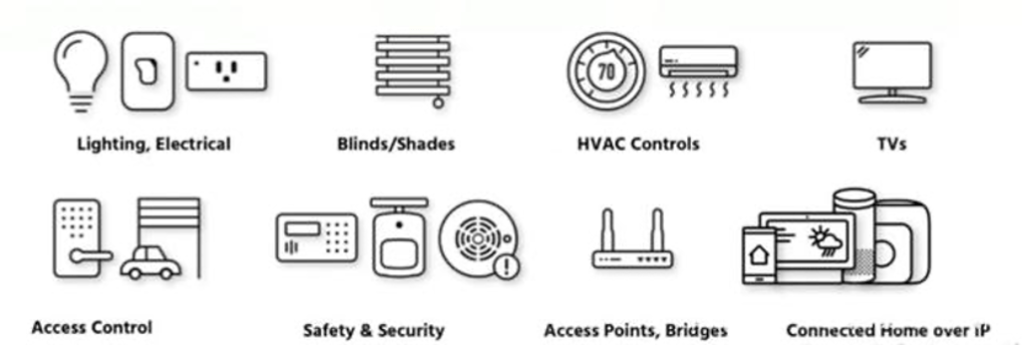
Matter 1.0 specs already support a variety of common smart home products, including lighting and electrical, HVAC controls, window coverings and shades, safety and security sensors, door locks, media devices including TVs, controllers as both devices and applications, and bridges. Support for security cameras, smart speakers, home appliances and robotic vacuums is already planned for subsequent versions of Matter. With the ecosystem expansion, new use cases and applications are expected to emerge.
Certification Process
Matter Testing
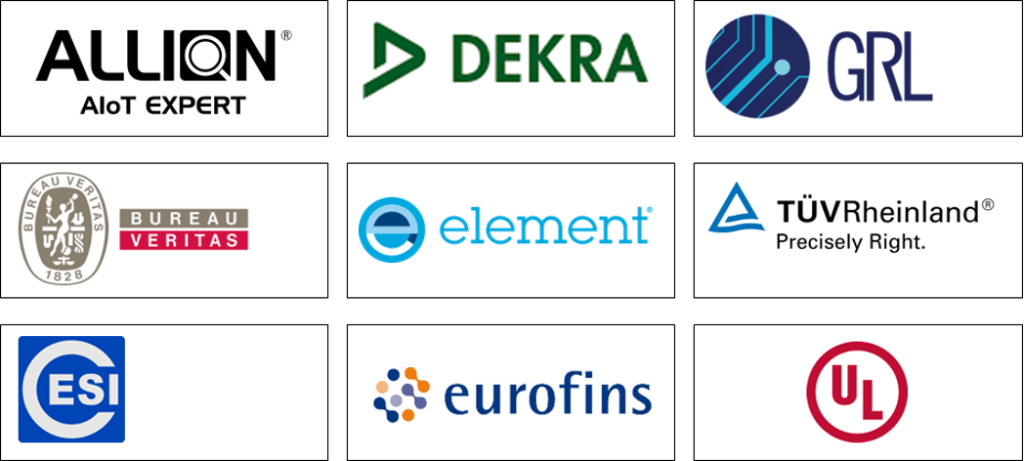
The Matter 1.0 standard launches with test cases and comprehensive test tools for Alliance members and a global certification program including nine authorized test labs who are primed to test not only Matter, but also Matter’s underlying network technologies, Wi-Fi and Thread. Wi-Fi enables Matter devices to interact over a high-bandwidth local network and allows smart home devices to communicate with the cloud. Thread provides an energy efficient and highly reliable mesh network within the home.
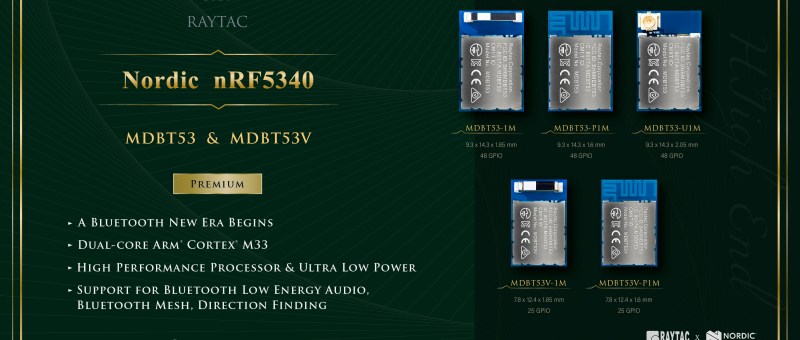
Bluetooth technology has been developing over decades, Nordic nRF5340 no doubt is the most important edge cutting wireless evolution released in 2020 since then. Throughout the common either audio or data Bluetooth transmission to advanced data & audio connection between devices, IoT applications now have already been derived from past simple purpose toward contemporary comprehensive and complex implements in either commercial or industrial fields.
MDBT53 is a System-on-Module (aka SoM) with a good size of 9.3mm x 14.3mm and 48 GPIO which is an ideal dimension to fit in most applications. MDBT53 provides 3 antenna options, Chip antenna; PCB antenna; and u.FL connector for external antenna which deliver a maximum feasibility for most IoT projects.
MDBT53V is designated for the application which has a space constraint design. A 7.8mm x 12.4mm with 25 GPIO is small enough to offer the opportunity of employing nRF5340 modules in the project. In addition, the module offers an extended working temperature of up to +105°C enabling the module to become the most reliable connectivity source for industrial applications. MDBT53V provides 2 options of antenna, Chip and PCB, for developers’ selection which is capable of optimizing the project plan in terms of performance and budgetary.
Over the past few years, Raytac experienced the fast changing of Bluetooth technology from BT2 all the way to latest BT5.2; from heavy power consumption to advanced Low Energy. Raytac is determined in its the mission to provide better module service in the aspects of quality, coverage, and stable pipeline to all partners. MDBT53 & MDBT53V, nRF5340 solution modules, an epochal Bluetooth technology which significantly improves the connectivity ability from data transmission toward audio broadcasting which would be the best model to provide technology that could benefit and contribute to people’s lives.
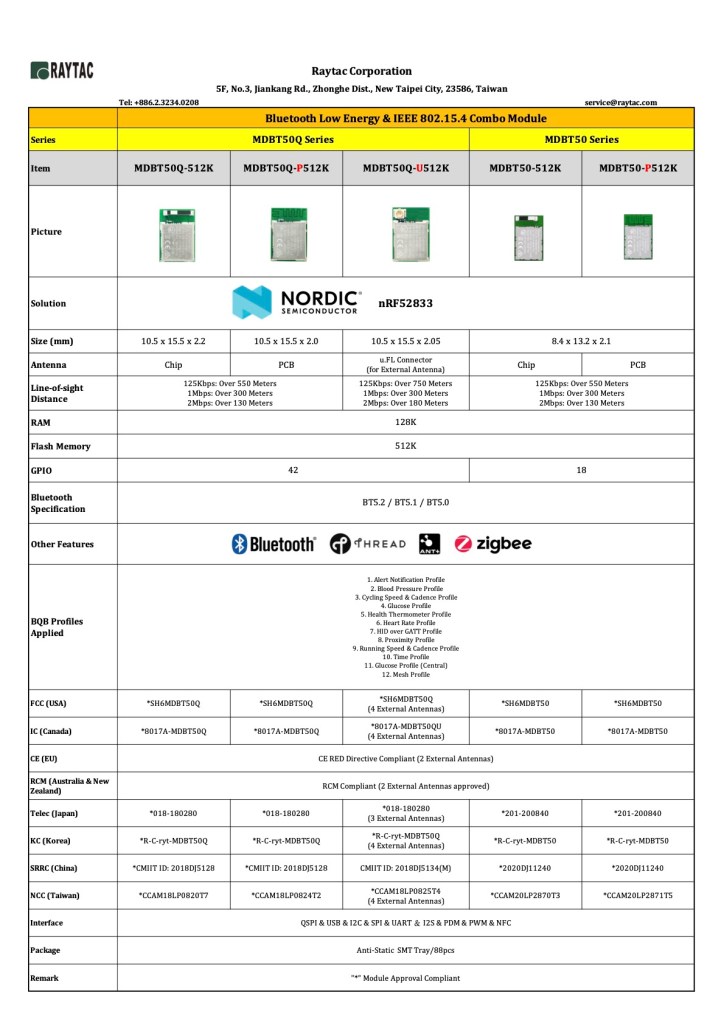
nRF52833 is a powerful solution which supports multiprotocol such as Bluetooth, Zigbee, and Thread but also qualified for industrial operation at an extended temperature range of -40°C to 105°C.
Raytac’s MDBT50Q and MDBT50 module employed nRF52833 solution offering 2 kinds of form factor with either 48 or 18 GPIO option for selection. 3 antenna options helps developers to find the best balance between performance and budgetary for projects.
MDBT50Q and MDBT50 modules are BT5.2 qualified supports direction finding and Bluetooth long range feature. Both are built around 128K RAM, 512K Flash memory with I2C, SPI, I2S, UART, NFC, USB interface. A 1.7V to 5.5V supply voltage range enables powering the device from rechargeable batteries or over USB and +8dBm output power has significantly enhance the bluetooth long range coverage which is suitable for outdoor or smart home applications.
Nordic nRF52833 module by Raytac MDBT50Q & MDBT50
The modules are FCC/IC/CE/Telec/KC/SRRC/NCC/RCM pre-certified and in mass production for volume shipment. EVK demo board is also available for quick debug and evaluation. Developers who are interested in nRF52833 module MDBT50Q and MDBT50 are welcome get in touch with Raytac for immediate service support.
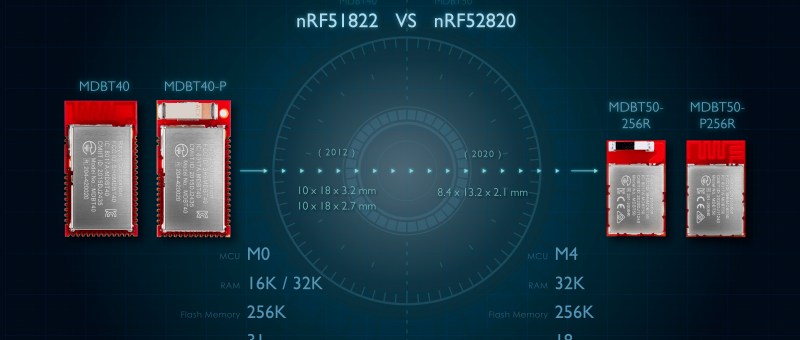
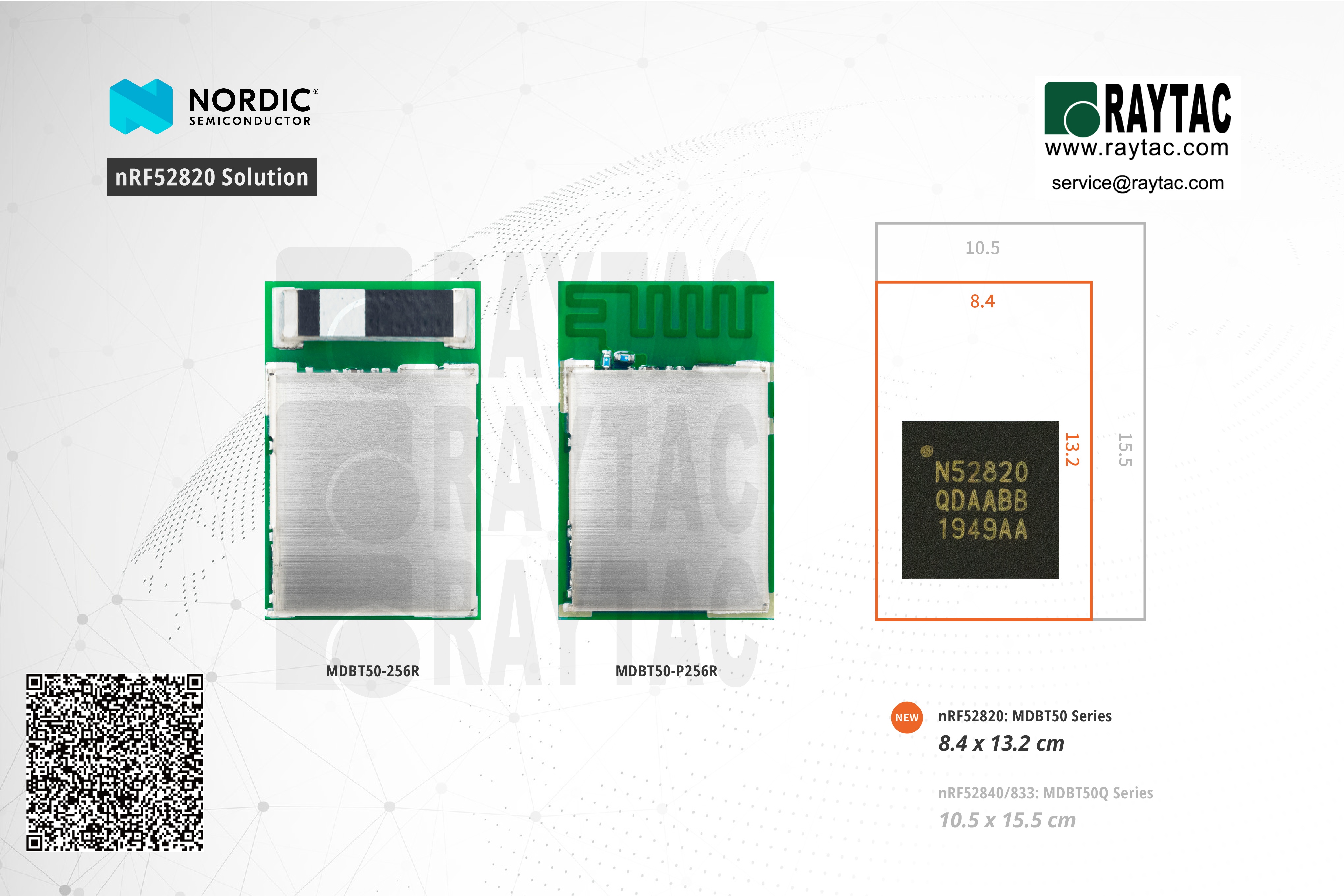
Raytac released MDBT50 series module which deployed Nordic latest nRF52 member, nRF52820 solution. nRF52820’s specification looks similar to nRF51822, but offer superior features than ever.
MDBT40 (nRF51822) VS. MDBT50 (nRF52820)
The nRF52820 features an Arm Cortex-M4 processor, 256 KB Flash and 32 KB RAM and offer I2C/SPI/UART but also full speed USB 2.0 interface which provide the maximum flexibility for commercial and industrial applications.
MDBT50 employed nRF52820 can be supplied with a voltage from 1.7 to 5.5 V, -40°C~105 industrial operation temperature. Features Upto +8 dBm output power and supports BT5.2 Direction Finding, high-throughput 2 Mbps, Long Range. Multiprotocol radio provides, Thread and Zigbee and Bluetooth mesh protocols.
MDBT50 series modules covers both nRF52833 and nRF52820 solutions and provide both chip and PCB antenna for customer’s selection. Developers are encouraged to visit Raytac website for more information.
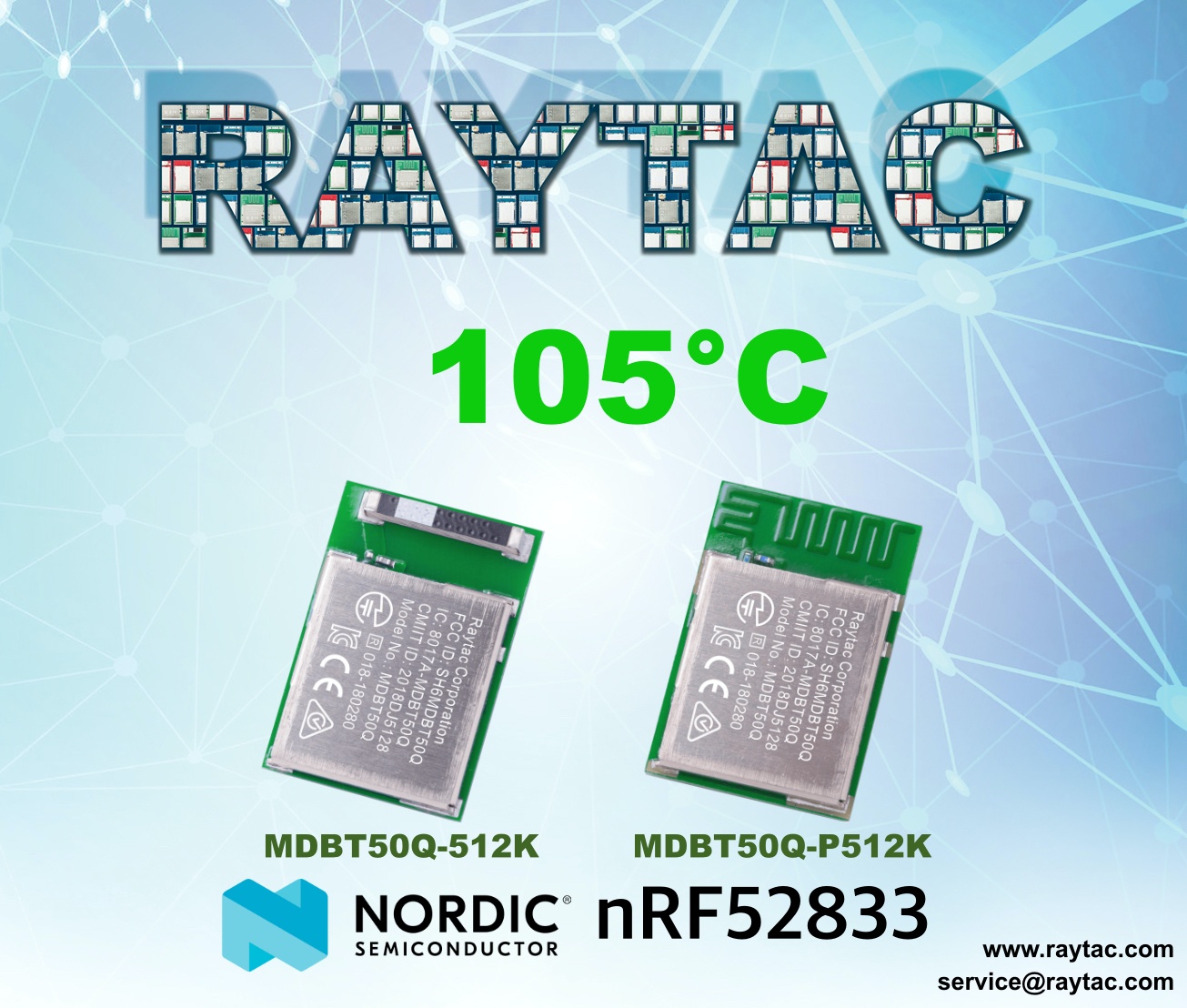
Raytac announced both MDBT50Q-512K & MDBT50Q-P1M modules has extended the ambient temperature up to 105°C, following Nordic’s nRF52833’s specification.
nRF52833 Module MDBT50Q By Raytac Has Extended To 105°C Ambient Temperature
Unlike a single component like SoC, modules acted as an integrated equipment which includes some other related components. To secure the module works under the latest environment request while Nordic nRF52833 released, Raytac ensured all related components meet the new temperature requirement with RF efficiency secured.
Today, we are pleased to announce nRF52833 modules:
MDBT50Q-512K: Chip Antenna
MDBT50Q-P512K: PCB Antenna
Both have successfully extended ambient temperature to 105°C which are the most ideal devices for a wide range of commercial and industrial applications.
Raytac Corporation 勁達國際電子有限公司
A BT5.2 & BT5.1 & BT5 & BT 4.2 module maker based on Nordic nRF52 & nRF51 solution
Nordic announced their 6th multi-protocol solution of nRF52 series with nRF52820, which supports Bluetooth Low Energy (BLE), Bluetooth mesh, Thread, Zigbee and 2.4GHz proprietary wireless connectivity.
Like other nRF52 siblings, nRF52820 highlights a powerful 64MHz 32bit Arm Cortex-M4 processor, includes 256Kb Flash Memory and 32Kb RAM, features of Bluetooth 5.2, 5.1 and 5 including long range and high-throughput of 2Mbits per second, as well as direction finding, low energy power control and low energy isochronous channels.
A full speed (12Mbits per second) USB 2.0 interface and 1.7~5.5V operation voltage bring a wide range of commercial and industrial wireless applications to nRF52820. To support nRF52820’s development, Nordic released SoftDevice S112, a new memory-optimized central stack. S112 now released as a alpha and will have full SDK (SDK V16.0.0) support coming in Q2 2020.













 Raytac Corporation