MDBT42Q Series Module (Nordic nRF52 Solution) Spec Sheet Updated

Raytac Corporation
A BT4.1 & BT4.2 module maker based on Nordic nRF51 & nRF52 solution 
(nRF51822 & nRF51422 & nRF52832 & nRF51802)
Tel: +886.2.3234.0208
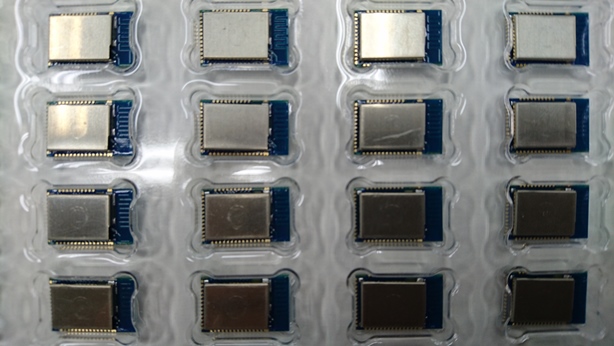
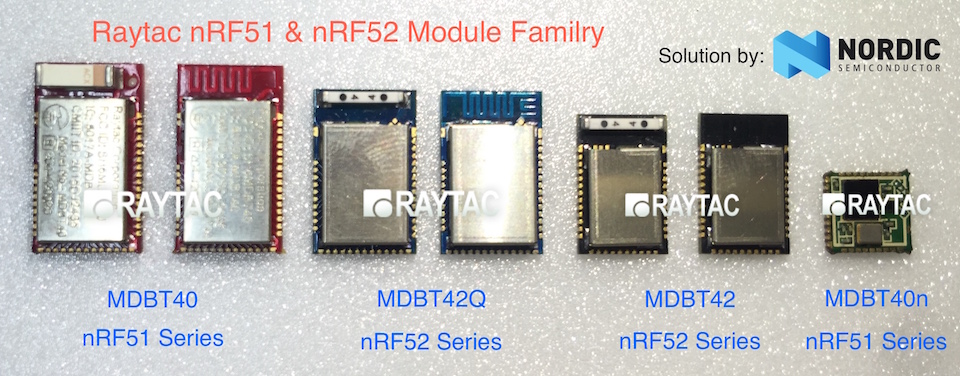
MDBT42 and MDBT42Q, solution by Nordic nRF52832, recently has FCC/CE/IC/Telec/SRRC/NCC granted.
We are sincerely invite all developers to download the updated Specification Sheet from below Link.
Products which built by MDBT42 or MDBT42Q now allowed to get rid of annoying safety regulation application and testing but ship and marketing in USA, Canada, Japan, China according to Module Approval Policy.
MDBT42 & MDBT42-P Spec Sheet Download Link

What is the difference between BT4.1 & BT4.2

Raytac Corporation
A BT4.1 & BT4.2 module maker based on Nordic nRF51 & nRF52 solution 
(nRF51822 & nRF51422 & nRF52832 & nRF51802)
Tel: +886.2.3234.0208
What is BT4.1 and 4.2~ That is a frequent question for our customers.
Here, we quoted some information from SIG to help readers have easy understanding between different Bluetooth version.

BT4.1

This updated specification aims to improve consumer usability with increased co-existence support for LTE,  efficient data exchange rates, and aid developer innovation by allowing devices to support multiple roles simultaneously.
  • Improving Usability—extends the brand promise to consumers with an “it just works” experience. This spec is engineered with several new features to make it work seamlessly with popular cell technologies like LTE, maintain connections with less frequent manual reconnection, and deliver a more efficient data exchange.
  • Empowering Developer Innovation—provides developers with greater flexibility to create innovative Bluetooth products and solutions through dual-mode topology and link-layer topology software features.
  • Enabling the Internet of Things—lays the groundwork for IP-based connections by allowing devices to setup a dedicated communication channel in the future thereby extending the central position for Bluetooth technology in the Internet of Things.

BT4.2

Key updates in 4.2 improve privacy and increase speed, and a soon-to-be ratified profile will enable IP connectivity.
  • Privacy and Security

Bluetooth 4.2 introduces industry-leading privacy settings that lowers power consumption and builds upon the government-grade security features of the Bluetooth specification. The new privacy features put control back into the hands of the consumer by making it difficult for eavesdroppers to track a device through its Bluetooth connection without permission. For example, when shopping in a retail store with beacons, unless you’ve enabled permission for the beacon to engage with your device, you can’t be tracked.

  • Speed

Bluetooth 4.2 increases the speed and reliability of data transfers between Bluetooth Smart devices. By increasing the capacity of Bluetooth Smart packets, devices transfer data up to 2.5 times faster than with previous versions. Increased data transfer speeds and packet capacity reduces the opportunity for transmission errors to occur and reduces battery consumption, resulting in a more efficient connection.

  • Internet Connectivity

Building on the capabilities released earlier with Bluetooth 4.1 and the new features released in 4.2, the Internet Protocol Support Profile (IPSP) will allow Bluetooth Smart sensors to access the Internet directly via IPv6/6LoWPAN. IP connectivity makes it possible to use existing IP infrastructure to manage Bluetooth Smart “edge” devices. This is ideal for connected home scenarios that need both personal and wide area control. This profile will be ratified by the end of the year.

Open source Bluetooth low energy beacon is so simple to program and debug almost anyone can do it wirelessly from a website with JavaScript

Raytac Corporation
A BT4.1 & BT4.2 module maker based on Nordic nRF51 & nRF52 solution 
(nRF51822 & nRF51422 & nRF52832 & nRF51802)
Tel: +886.2.3234.0208
This open source Bluetooth low energy beacon is like a development kit and finished product all in one small package that needs no wires or software
Entering its last week on Kickstarter for delivery in December (campaign ends Friday August 5 at 8pm GMT) the $30 Puck.js has all the required programing and debug software tools built-in, and runs from a single Nordic Semiconductor nRF52832 Bluetooth low energy System-on-Chip (SoC) with built-in ARM Cortex M4F processor
,
Nordic Semiconductor today announces the availability on Kickstarter of a Nordic nRF52832 SoC based Bluetooth® low energy (formerly Bluetooth Smart) beacon, named Puck.js, that is said to be so simple to program almost anyone can do it wirelessly from a website using a graphical editor or easy-to-learn JavaScript instead of C or C++ traditionally used by Bluetooth low energy beacon developers.
“Most manufacturers conveniently gloss over the difficulties of programming their hardware, and other beacons are provided without software or left crippled by their boring factory-installed firmware,” says UK-based Puck.js creator, Gordon Williams. “Puck.js is different. It comes with our Open Source JavaScript interpreter ‘Espruino’ pre-installed, which makes it incredibly easy-to-use and means you can get started in just seconds, without any prior programming experience.”
The intentionally hacker-friendly Puck.js is open source, supports both the iBeacon and Eddystone beacon formats, and will be supplied with firmware updates for the forthcoming Bluetooth v5.0 specification that will quadruple the range and double the speed of Bluetooth v4.2. Puck.js has a circular 35mm diameter form-factor that is 10mm thick, with a silicone rubber cover and plastic base. It is powered from a CR2032 coin cell battery and includes a magnetometer (digital compass), user-assignable tactile button, and four (Red, Green, Blue, and Infrared) LEDs.
Thanks to the Nordic Semiconductor nRF52832 SoC, the Puck.js benefits from an extremely powerful ARM® Cortex®-M4F processor, 64MHz clock speed, an extremely generous 64kB of RAM and 512kB of Flash, built-in Near-Field Comms (NFC™), Over-the-Air firmware updates, 12-bit ADC, timers, SPI, I2C, and serial interfaces that can be used on any available pins, plus a temperature sensor.
Williams says that in summary this means the Puck.js can measure rotation (e.g. using the Puck as a control knob), light, temperature, magnetic fields (e.g. magnets used on doors to detect opening and closing or water level via a magnet on a float), can control Infrared devices, and produce any color light.
“JavaScript is probably the most popular programming language at the moment and the majority of web developers, makers, and students at school wouldn’t usually have used C or C++,” Williams continues. “So what I aimed to do with Puck.js was lower the barrier-to-entry and make development easier and more fun – allowing a whole bunch of people to use Bluetooth low energy beacon and IoT technologies that may otherwise be restricted to professional embedded developers.”
Williams says Puck.js is like a development kit that’s also a finished product. “You insert a battery, put the case on, and it’s a ready-to-go Bluetooth low energy beacon straight-out-the-box with no wires of software required,” he adds. “At the same time it’s very easy to add new functions and features for home automation projects, IoT prototyping, or education purposes.”

nRF52832 ANT Protocol Stacks: S212 and S332 Available Now

Raytac Corporation

A BT4.1 & BT4.2 module maker based on Nordic nRF51 & nRF52 solution 

(nRF51822 & nRF51422 & nRF52832 & nRF51802)

Tel: +886.2.3234.0208

Quoted from “ANT Wireless Tech Update 22 July, 2016″

ANT Wireless announced the formal production release of the ANT and concurrent ANT/BLE protocol stacks designed for Nordic Semiconductor’s nRF52832 SoC. The S212 (ANT only) and the S332 (concurrent ANT/BLE) are now available for licensing and download at thisisant.com on the nRF52832’s SoftDevices tab.

Developers currently using alpha versions of the S212 or S332 SoftDevices are encouraged to upgrade to the new production ready versions by agreeing to the updated license agreement and incorporating the production ready SoftDevices into their designs.

Note: In a move to simplify the licensing process, ANT Wireless has combined the evaluation terms of use and the commercial terms of use into a single license agreement.

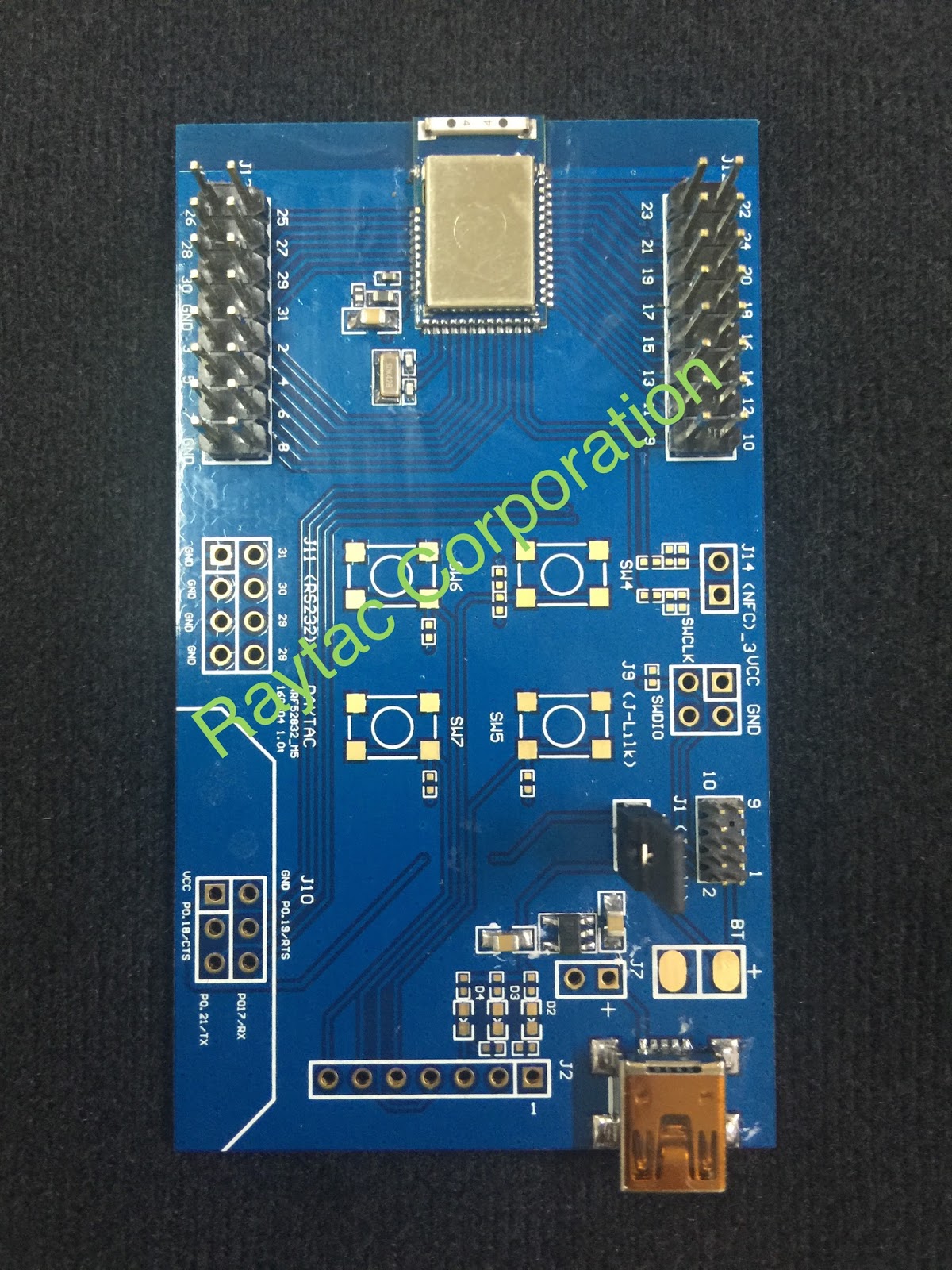
MDBT42Q Development Board Now Available

Raytac Corporation

A BT4.1 & BT4.2 module maker based on Nordic nRF51 & nRF52 solution 

(nRF51822 & nRF51422 & nRF52832 & nRF51802)

Tel: +886.2.3234.0208

MDBT42Q / MDBT42Q-P which are built based on Nordic nRF52832 solution.

The modules now are already in mass production stage for volume shipment.

Raytac would like to announce that MDBT42Q Series Development Board now is available.

Developers may access through Raytac’s Distributors or direct to Raytac Corporation for inquiry.

What is dBm?

Raytac Corporation

A BT4.1 & BT4.2 module maker based on Nordic nRF51 & nRF52 solution 

(nRF51822 & nRF51422 & nRF52832 & nRF51802)

Tel: +886.2.3234.0208

What is dBM?

From Spec sheet, we can find the output power always stated as dBM.

For example:

Nordic nRF52832

Transmitting power (+4dBM~-20dBM) / Receiving Sensitivity (-96dBM)

dBm is the unit for radiowave, it is a way to express the comparison between the reference signal value

The reference value is 0dBM at 1mW, the unit represented as shown below

1/10000 times = -40 dBm

1/1000 times = -30 dBm

1/100 times = -20 dBm

1/10 times = -10 dBm

1mW =     0 dbm ← Reference Signal Value

10 times  =  10 dBm

100 times  =  20 dBm

1000 times  =  30 dBm

Raytac MDBT42Q-P512K評価サンプル出荷開始

Raytac Corporation

A BT4.1 & BT4.2 module maker based on Nordic nRF51 & nRF52 solution 
(nRF51822 & nRF51422 & nRF52832 & nRF51802)
Tel: +886.2.3234.0208
email: service@raytac.com
日本での代理店への連絡は下記の通り。
株式会社フクミ (Fukumi corporation)
消費材企画開発Gr. LBTチーム (Consumer Products R&D Group, LBT team)
榊 和優 (Kazumasa Sakaki)
Tel : 03-5687-2890 (+81-3-5687-2890)
Mail : lbt_bt@fukumi.co.jp
ブログから引用。詳細は下記Link先へ。

http://bluetooth.tokyo/raytac-mdbt42q-p512k%E8%A9%95%E4%BE%A1%E3%82%B5%E3%83%B3%E3%83%97%E3%83%AB%E5%87%BA%E8%8D%B7%E9%96%8B%E5%A7%8B-360.html

先に出荷が開始されたMDBT42Q-512Kとはアンテナの違いだけです。
品番に「P」が付くとPCBのパターンアンテナ(通信距離目安60M)で、
「P」が付かないとチップアンテナ(通信距離目安80M)となります。
■MDBT42Q 概要
SoC:nRF52832
BT ver :BT4.2
Size : 16 x 10 x 2.2mm
Flash memory : 512kB
RAM : 64kB
Antenna : Chip Antenna (MDBT42Q-512K) / Printed Antenna (MDBT42Q-P512K)
評価サンプルをご希望される場合ですが、
メニューの「お問い合わせ」もしくは「見積依頼」よりお願い致します。

MDBT42 Module (Nordic nRF52832 Solution) Now Launched

Raytac Corporation

A BT4.1 & BT4.2 module maker based on Nordic nRF51 & nRF52 solution 

(nRF51822 & nRF51422 & nRF52832 & nRF51802)

Tel: +886.2.3234.0208

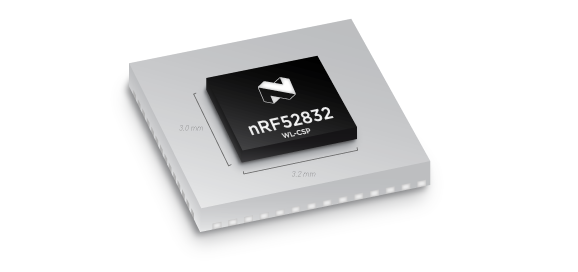
MDBT42, based on Nordic nRF52832 WL-CSP solution, is about to be armed and targeting for IoT industry.

Raytac’s module line in 2016 now has become ready and all well loaded.

Targeting next-generation wearables and space-constrained IoT applications, the nRF52832 Wafer Level Chip Scale Package (WL-CSP) has a super-compact 3.0 by 3.2mm footprint that occupies one quarter of the footprint area of Nordic’s standard 6.0 by 6.0mm QFN48-packaged nRF52832, yet offers the same full feature set

Oslo, Norway 2016/07/05

Nordic Semiconductor today announces the availability of a Wafer Level Chip Scale Package (WL-CSP) variant of its nRF52832 Bluetooth® low energy (formerly known as Bluetooth Smart) System-on-Chip (SoC) that occupies a quarter of the footprint area of the standard-packaged Nordic nRF52832 and targets next-generation, high-performance wearables and space-constrained IoT applications.

The nRF52832 WL-CSP has a super-compact 3.0 by 3.2mm footprint compared to the standard 6.0 by 6.0mm footprint of its larger but conventionally-packaged nRF52832 QFN48 cousin, yet offers the same full single-chip feature set and best-in-class, ultra-low-power application operation. This includes a powerful on-board 64MHz ARM® Cortex®-M4F processor that enables protocol and application task processing to be completed in unprecedentedly short time-frames, thus allowing power-saving sleep modes to be entered much quickly compared to competing devices.

Like the nRF52832, the nRF52832 WL-CSP features: 512kB Flash and 64kB RAM; on-chip NFC™ tag for consumer-friendly Touch-to-Pair; best-in-class ultra-high performance, ultra-low-power multi-protocol Bluetooth low energy, ANT™, and proprietary 2.4GHz radio; 5.5mA peak RX/TX currents; an on-chip RF Balun; plus a unique fully-automatic power management system that makes achieving optimal power consumption easy for designers.

The nRF52832 WL-CSP is compatible with Nordic’s Bluetooth 4.2 stacks and supporting SDKs including the latest S132 multi-role concurrent software stack, nRF5 SDK, nRF5 SDK for HomeKit, and nRF5 SDK for AirFuel (resonant wireless charging).

“The availability of a super-compact footprint nRF52832 brings new design opportunities to wearables and other space-constrained IoT applications,” comments Kjetil Holstad, Product Manager Ultra Low-Power Wireless at Nordic Semiconductor. “And this SoC is available now in high production volumes for immediate inclusion in upcoming product development.”

Holstad adds: “The evolution of wearables to date has only ever gone one way: ever increasing performance and functionality in ever-slimmer, lighter, form factors. The nRF52832 WL-CSP is by a clear margin, the smallest and most advanced Bluetooth low energy SoC available on the market today.”

About Bluetooth 5

Raytac Corporation

A BT4.1 & BT4.2 module maker based on Nordic nRF51 & nRF52 solution 

(nRF51822 & nRF51422 & nRF52832 & nRF51802)

Tel: +886.2.3234.0208

Simple Summary

Scheduled to be released in end or 2016 or early 2017

1.Quadruples range

Extending range will deliver robust, reliable Internet of Things (IoT) connections that make full-home and building and outdoor use cases a reality. The expect power consumption of BT5  is expected to remain the same level as BT4.2. 

BT4.2: 10~100M

BT5.X: Upto 400M

2.Doubles speed

Higher speeds will send data faster and optimize responsiveness. Increasing broadcast capacity will propel the next generation of “connectionless” services like beacons and location-relevant information and navigation.

BT4.2: 1M bit/Sec

BT5.X: 2M bit/Sec

3. Data broadcasting capacity by 800%

Bluetooth 5,will quadruple range and double speed of low energy connections while increasing the capacity of connectionless data broadcasts by 800%. 

According to SIG’s news press

 “Increasing operation range will enable connections to IoT devices that extend far beyond the walls of a typical home, while increasing speed supports faster data transfers and software updates for devices. And now with the ability to broadcast a much richer set of information, Bluetooth 5 will make beacons, location awareness, and other connectionless services an even more relevant part of an effortless and seamless IoT experience” 

“With the major boost in broadcast messaging capacity, the data being transferred will be richer, more intelligent. This will redefine the way Bluetooth devices transmit information, moving away from the app-paired-to-device model to a connectionless IoT where there is less need to download an app or connect the app to a device."

To redefine the behavior of moving away from app-paired-to-device model must bring a revolutionary user behavior and environment from 2017. That is the most critical point for all product design or related Bluetooth industry need to pay highly attention!

Steps to Qualify Your Bluetooth Products

Raytac Corporation
A BT4.1 & BT4.2 module maker based on Nordic nRF51 & nRF52 solution 
(nRF51822 & nRF51422 & nRF52832 & nRF51802)
Tel: +886.2.3234.0208
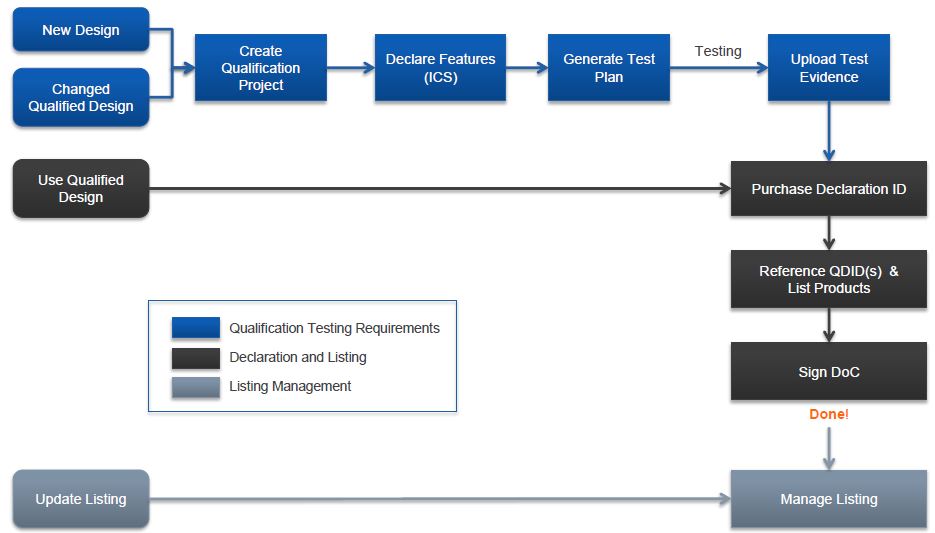
To qualify a Bluetooth product always the issue make people headache.
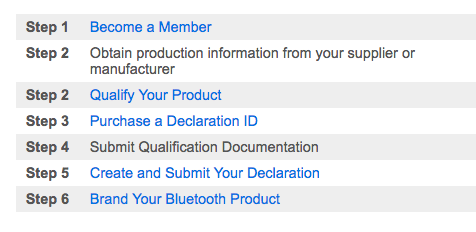
Here, we summarized the procedure become simple steps to help readers to easy to follow
From Step 3~5, we are sincerely suggest readers to entrust BQB (Bluetooth Qualify Body) to provide the professional service to save time and energy according to our experience.

STEP 1 Become a membership

Adopter Membership: Free–> “Most customers pick"
Associated Membership: US$7,500 or US$35,000 (depends on company size)
For more detail of the benefit between different membership, please visit the link as below

STEP 2. Obtain Production Information from supplier or manufacturer

Make sure your chip supplier or module manufacturer has well certified or not.
All information can be refer to SIG’s QDID information in public.
Makes sure the supplier or manufacturers’ QDID has well certified including both Hardware and Profile QDID

STEP 2-1. Qualify Your Products

a. Customers can log in SIG’s website to create a project in Test Plan Generator.
b. Pick up the type of qualification, such as End Product/Subsystem/Component/Development tool/Test equipment…etc.)
c. Link Layer, Spec, Profile

STEP 3. Purchase the Declaration ID (DID)

Readers can buy the DID from SIG’s website directly.

STEP 4. Submit Qualification Document

The Qualification Documents must been signed by BQE (Bluetooth Qualify Engineer) by BQB

STEP 5. Create and Submit the qualification

STEP 6. Brand Your Bluetooth Product