About MDBT42Q (Nordic nRF52 Solution) BT4.2 Module

Raytac Corporation

A BT4.1 & BT4.2 module maker based on Nordic nRF51 & nRF52 solution 

(nRF51822 & nRF51422 & nRF52832 & nRF51802)

Tel: +886.2.3234.0208

Many customers are interested in MDBT42Q based on Nordic nRF52832 solution.

Raytac’s MDBT42Q has started mass production and has widely shipped worldwide.

To provide a better service and easy customers safety regulation cost, Raytac’s remain the policy to apply module approval for most of the countries.

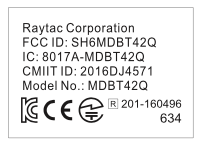
Allow for safety regulation requested, Raytac’s MDBT42Q has equipped the shielding case with certificate no. engraved.

Safety Regulation Approval Countries 

FCC (USA): SH6MDBT42Q

IC (Canada): 8017A-MDBT42Q

Telec (Japan): 201-260496

SRRC (China): CMIIT ID: 2016DJ4571

Taiwan (NCC) : MDBT42Q (CCAM16LP1180T2) / MDBT42Q-P (CCAM16LP1181T1)

KCC (Korea): MSIP-CRM-ryt-MDBT42Q

CE (EU): R&TTE (EN300328 V1.9.1)

What is the AQL?

Raytac Corporation
A BT4.1 & BT4.2 module maker based on Nordic nRF51 & nRF52 solution 
(nRF51822 & nRF51422 & nRF52832 & nRF51802)
Tel: +886.2.3234.0208
Quoted from
 
The “AQL tables" are statistical tools at the disposal of product inspections. They help determine two key elements:
  • How many samples should be inspected?
  • Where is the limit between acceptability and refusal, when it comes to defective products?
The need for an objective measurement of quality
In virtually every production batch, there will be defective products. It is true even after the manufacturer has checked each individual product and has repaired the defective ones.
Thus, in a supplier/buyer relationship, the supplier cannot be expected to deliver defect-free goods. However, the buyer wants to control the quality of purchased goods, since he does not want too many defects. But what does “too many" mean?
How to set the limit between acceptability and refusal in a way that can be agreed upon and measured?

Definition and application of ‘AQL’
The limit, as described above, is called the ‘AQL’. It stands for ‘Acceptance Quality Limit’, and is defined as the “quality level that is the worst tolerable" (ISO 2859 standard).
For example: “I want no more than 1.5% defective items in the whole order quantity" means the AQL is 1.5%.
In practice, three types of defects are distinguished. For most consumer goods, the limits are:
  • 0% for critical defects (totally unacceptable: a user might get harmed, or regulations are not respected).
  • 2.5% for major defects (these products would usually not be considered acceptable by the end user).
  • 4.0% for minor defects (there is some departure from specifications, but most users would not mind it).
These proportions vary in function of the product and its market. Components used in building an airplane are subject to much lower AQL limits.

Getting familiar with the AQL tables
Before using the AQL tables, you should decide on three parameters:
  • The ‘lot size’. If you ordered different products, the quantity of each product is a lot size, and separate inspections should be carried out for each lot. If you ordered only one product, the lot size is your total order quantity.
  • The inspection level. Different inspection levels will command different number of samples to inspect. In this article, we will stick to the so-called “level II", under “normal severity".
  • The AQL level appropriate for your market. If your customers accept very few defects, you might want to set a lower AQL for both major and minor defects.
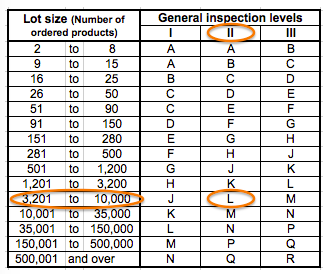
There are basically two tables. The first one tells you which ‘code letter’ to use. Then, the code letter will give you the sample size and the maximum numbers of defects that can be accepted.
First table: sample size code letters
How to read this table? It is very easy.
If you follow my example, I assume your ‘lot size’ is comprised between 3,201pcs and 10,000pcs, and that your inspection level is ‘II’. Consequently, the code letter is “L".
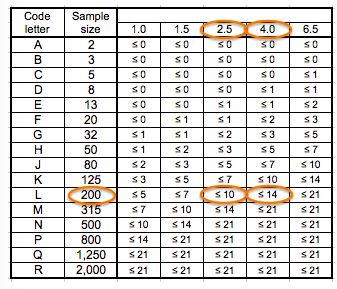
Second table: single sampling plans for level II inspection (normal severity)
How to read this table?
Your code letter is “L", so you will have to draw 200pcs randomly from the total lot size.
Besides, I assume you have set your AQL at 2.5% for major defects and 4.0% for minor defects. Therefore, here are the limits: the products are accepted if NO MORE than 10 major defects AND NO MORE than 14 minor defects are found.
For example, if you find 15 major defects and 12 minor defects, the products are refused. If you find 3 major defects and 7 minor defects, they are accepted.
Frequently asked questions about AQL
“What are the reduced and tightened inspection severities?"
They are designed to be used in very specific situations, when a producer is particularly reliable, or on the contrary fails too often. In practice, these severities are used in less than 1% of QC inspections.
The normal severity already allows for a good variation of sample sizes. In the vast majority of cases, third-party inspectors follow only the normal severity.

“So, basically I have to authorize the factory to produce some defects?"
Yes, some defects, since a factory cannot reasonably be expected to turn out 100% good quality.
However, it does not mean the buyer tolerates everything as long as the number of defects are below the AQL limits. Please see below the note issued in the ISO2859 standard:
“Although individual lots with quality as bad as the acceptance quality limit may be accepted with fairly high probability, the designation of an acceptance quality limit does not suggest that this is a desirable quality level. Sampling schemes […] are designed to encourage suppliers to have process averages consistently better than the AQL."

KiQ makes Pet more than a best friend

Raytac Corporation
A BT4.1 & BT4.2 module maker based on Nordic nRF51 & nRF52 solution 
(nRF51822 & nRF51422 & nRF52832 & nRF51802)
Tel: +886.2.3234.0208
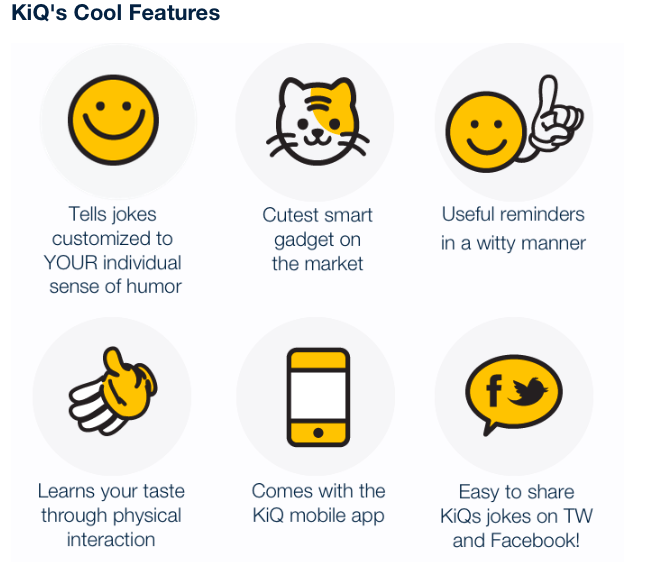
KiQ is a smart gadget that links wirelessly to your phone. She notifies you of incoming calls and messages; tracks your appointments AND entertains you with an ever-expanding library of jokes written by up-and-coming comedy writers.  
KiQ keeps the technology simple, the experience fun and to deliver on the promise of a personal assistant who you’d want to keep around.
Why not visit the Kickstarter (Click me) to know more about!
Project owned by Signe Networks, Inc.
KiQ Official Website:  www.kiqtoy.com
Signe Networks, Inc.  http://signenetworks.com 


nRF52 Raytac Module Reflow Profile Reference

Raytac Corporation
A BT4.1 & BT4.2 module maker based on Nordic nRF51 & nRF52 solution 
(nRF51822 & nRF51422 & nRF52832 & nRF51802)
Tel: +886.2.3234.0208
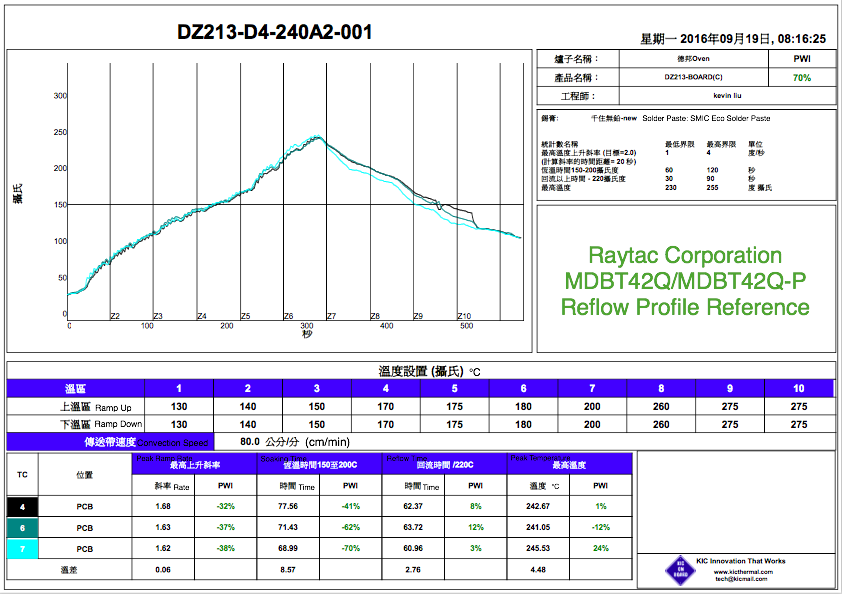
To help customers to proceed the SMT process, Raytac provides the Reflow Profile reference.
The Reflow Profile provided in below is considered as the reference only.
Due to SMT facility and solder paste may be different by each factory, Raytac is strongly suggesting all customers may proceed the trial run first to get the best and right reflow profile which works for their own facility.

Tutorial about Bluetooth low energy By Nordic

Raytac Corporation
A BT4.1 & BT4.2 & BT5 module maker based on Nordic nRF51 & nRF52 solution 
(nRF51822 & nRF51422 & nRF52832 & nR52810 & nRF52840)
www.raytac.com          email: cs@raytac.com          Tel: +886.2.3234.0208
Check out our two-part video tutorial about #Bluetooth low energy. In this tutorial, Nordic gives a developer’s introduction to Bluetooth and the development tools offered.

Part 1/2: Introduction to Bluetooth low energy (BLE)

An application oriented introduction to Bluetooth low energy.

Part 2/2: Nordic Semiconductor’s development resources

An introduction to the development tools offered by Nordic:
  • Code walk-through of an SDK example
  • Tools: mobile apps, pc application (nRF Connect), sniffer
  • Information resources: devzone, infocenter

MDBT42Q / MDBT42Q-P Safety Regulation Granted List

Raytac Corporation
A BT4.1 & BT4.2 module maker based on Nordic nRF51 & nRF52 solution 
(nRF51822 & nRF51422 & nRF52832 & nRF51802)
Tel: +886.2.3234.0208
Raytac MDBT42Q series module has following safety regulation granted.
Item: MDBT42Q / MDBT42Q-P
USA (FCC): SH6MDBT42Q
Canada (IC): 8017A-MDBT42Q
Japan( Telec): 201-260496
Korea (KCC): MSIP-CRM-ryt-MDBT42Q
China (SRRC): CMIIT ID: 2016DJ4571
Taiwan (NCC) : CCAM16LP1180T2 (MDBT42Q) / CCAM16LP1181T1 (MDBT42Q-P)
EU (CE): R&TTE V1.9.1 Report

Nordic nRF5 SDK v.12.1.0 Released

Raytac Corporation
A BT4.1 & BT4.2 module maker based on Nordic nRF51 & nRF52 solution 
(nRF51822 & nRF51422 & nRF52832 & nRF51802)
Tel: +886.2.3234.0208
Nordic relleased nRF5 SDK V12.1.0

Software Update

nRF5 SDK v.12.1.0
Software Development Kit for the nRF51 Series and nRF52 Series.
Highlights of this release:
  • Added serialization of the S132 SoftDevice v3.0.0. Serialization of S130 is now deprecated.
  • Included the latest MDK v8.9.0 with a crucial workaround for nRF52832 Errata 108.
More information in the release notes (inside the download).

Nordic nRF5x MDK v8.9.0 released

Raytac Corporation
A BT4.1 & BT4.2 module maker based on Nordic nRF51 & nRF52 solution 
(nRF51822 & nRF51422 & nRF52832 & nRF51802)
Tel: +886.2.3234.0208
Nordic has released the nRF5x MDK v8.9.0 in 20 Sep., 2016
 Software Update:  
The nRF5x MDK v8.9.0 has been released. 
Changelog:
  • Updated compiler abstraction header files with __ALIGN macro for IAR compiler and __PACKED macro.
  • Added Baud56000 to UART enumerated values in nrf51_bitfields and nrf52_bitfields.
  • Added missing macro transformations in nrf51_to_nrf52.h compatibility header file.
  • Added missing macros for FPU and SYSTICK in nrf52832_peripheral.h header file.
  • Updated RAM size in nRF52832 device in keil4 device database. No longer reflecting EngA size but EngB and FP1.
  • Renamed some files for IAR EW IDE.
  • Added workaround for Errata 108 into system_nrf52.c.
Please choose your download below:

Nordic nRF52 Module Solution Evaluation Board Now Available!

Raytac Corporation
A BT4.1 & BT4.2 module maker based on Nordic nRF51 & nRF52 solution 
(nRF51822 & nRF51422 & nRF52832 & nRF51802)
Tel: +886.2.3234.0208
To implement the solution by module, the evaluation board is necessary and practical.
Raytac Corporation has released 3 series of module solution based on Nordic nRF52832 (nRF52 series).
MDBT42 / MDBT42Q / MDBT42N
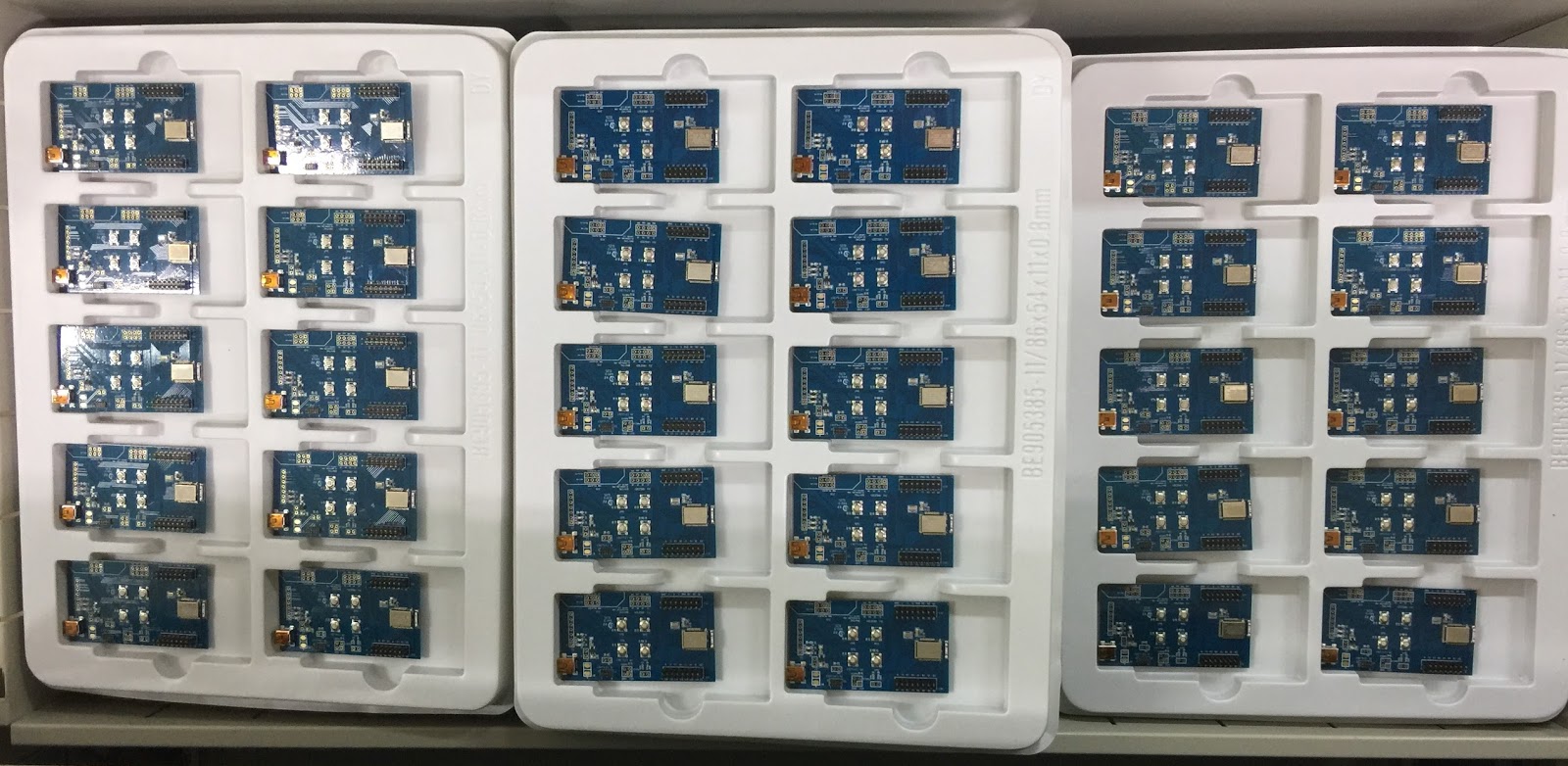
The evaluation board is designed and made up based on MDBT42Q, which has 32 GPIO that may satisfy all developers’ demand, and now is available for all developers to have a quick and easy experience to explore the Bluetooth world.
Those who are interested in the evaluation board may access Raytac’s Distributor or come up to contact with Raytac directly.

GPIOって???

Raytac Corporation

A BT4.1 & BT4.2 module maker based on Nordic nRF51 & nRF52 solution 
(nRF51822 & nRF51422 & nRF52832 & nRF51802)
Tel: +886.2.3234.0208
email: service@raytac.com
日本での代理店への連絡は下記の通り。
株式会社フクミ (Fukumi corporation)
消費材企画開発Gr. LBTチーム (Consumer Products R&D Group, LBT team)
榊 和優 (Kazumasa Sakaki)
Tel : 03-5687-2890 (+81-3-5687-2890)
Mail : lbt_bt@fukumi.co.jp
ブログから引用。詳細は下記Link先へ。
 
Bluetoothのチップ等の製品仕様などを見ていると
「GPIO 32ピン プログラマブルGPIO」なんて言葉が出てきたりしますが、
そもそも、この「GPIO」って何?について解説する回です。
GPIOはGeneral Purpose Input/Output(汎用入出力)の略語で
簡単に言うと「入力にも出力にも使えるデジタル信号の出入口」です。
そもそもマイコンは「CPU」と「メモリ」、「周辺機能」で構成されていて、
CPUはプログラムに従って、演算やデータの読み書き、条件判断などを行います。
メモリは、そのプログラムを格納します。
周辺機能は、マイコンを便利に使うためのさまざまな機能となります。
例えば、CPUと外部のセンサやスイッチなどの信号のやり取りをするために、
周辺機能である「入出力ポート(I/Oポート)」が必要です。
この入出力ポートのうちデジタル信号の出入口がGPIOです。
例えば、たくさんのセンサを積んだ製品には
このGPIOピンをたくさん使用することになりますが、その分サイズが大きくなります。
RaytacではNordic SoC nRF52832のWL-CSPパッケージを積んだモジュールを現在開発中で、
近々GPIO 31ピンと20ピンの2バージョンのリリース情報が報告できると思います。