The Bluetooth SIG Board of Directors(BoD) has granted its approval for a 15% increase in member fees, effective from January 1,2024. This decision comes after careful consideration of the organization’s financial situation and the need to cover the rising costs of current and futrue member services throughout 2024.
Feel free to explore the mission and operations of the Bluetooth SIG by visiting the provided web pages below:
You will get a brief understanding of WPC-ETA certificate (India) and how it relates to Raytac low energy Bluetooth module and how it helps you entering Raytac Bluetooth module into India by passing through importing and Customs clearance procedure way efficiently.
There are some types of ETA certificate categorized by the spec of your wireless transmission product (Bluetooth/Wifi/RFID and by device using frequency spectrum).
Hereafter we’re talking about the WPC-ETA compliance regulation to specifically on “Raytac’s low energy Bluetooth module.”
Outline of the article:
What is WPC Certificate/Equipment Type Approval (ETA) in India?
Raytac Bluetooth module applied to WPC-ETA Regulation Category
What is essential to get the ETA-SD license (ETA Approval)?
How the ETA-SD license works during importing process
A. What is WPC Certificate/Equipment Type Approval (ETA) in India?
The WPC (Wireless Planning & Coordination) is the broadcasting authority and is part of the Ministry of Communications and Information Technology in India.
Products with radio and/or wireless functionality imported or manufactured or marketed in India are required to have an Equipment Type Approval certificate (ETA certificate) from the Wireless Planning and Coordination (WPC India) Wing of the Ministry of Communications of the government of India. This includes product with Bluetooth, wireless local area network access technology (Wi-Fi), small digital radios (Zigbee), and radio frequency identification (RFID) and else more. The WPC-ETA certificate is required for anyone who wants to do wireless device business in India.
B. Raytac Bluetooth module applied to WPC-ETA Regulation Category
–ETA Through Self Declaration (ETA-SD License)
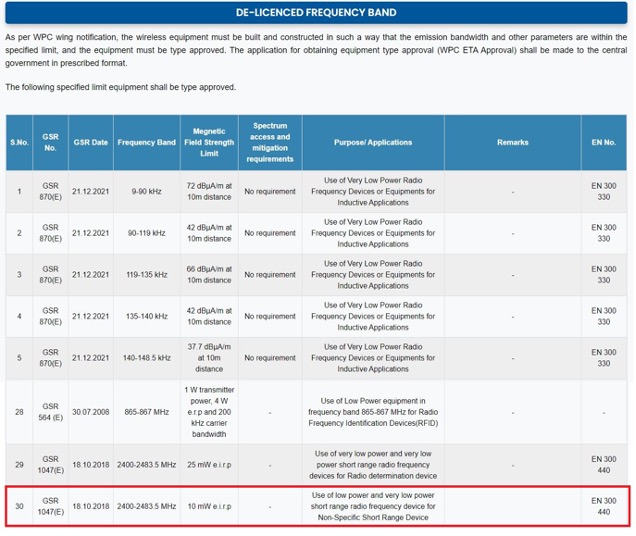
To specifically recognize what is the compliance regulation of equipment applies to Raytac Bluetooth module, we can be assured with our Bluetooth module spec located within “De-licensed Frequency Band list” , 2400-2483.5MHz / Limit with 10mW EIRP / Use of low power and very low power short range radio frequency device for Non-Specific Short range device, from the following chart which was released from WPC authority.
Once we confirm Raytac Bluetooth module spec is operated in De-License Frequency Band with low transmission power, at the mean time making sure the device is exempt from import license as per Import Policy of DGFT (Directorate General Of Foreign Trade), Ministry OM ETA-WPC-Policy-2018-19 dated 26th February 2019, free from EXIM Policy of DGFT, Raytac is granted to apply for “ETA Through Self-declaration” application procedure which was enabled by SARAL SANCHAR Portal of DoT on 12th April, 2019.
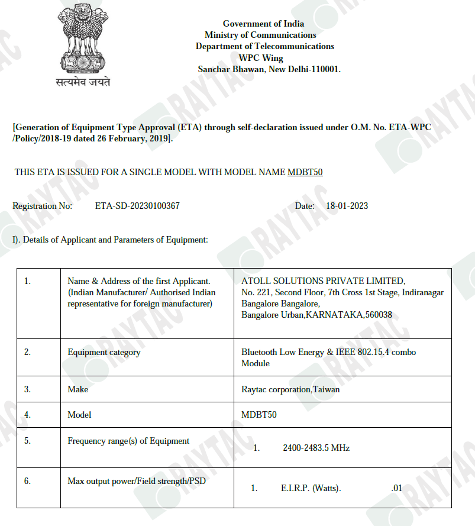
Here’s Raytac’s ETA through self-declaration (ETA-SD license) of module MDBT50 certified by WPC authority. (Please refer to the following image)
C. What is essential to get the ETA-SD license (ETA Approval)?
After getting idea of what ETA-SD license means to Raytac low energy Bluetooth module business, we need to get ready of the following points for applying the ETA Approval (ETA-SD License)
Applicant must be India manufacturing or authorized Indian representative
Making sure product exempt from import license
Making sure product working in the de-licensed frequency band
Wireless RF test report conducted by accredited laboratory
Details of Accreditation laboratory & Accreditation certificate issuing authority
Authorization letter
D. How the ETA-SD license works during importing process
Once ETA through self-declaration is generated for a model, subsequently it may be utilized by other person(s) for import/usage purpose in India. It is not necessary the importing agent/manufacturer is same party to the applicant of the license.
Question: How to import products falling under the category of ETA through Self-Declaration? Answer: Such category of product(s) may be imported by submitting an undertaking to the customs along with ETA-SD License without additional payment.
The ETA-SD license remains valid and NO renewal is needed until the technical parameter/design of the device is modified or altered.
Generally speaking , India doesn’t follow Modular policy nor Non-Modular policy. It determines how you proceed WPC-ETA certificate by product type (Semi-finished & End-product) and product technical spec (Frequency spectrum & Max output power). For instance: When the product is manufactured in India and its RF module(s) having ETA certificate is/are fitted inside it without any modification/alteration; then NO separate ETA is required for such finished product during import process. However, if finished product(s) are manufactured outside India, then ETA is required for each product before its import.
For the product which does not fall under De-Licensed frequency band and exempt from import license, WPC/ETA Certificate shall be obtained by routine proceeding to the concerned RLO ETA certificate. Both ETA (RLO) certificate and Import license shall be submitted to Customs during importing process whereas ETA-SD license Raytac module certified is exempt from import license that is way easier to proceed.
Edited by Account Manager: Jocelyn Tsai
Raytac Corporation 勁達國際電子股份有限公司 Bluetooth & WiFi module maker based on Nordic nRF54, nRF53, nRF52, nRF7002 solution BT5.3 & BT5.2 & BT5.1 Qualified, FCC/IC/CE/Telec/KC/RCM/SRRC/NCC Pre-Certified.
Bluetooth Core Specification 5.4 released in 2023 introduces four significant capabilities to the existing specifications.
1. Periodic Advertising with Response(PAwR)
PAwR is one of the key feature. Prior to Bluetooth 5.4, connectionless bidirectional communication is not possible. PAwR now allows bidirectional transfer of data in connectionless mode between a single central device and a large number of multiple devices (up to 32,640) in a star network topology.
2. Encrypted Adverting Data (EAD)
EAD provides a standardized approach to the secure broadcasting of data in advertising packets and enables the encrypted data over-the-star network to be decrypted only by devices that have shared the key material previously. This security feature protects PAwR communications to safeguard against data tampering, human error, and data leaks.
3. LE GATT Security Levels Characteristic(SLC)
When a GATT Client attempts to access a server attributes (characteristics, descriptors), attributes permissions are checked. If permissions are insufficient, the access is denied and all GATT features will not work properly. With SLC, the client can upgrade its security level to reattempt access of the previous failed operation. SLC enables devices to identify the security mode and level for all their GATT functionality.
4. Advertising Coding Selection
For LE Coded PHY, a Forward Error Correction (FEC) algorithm is used which results in significantly longer transmission distances. FEC parameter (S) uses one of two values (S=2 or S=8) and controls how much data is made to fix errors and how much Bluetooth range may be achieved. Prior to Bluetooth 5.4, specifying the value of the S coding parameter was not impossible. Bluetooth 5.4 allows the host to specify the value of the coding parameter S (S=2 or S=8) when the LE Coded PHY is selected for use with extended advertising.
Main beneficiary market of Bluetooth 5.4
The combination of these features enables ultra-low power, efficient radio usage and secure star networks that can be deployed in large scale ESL (Electronic Shelf Labels) and sensor applications with transferring a small amount of data. Devices accept slightly longer advertising-delay to exchange an extended battery life. It’s easy to see the retail industry as well as the market for ESL and shelf sensors will benefit greatly. ESL are devices that display pricing information for product on retail store shelves. They use small electronic paper displays powered by batteries and can replace traditional paper labels. Besides, ESL use wireless technology and a central hub device to transmit data, allowing retailers to automate pricing and replace traditional manual processes, and creating more efficient in-store operations.
Edited by Account Manager: Ms. Gracie Chuang
Raytac Corporation 勁達國際電子有限公司 A Bluetooth & WiFi module maker based on Nordic nRF53, nRF52, nRF70 solution www.raytac.com email: service@raytac.com Tel: +886.2.3234.0208
Intro: With the ready built code of zephyr.hex file for net core and application core individually, we would like to proceed code flashing into the MDBT53/53V Nordic nRF5340 BLE module.
Ready Built Code Programming Steps
Step1.
Execute nRF Connect >> Programmer > > Open
Step2.
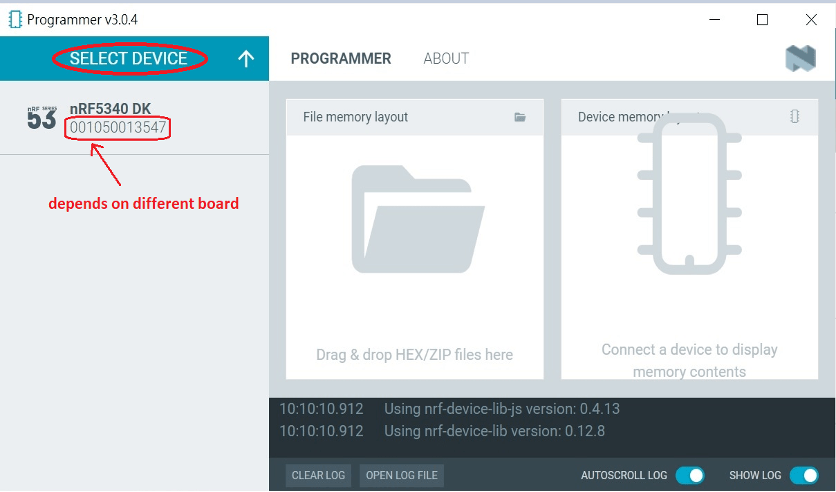
Click “SELECT DEVICE” >> Find icon of “nRF5340 DK” which is detected by the programmer app
Step3.
Click icon of “nRF5340 DK” >> “Erase All” to remove the flash memory from MDBT53/53V BLE Module
Step4.
Click “Add File” to load the net core zephyr.hex and application core zephyr.hex both into programmer
Step5.
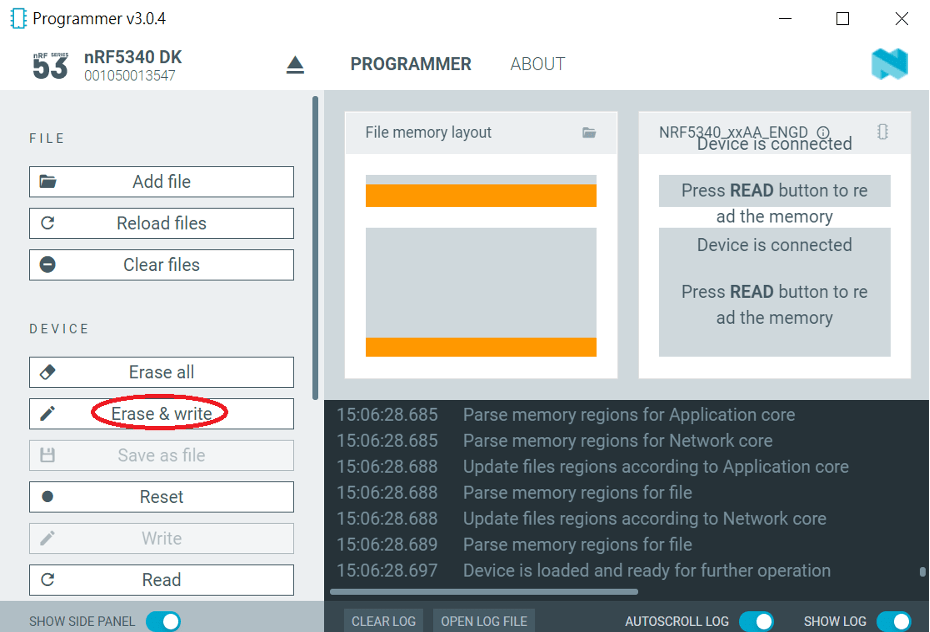
Do “Erase & Write ” to execute the flashing process for both zephyr.hex into memory of MDBT53/53V Module.
Step6.
To validate the wireless broadcast of default name “Nordic_UART_Service” from MDBT53/53V Module, please check on the “nRF Connect for mobile” APP and do “Scan device” through your mobile.
Once the device name is detected in your mobile , the wireless connection is successfully done.
There are some more useful resources in the below links:
Raytac’s pre-certified module for your convenience – but how?So, in this post, we would like to take you on a little journey through most of the important certifications that Raytac has pre-certified their modules with.
The exact topic is actually what you need to know and what that means to you as a Raytac customer.Obviously, each and every certification has their own rules, so that’s how we’re going to do this – one by one.
FCC – (U.S.A.)
Most people in the industry have heard of FCC, but for you who really don’t know what it is, it’s the Federal Communications Commission in the United States of America. Although considered as a center for these regulations, you will soon realize that they’re not really the center of these regulations and laws at all.
So for the FCC certification, you can as a Raytac customer:
Use Raytac’s certification ID directly on your finished product’s label
But you need to:
Test FCC Part 15B EMC for your finished products
IC – (Canada)
When it comes to the Industry Canada (yes, that’s what IC stands for), the regulations and procedures are much like their sibling FCC.
Use Raytac’s certification ID on your finished product’s label (same as FCC)
But, just like FCC, you need to:
Test IC ES003 (EMC)
This can be combined together with the FCC Part 15B test
TELEC – (Japan)
TELEC, sometimes referred to as MIC, is surprisingly simple.
What you will need to do is:
Use Raytac’s certification ID on your finished product’s label
Yes – you can actually just go right ahead and implement and/or commercialize your product after its parts are all proven TELEC certified which is pretty neat. However, there is another test that you as a customer can do if you wish, and that is VCCI which is just like the EMC tests mentioned above with the only difference (in terms of regulation) is that it’s NOT mandatory. Thus, you can choose not to do it as well.
KC – (South Korea)
As for the Korean regulation, these are the things you will have to do:
Test EMC for wireless (KN301489 – same as CE’s EN301489)
Test EMC for wire (IO port) (KN3235)
If, and only if, your final product is equipped with IO ports, that is.
These two tests needs to be done locally (Korean test lab) and depending on which test it is, you’ll have to deal with them differently.
Firstly, for the wireless test, you can refer to Raytac’s own certification report so that the lab knows the module itself has passed although it still needs to be tested.
Secondly, the for wire (IO port) test, you will have to do from scratch essentially.
Thus, even though we have applied for KC for our modules, you will still have to test them locally.
CE (Radio Equipment Directive 2014/53/EU (RED)) – (EEA, Europe)
Although CE is considered as strict regulation, the procedure is pretty simple. Simply put, you will have to conduct tests on a few different samples, and the procedure goes:
Test on Conducted engineering sample (EN300328)
You can refer to Raytac’s test report, if the test lab accepts it, that is.
To ensure that they do, you can choose to conduct your tests at the same lab as Raytac – SGS.
Test on Radiated engineering sample (EN300328)
Test EMC (EN301489)
Test Safety (EN60950)
Subject to change to EN62368 in 2021
SRRC
Simply put, you will have 2 scenarios:
Your end product can either be defined as a “Home Appliances" or an “Office Utilities" product
Then you can simply refer Raytac’s SRRC ID (module policy just like FCC/IC/TELEC)
Your end product is neither of the above
You have to apply for your own SRRC ID by testing everything required by the regulation
NCC
They go by a “Platform policy" which basically means that as long as you are just adding functionality onto an already existing feature, then you can leverage Raytac’s NCC ID on your product’s label directly (module policy just like FCC/IC/TELEC/SRRC). Otherwise, you will have to apply for a new one.
Thus, the procedure becomes:
Adding functionality of an already existing feature (a.k.a. platform)?
Then you can simply refer Raytac’s NCC ID on your product (module policy just like FCC/IC/TELEC/SRRC)
New ideas/features?
Sorry, you have to apply for your own NCC ID by conducting all tests necessary
RCM
Australia’s RCM (Regulatory Compliance Mark) is a lot like CE, much like IC is similar to FCC.
When applying to this certification, you will be in either of these two circumstances:
CE already done.
You can refer to your own CE certification and ask your test lab to copy the report to your RCM application.
CE NOT done.
You must conduct the test from scratch. But it is a whole lot like CE, meaning:
Test on Conducted engineering sample
Test on Radiated engineering sample
Test EMC
Test Safety
Bluetooth Certification
Last, but definitely not least, is the Bluetooth Certification. For this one, choosing Raytac’s modules will bring you great benefits. But first, you need to:
Apply for Bluetooth SIG’s “Adopter Membership" (free)
For your first product, that is all you will have to do. But what if you come up with a new model of the product? Before you ask, I will answer “No – you don’t necessarily have to purchase another DID." In order for this to be true though, your new product cannot have either of these things changed:
Hardware
Unless you are still using Raytac’s module
Feature
Unless you are still using Raytac’s module
Brand Name
Brand name remains unchanged.
Although you might be able to apply for these certifications all on your own without trouble whatsoever, we always encourage customers using Raytac’s BLE modules to contact us before hand so that we can provide you valuable information. This way, you will get unbiased guidance which will save you time and money.
We are pleased to release that Raytac’s MDBT42 series module (including MDBT42Q / MDBT42 / MDBT42V) based on Nordic nRF52 series solution has completed the BQB testing and BT4.2 certificated granted.
Bluetooth products must purchase DID and submit the testing evidence issued by BQE to completed the SIG registration and activate the DID
Only products’s DID been activated then allowed to use Bluetooth logo.
Developer’s who built the products based on Raytac module is allow to relable Raytac’s DID to easy the process.
Simply purchase their own DID from SIG, and relabel Raytac’s DID then can completethe Bluetooth activation process.
Raytac’s MDBT40/MDBT40-P QDID/DID is applied by subsidiary of Ginstar Corporation.
The QDID is 60912 / D023258
We welcome all Raytac’s customers to relabel the QDID as long as product built by MDBT40/MDBT40-P. As such, the Bluetooth process becomes simple and cost effective.
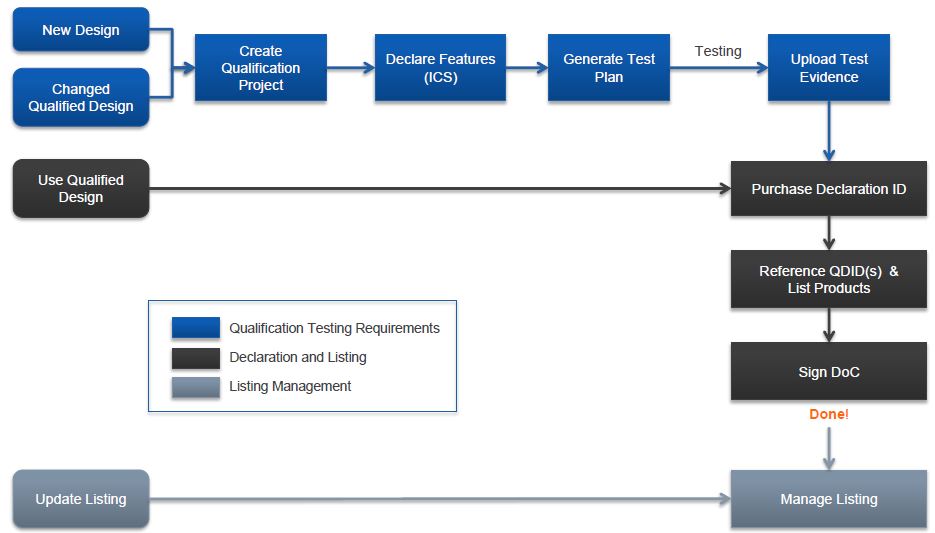
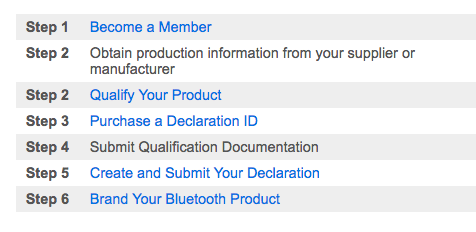
To qualify a Bluetooth product always the issue make people headache.
Here, we summarized the procedure become simple steps to help readers to easy to follow
From Step 3~5, we are sincerely suggest readers to entrust BQB (Bluetooth Qualify Body) to provide the professional service to save time and energy according to our experience.







 Obviously, each and every certification has their own rules, so that’s how we’re going to do this – one by one.



 Raytac Corporation