Raytac’s Impact on the Zephyr Ecosystem – Little Module, Huge Potential

In this article, Stanley Huang, MSc, Deputy Manager of Firmware Development at Raytac, shares insights on how Raytac’s modules and development kits strengthen the Zephyr ecosystem.

[Stanley Huang, New Taipei City]
When we talk about open-source platforms like Zephyr RTOS, most people immediately think of major chip manufacturers such as ST Micro, NXP, or Nordic. But to me, what truly makes Zephyr famous amongst the developer community is through modules that developers can actually touch: those they can instantly plug in and start using right away. In these terms, Raytac is one of the most underrated and important contributors in this ecosystem.

Raytac Modules Make Zephyr More Accessible
Instead of being a chip vendor, we specialize in producing high-quality, globally certified modules – especially Bluetooth and Wi-Fi modules based on Nordic chipsets, such as the AN7002Q, AN54LQ, AN54LV, MDBT53, MDBT50Q, and MDBT42Q.
All these modules are already certified with Regional RF compliances(FCC, IC, CE, KC, etc.) and the latest Bluetooth Specifications, offering developers the assurance of “plug and play” and “production-ready” solutions.
We assure that our modules have become one of the easiest platforms for Zephyr developers to test BLE functionality.

I paired Zephyr with Raytac’s MDBT50Q-DB-40 development board when I first applied Zephyr in a BLE Peripheral project . With a simple west build -b nrf52840dk_nrf52840 followed by flashing the firmware using J-Link or nRF Connect for Desktop, the BLE beacon immediately showed up on my phone. Clean, simple, noise-free, and developer-friendly – that’s Raytac’s style.

Modules play an invaluable role in product development
Many would say Raytac only makes modules and the real core is still Nordic’s SoC.
But I believe that in an open-source system like Zephyr, the hardware that helps your project runs first is that which contributes the most.
Our Zephyr-registered development kits eliminate the hassles of manual soldering, regulatory certification, and antenna design, allowing engineers to fully focus on developing applications based on Zephyr.
They can run Zephyr’s BLE peripheral, central, GATT, and HCI samples directly on the Raytac kits that act as a one-stop hardware solution.
In many ways, Raytac has pushed Zephyr’s usability a significant step forward.

Raytac Also Expands Zephyr’s Application Horizon
Many of Raytac’s modules are ultra-compact- ideal for wearables, smart sensors, and low-power beacons…etc. These are the scenarios where Zephyr excels, and Raytac’s modules provide the physical platform to enable companies to build their “dream devices".
When running Zephyr on a tiny module like the AN54LV-15(Product Link), developers will be amazed that something smaller than a piece of corn kernel can run a full RTOS, manage the BLE stack, trigger timers, drive I2C sensors, and even connect to the cloud, all by itself.  This combination doesn’t just make development easier – it inspires developers to realize that: “they can build their projects using Raytac’s hardware.”

Raytac may not be the star, but we’re always ready for you
On Zephyr’s main stage, companies like Nordic, STM, and Intel take the spotlight, but Raytac plays an essential supporting role – supporting the performance from behind the scenes. We offer stable, high quality, and low-power platforms, giving every line of Zephyr code a place to run and every feature a cornerstone.
Our greatest value lies in helping developers skip antenna design and RF interference concerns – so they can jump right into the Zephyr ecosystem with ease.

Our products deliver the reliability you need and the efficiency you expect.

We invite you to explore more about how Raytac supports the Zephyr ecosystem and discover our range of development kits and modules designed for seamless integration.
Visit our Zephyr page here: https://docs.zephyrproject.org/latest/boards/raytac/index.html
Visit Zephyr’s Ecosystem Vendors page: https://www.zephyrproject.org/ecosystem-vendor-offerings/

For more information, please contact:
Raytac Contact Form: https://www.raytac.com/contact/
Raytac Sales email: sales@raytac.com
abietec Service email: service@abietec.com


Article by Firmware Deputy Manager: Stanley Huang
Edited by Business Development Manager: Tony Yin

Raytac Corporation 勁達國際電子股份有限公司 / Raytac Corporation (USA) / abietec Inc.
A Bluetooth, Wi-Fi, and LoRa Module Maker/ODM & OEM Manufacturer based on
Nordic nRF54; nRF53: nRF52; nRF51; nRF7002
Semtech Specification: SX1262

Bluetooth Specification: BT6 ; BT5.4 ; BT5.3 ; BT5.2.
Wi-Fi Specification: Wi-Fi 6
LoRa Specification: LoRaWAN


All products are FCC/IC/CE/Telec/KC/RCM/SRRC/NCC/WPC/RoHS/Reach Pre-Certified.
http://www.raytac.com
https://www.raytac.com/contact/
email: sales@raytac.com
Tel: +886-2-3234-0208(TW)/+1-626-217-3139(USA)

SRRC Certification Update – Document No. 129

About SRRC Certification:

SRRC, or the State Radio Regulation Committee, is a mandatory certification required by the National Radio Management Committee of the Ministry of Industry and Information Technology of China. All wireless products sold within China must obtain certification, commonly referred to as SRRC certification, which involves approval of the wireless transmission equipment model.

SRRC Document No. 129:

Document No. 129 introduces various interference avoidance technical requirements for wireless transmission equipment, including “pre-transmission scanning," “monitoring and avoidance," and “Medium Utilization (MU)" for equivalent occupancy rate.

a. “Pre-transmission scanning" and “monitoring and avoidance" mechanisms involve monitoring and listening to the wireless channel before or during signal transmission. By setting appropriate detection threshold levels, the channel’s occupancy status is determined to select an idle channel for access.

b. The “equivalent occupancy rate" mechanism requires wireless transmission equipment to self-adjust based on parameters such as “Duty Cycle" and “transmission power," ensuring the “equivalent occupancy rate" remains at a lower level (not exceeding 10%).


1.     Certificate Validity Period:
Enforced from October 15, 2023. During this period, both old and new policies can be applied. Certificates obtained under the old regulation (Document No. 353) are valid until December 31, 2025. However, certificates obtained by complying with the requirements of Document No. 129 will be valid for 5 years.


2.     Sample Requirements:
2.1   The quantity of conducted samples prepared according to the old regulation remains unchanged: 5 samples.
2.2   The major change introduced by Document No. 129 is the addition of interference avoidance technical requirements. The interference avoidance test items include:
1.     Maximum channel occupancy time
2.     Minimum channel idle time
3.     Minimum silence period duration
4.     Detection of unused signals
5.     Detection threshold
6.     Short control signal duty cycle
7.     Equivalent occupancy rate.


Differences between Old and New Regulations:


Edited by Sales Manager: Ms. Vicky Huang

Raytac Corporation 勁達國際電子股份有限公司

Bluetooth & WiFi module maker based on Nordic nRF54, nRF53, nRF52, nRF7002 solution
BT5.4 &BT5.3 & BT5.2 & BT5.1 Qualified, FCC/IC/CE/Telec/KC/RCM/SRRC/NCC Pre-Certified.
Bluetooth Solution: nRF54, nRF5340, nRF52840, nRF52833, nRF52832, nRF52820, nRF52811, nRF52810, nRF52805, nRF51822 WiFi Solution: nRF7002
http://www.raytac.com
email:service@raytac.com
Tel: +886.2.3234.0208


ANT+ Module by Raytac

nRF51422 is the first solution supports both Bluetooth and ANT+, different from pure Bluetooth Low Energy BLE solution, nRF51822 released earlier. The edge cutting technology enable nRF51422 suporting multiprotocol concurrency capable for both Bluetooth Low Energy and ANT+. At the same time Nordic released SDK S310 for nRF51422 which is a combined peripheral BLE and ANT+ protocol stack that supports concurrent operation and all ANT+ features.

When Nordic moved to nRF52, started from nRF52832, the game changed. Even nF52832 still supports ANT+, the technology support such as SDK releasing or developers’ forums, has moved to direct supported by ANT+ Wireless (formerly Dynastream Innovations). Since then, Raytac suggest developers who is interested in ANT+ product still able to select the modules based on core specification and form factor, but access the firmware development support from ANT+ directly. Developers who are interested to know more about ANT+ is encouraged visit ANT+ FAQ support page first for more information about membership, development, resource and certification.

All Nordic nRF52 solutions supports ANT+ feature, developers may refer to below Raytac module map and find what the protocol supports by the symbol stated besides the Nordic solution indication.

Raytac Corporation 勁達國際電子有限公司
A BT5.2 & BT5.1 & BT5 module maker based on Nordic nRF52 & nRF51 solution 
(nRF5340 & nRF52840 & nRF52833 & nRF52832 & nRF52820 & nRF52811 & nRF52810 & nRF52805 & nRF51822)
www.raytac.com. email: cs@raytac.com. Tel: +886.2.3234.0208

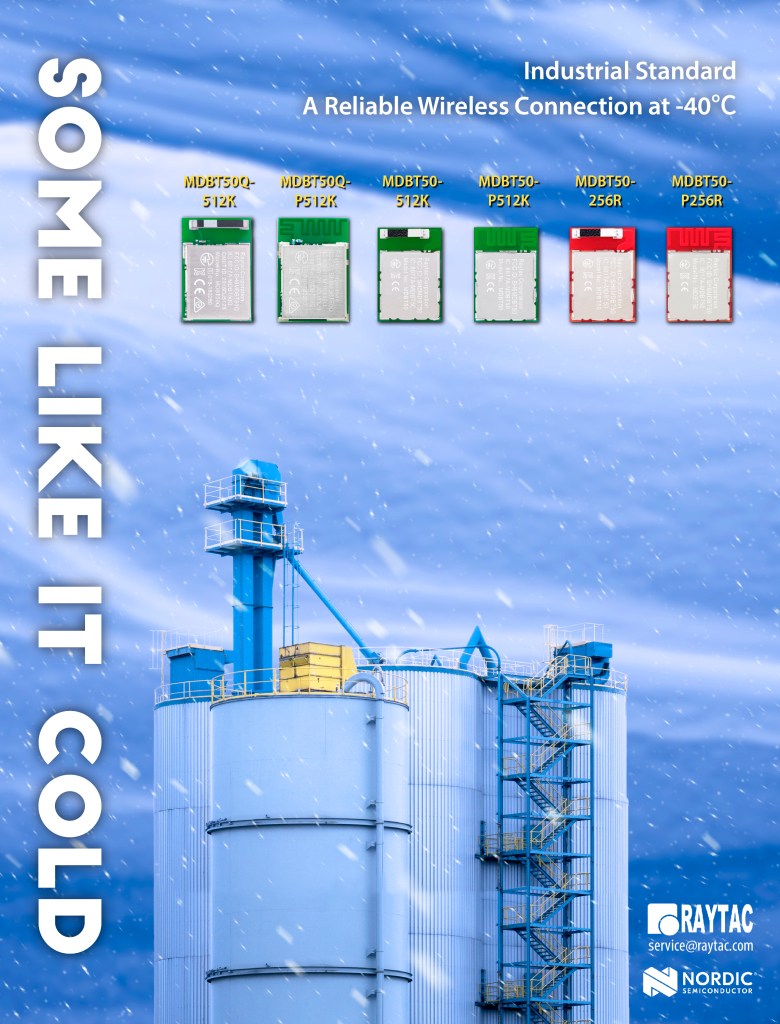
Some One Like It Cold @ -40°C

Outside the home in the frozen world. Raytac take care!

 Winter is coming and field is chilly. Stay home enjoy the warm is what people is looking for.To ensure users enjoy the joyful time on couch, Raytac conduct a  72 hrs non-stop connection reliability test under -40°which is compliant with industrial standard. The significant result shows there is no any single packet lost over 252,979,200 bytes (244 bytes/Packet).

Raytac Corporation 勁達國際電子有限公司
A BT5.2 & BT5.1 & BT5 module maker based on Nordic nRF52 & nRF51 solution 
(nRF5340 & nRF52840 & nRF52833 & nRF52832 & nRF52820 & nRF52811 & nRF52810 & nRF52805 & nRF51822)
www.raytac.com service@raytac.com Tel: +886.2.3234.0208

Raytac Product Change Notice (PCN) Announcement for Nordic nRF52832 Solution Module

Raytac would like to announce Product Change Notice (PCN-19121601) for all nRF52832 module lines include MDBT42Q / MDBT42 / MDBT42V series.


There is no panic for this PCN,  it is refer to module’s appearance changes only but no others. Raytac will remove YELLOW DOT marking on shielding for all modules produced based on Nordic nRF52832 (Build Code: EXX) V.2 SoC since 2020 (Date Code from 001).

In case there is anything unclear for this PCN , please do not be hesitated to contact Account Manger for further assistance.

Raytac Corporation 勁達國際電子有限公司

A BT5.1 & BT5 & BT 4.2 module maker based on Nordic nRF52 & nRF51 solution 

(nRF52840 & nRF52833 & nRF52832 & nRF52810 & nRF52811 & nRF51822)

www.raytac.com          email: cs@raytac.com          Tel: +886.2.3234.0208

Raytac Jointed Apple HomeKit MFi Program

Standing on marketing perspective point of view, iPhone user are often been viewed as a higher contribution margin group. Not only talking about consumer behavior, but also the motivation looking for device integrated with their own iOS devices. That explains why HomeKit devices recently has been widely spreading out in Apple stores or shops.

Wireless technology, says Bluetooth or WiFi, is the key role to connect between devices for Apple HomeKit implements. Surely, Bluetooth is more applicable than WiFi, not only easier to connect to iOS devices but also much lower power consumption and higher security level to rich consumer’s experience.

Raytac has been devoting to Bluetooth Low Energy module development for several years, started from BT4.0 to the latest. Raytac modules has selected Nordic’s solution, which is a highly optimized solution running HomeKit Accessory Protocol (HAP) and application firmware. The ultra-low power even enhance the design and usability for HomeKit devices implements.

After MFi Licenses program jointed, Nordic nRF5 HomeKit SDK is capable to access, Raytac expects to escalate the support ability in terms of hardware and firmware aspects for all customers who are interested in Apple HomeKit implements.

Raytac BLE Module-nRF52840 & nRF52833.jpg
Raytac nRF52840 & nRF52833 Modules

Raytac Corporation 勁達國際電子有限公司

A BT5.1 & BT5 & BT 4.2 module maker based on Nordic nRF52 & nRF51 solution 

(nRF52840 & nRF52833 & nRF52832 & nRF52810 & nRF52811 & nRF51822)

www.raytac.com          email: cs@raytac.com          Tel: +886.2.3234.0208

Raytac nRF52 Modules Bluetooth Specification Updated to BT5.1

Raytac nRF52 series module now has been updated to BT5.1

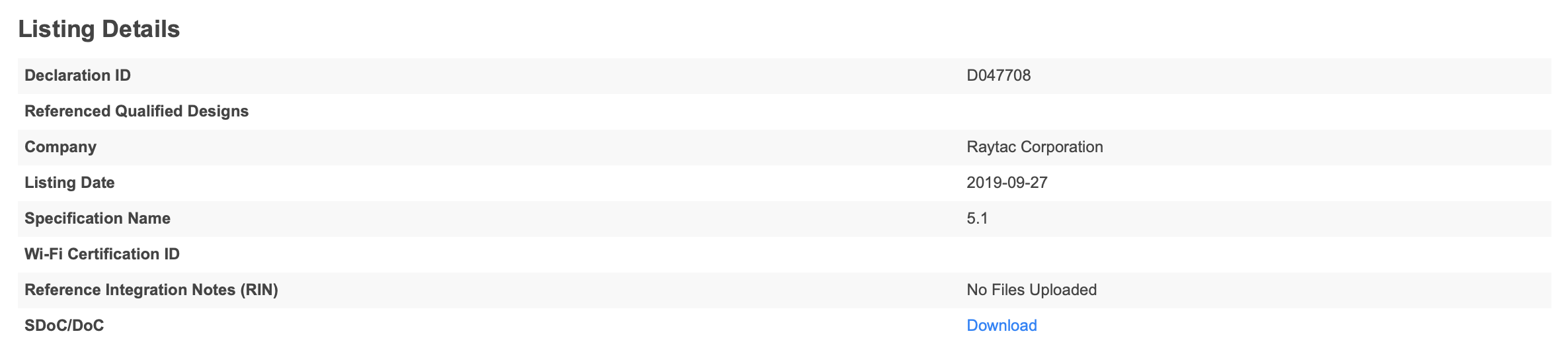
QDID: 139361 / DID: D047708

Raytac Module BT5.1 Specification

Bluetooth – Current and soon-to-perish versions

Bluetooth has been around for quite some time, but that doesn’t mean that no one is a beginner when it comes to developing Bluetooth-based products. In fact, due to their recent updates, Bluetooth is becoming increasingly popular as demand for power efficient gadgets and wireless technology is increasing. Smart watches is just one of the many examples out there.

For each and every single one of these devices, you’ll first have to register your new product with Bluetooth-functions built in on Bluetooth SIG’s website. You will eventually register (and pay for) your product based on what version of the Bluetooth protocol that you’re using in the product and do so by purchasing a so called Declaration ID (DID).

Yes, a little exaggeration in the title, but that’s essentially what it comes down to. Bluetooth SIG is doing some major updates and changes to the Bluetooth protocol which includes getting rid of the more outdated versions.

There are quite a few versions of the Bluetooth protocol out there, but nowadays you will basically be advised to choose from 2 versions:
v.4.2 or v.5.0
These two versions would be, as I mentioned in the title, the two current versions of Bluetooth.

Although it might seem very simple at first, there are a few things that you need to understand the content of the announcements to fully grasp what these updates and changes mean. That, my friends, is today’s topic of this post.

Archived specifications

Deprecated and Withdrawn Specifications

When a specification reaches the end of its useful life, the Bluetooth® SIG may choose either to deprecate the specification, ending maintenance and restricting its use, or to withdraw the specification from use.

Bluetooth SIG – https://www.bluetooth.com/specifications/archived-specifications

What has changed recently is nothing new, but it’s big. What I mean is that similar changes have been done in the past, but since the market is more dependent on the technology now than before, it matters far more for people when the Bluetooth SIG do the same changes nowadays. Those changes are as follows:

On 01/28/2019, the following policy changes will be enacted:
– Creating new designs that implement deprecated or withdrawn specifications will not be permitted
– New products cannot be added to designs that implement withdrawn specifications
– You cannot pay a $25,000 fee to qualify a new design that implements a deprecated specification
– Purchased but unused $25,000 Declaration IDs will no longer be valid and the cost of any unused $25,000 Declaration IDs will be credited to your account


Bluetooth SIG – bluetooth.com

This piece of information tells us that the process of withdrawing specifications comes down to two different steps, namely deprecation and withdrawal.
While deprecation literally means “to stop use", it is in this case the first step in the process of making a certain Bluetooth specification obsolete.
Then there’s a time gap between a certain specification gets deprecated until it’s withdrawn. During this gap, as mentioned above, no new designs can be paid for and/or registered and unused DID’s will be invalid. This is only to prevent new devices with deprecated Bluetooth specifications from being produced. To stop the “bloodline" of those specifications if you will. During this gap, however, you are still able to add new products that implement the same fundamental design (e.g. version updates) as you wish.

After this gap is over, when the specification in question is actually withdrawn, you will not be able to add any new products to any existing designs.

Got it? No? It’s alright. In fact, there’s a lot of information and it’s hard to put into context right away. Just to make things clear, let’s make an example:
Company R is currently developing a new device called RIC which implements Bluetooth 4.0 specifications. For now, everything’s alright and Company R can go right ahead with their developments.
When the Bluetooth core specification 4.0 becomes deprecated in Jan 28th, Company R can no longer come up with new product designs such as RIC-2 since that would count as a new design, but Company R can update their original device RIC as long as they don’t change the physical design.
Then, when the Bluetooth core specification 4.0 is finally withdrawn, Company R cannot update their product RIC anymore AND they cannot register new designs under Bluetooth core specification 4.0.

If you’re a developer who is very familiar with Bluetooth already, this information might already be, as certain people refer it as, “peanuts". If you’re new to the Bluetooth world, however, this is a lot to take in and you might want to read up more about it. We hope this explanation made things clearer for you though 🙂

You can find more info at:
Bluetooth SIG – https://www.bluetooth.com/specifications/archived-specifications

Don’t forget that Raytac Corporation’s modules are all pre-certified with FCC, TELEC, IC, CE, RCM, KC and SRRC. The best part is that more is yet to come!
Take a look at our modules on our website: http://www.raytac.com


Come to visit Raytac at Embedded World #Hall 3 / 3-520

With over 1,000 exhibitors gathering in Nuremberg, Germany on 26 Feb.~29 Feb., 2019 , Embedded World has become one of  the biggest trade fair among the IoT Technologies.

RAYTAC27-20181220_lo