Bluetoothのバージョンについて

Raytac Corporation

A BT4.1 & BT4.2 module maker based on Nordic nRF51 & nRF52 solution 
(nRF51822 & nRF51422 & nRF52832 & nRF51802)
Tel: +886.2.3234.0208
email: service@raytac.com
日本での代理店への連絡は下記の通り。
株式会社フクミ (Fukumi corporation)
消費材企画開発Gr. LBTチーム (Consumer Products R&D Group, LBT team)
榊 和優 (Kazumasa Sakaki)
Tel : 03-5687-2890 (+81-3-5687-2890)
Mail : lbt_bt@fukumi.co.jp
株式会社フクミのブログから引用。詳細は下記Link先へ。

Bluetoothは1999年に最初のバージョン1.0が発表されて以降、たびたびバージョンアップが繰り返されてきました。
バージョンの違いによって機能や特徴に違いがありますので、
一般的に市販されているBluetoothのバージョンにおいて下記にまとめたいと思います。
Bluetooth2.1 : ペアリングの簡素化・NFCに対応。バッテリー寿命の延命機能「Sniff Subrating」搭載
Bluetooth3.0 : 最大通信速度24MbpsのHS(Hight Speed)をオプションで用意。電力管理機能強化による省電力化
Bluetooth4.0 : 大幅な省電力化Bluetooth Low Energy(BLE)。転送速度1Mbps。以前のバージョンとの互換性無し
Bluetooth4.1 : IPv6/6LowPANでインターネットに直接接続。LTEとの干渉抑制
Bluetooth4.2 : 転送速度の高速化。セキュリティ強化(FIPS対応)
*4.0以降は以前(3.0以前)のバージョンとの互換性がありません。

6 wireless technologies for wearables

6 wireless technologies for wearables

Raytac Corporation
A BT4.1 & BT4.2 module maker based on Nordic nRF51 & nRF52 solution 
(nRF51822 & nRF51422 & nRF52832 & nRF51802)
Tel: +886.2.3234.0208
Quoted from Nordic Blog
Which one of these wireless technologies is best for your wearable product?
Are you creating a wearable product, but not sure of what wireless technology to choose? The way modern APIs work, developers don’t necessarily need to know the technical details. But having a basic understanding of the underlying technology will help you make apps that are more efficient, more responsive and easier to use.
Which solution is best for your wearable product? This depends on your requirements for bandwidth, power considerations and range. Here’s a brief overview of the 6 most common wireless technologies to consider.

Near Field Communication (NFC)

NFC works best for wearables that require low power consumption. It involves the transfer of tiny amounts of data over a very short range, essentially by touching two devices together. The devices will switch between two different modes: Active and passive. The power consumption for NFC is similar to what we see in Bluetooth Low Energy, although higher when communicating with a passive tag.

If you need your wearable to transfer data over a longer range, you should look for other options.

Bluetooth Low Energy (BLE)

Today, most wearables are running on Bluetooth Low Energy (BLE, formerly called Bluetooth Smart).
This technology is known as an easy to implement, low-cost option that requires very little power from your wearable. Your product can be powered by a coin cell battery for months – even years in some cases. But BLE comes with a compromise: Your data throughput will be limited. As most wearables generally transfer very little data, product owners can usually live with this.
The BLE chip is small, and fits nicely into an esthetically pleasing wearable that is convenient for the user to wear. A line-of-sight range of up to 100 meters is possible.

Using BLE requires your device to be paired with a host, most usually a cellphone with an app activated.

If you plan for your wearable to transfer higher amounts of data frequently,Bluetooth Low Energy may not be the best choice. Limited data transfer capacity makes this technology unsuitable for audio and video streaming, for example.

ANT

The wireless network technology ANT is a good option for sports wearables. A subsidiary of Garmin, ANT is huge in the sports and fitness segment where it is typically used for monitoring of heart rate, cycling power, distance and speed. Many of today’s cycling and fitness brands use ANT for their wearables. In fact, it has almost become a de facto standard in cycling.

The sensors and other nodes will act as either slaves or masters within a wireless network. Each node can transmit, receive or even function as a repeater to increase the range of the network. You can configure the network to spend long periods in low-power sleep mode, consuming extremely little power.

Bluetooth Classic

Initially a standard intended to cover a lot of use cases for wireless communication, Bluetooth Classic (originally named slimply ‘Bluetooth’, of course) found its niche in audio. Today it is the de facto standard for audio streaming, whether from your smartphone to a headset, speaker or in-car multimedia system.
Compared to BLE, Bluetooth Classic requires much higher bandwith and therefore more power. The network topology is limited and not suitable for large sensor networks.

Wi-Fi

If your wearable needs to transfer a lot of data with as little lag as possible, Wi-Fi is your best option. The technology is best when streaming huge amounts of data, like video, but its main drawback is high power consumption that will require daily battery charging.

By using Wi-Fi, your wearable product can connect directly to the Internet via a Wi-Fi Access point.
Google Glass uses Wi-Fi to transfer graphics at high data rates for a better user experience. But the high power consumption of the display, and the high CPU load, requires the consumer to charge the device frequently. Be aware that such charging requirements will be a very important factor in overall customer satisfaction.

Cellular

In a similar way to how your smartphone operates, using a cellular radio means that your wearable device can talk directly to the cellular network. Although convenient, as there is no need for a bridge device such as a smart phone to access the cloud, today’s cellular technologies are not suitable for small wearable devices. Power consumption is high and the physical dimensions are usually rather large. In the future, we will see new cellular technologies that are more competitive in the wearable space. But we’re not there yet.

The best of all worlds?

Some wearables combine different wireless technologies to take advantage of different aspects of each method. The Apple Watch uses Bluetooth Classic, BLE, Wi-Fi, and even NFC for mobile payments. Nordic Semiconductor is currently the only manufacturer delivering chips that support both ANT and Bluetooth Low Energy (BLE), as well as NFC – all in one low power, ‘system on chip’ solution.

Hopefully, you’re now a little clearer on which wireless technology is best for you. If you’re still struggling, consider your product priorities. Is it size, power consumption, user experience, cost, or something else? Once you’re clear on the priorities for your wearable, your wireless communication options become a lot clearer, too.

Bluetooth関連の日本語ブログ オープンしました

Raytac Corporation

A BT4.1 & BT4.2 module maker based on Nordic nRF51 & nRF52 solution 
(nRF51822 & nRF51422 & nRF52832 & nRF51802)
Tel: +886.2.3234.0208
email: service@raytac.com
日本での代理店への連絡は下記の通り。
株式会社フクミ (Fukumi corporation)
消費材企画開発Gr. LBTチーム (Consumer Products R&D Group, LBT team)
榊 和優 (Kazumasa Sakaki)
Tel : 03-5687-2890 (+81-3-5687-2890)
Mail : lbt_bt@fukumi.co.jp
Bluetoothの知りたい情報がここで入手できます!

Nordic nRF52 Module Ready For Evaluation

Raytac Corporation
A BT4.1 & BT4.2 module maker based on Nordic nRF51 & nRF52 solution 
(nRF51822 & nRF51422 & nRF52832 & nRF51802)
Tel: +886.2.3234.0208
Raytac’s nRF52 module <MDBT42Q series> now is ready to ship for customer’s evaluation.
Customers may access to Raytac’s email for further request.
Part No.: MDBT42Q-512K

Innovation Incentive Program – A cost saving way to enter into Bluetooth world

Raytac Corporation
A BT4.1 & BT4.2 module maker based on Nordic nRF51 & nRF52 solution 
(nRF51822 & nRF51422 & nRF52832 & nRF51802)
Tel: +886.2.3234.0208
No doubt!
After 2014/2/1, Bluetooth trademark compliance does costs a lot and actually curb developers or brand owner to get into the Bluetooth world especially those start-up companies which always encounters limited financial resource.
Upon coming up widely application of IoT worlds, those star-up companies actually not only plays the critical role, but also the engine to lead the fashion and adventure.
 
SIG, The Bluetooth Special Interest Group, encourage start-up members has an easy and simple way to make use of the Bluetooth Technology, provides the Innovation Incentive Program.  
 

    Innovation Incentive Program

      The Innovation Incentive Program is available to our start-up members.  
      The program allows companies with less than one million in revenues and no prior product listings 

      to declare up to two listings for an introductory fee of $2,500 each.                                                                    
      (Original Declaration ID cost for Adopter membership is US$8,000 each)

      Eligible members can participate in the Innovation Incentive Program one time only.
      Qualification Criteria:
  • Applicant company does not have any prior product listings—no QDLs, EPLs, or Declarations
  • Applicant company’s total annual revenue is less than $1M USD
  • Applicant company is required to provide documentation showing total gross revenue for                              the previous year or most recent accounting period
        Format for total gross revenue MUST be one of the following:
  • Tax Documents which show total annual revenue
  • Yearly Profit and Loss Report/Statement                                                                                                   must be verified and signed by a certified accountant
  • Report or Letter which verifies total annual revenue is below $1M USD—                                                  must be provided on accounting firm’s letterhead and verified and signed by certified                        accountant, and must include official link to accounting firm’s website
  • Published Annual Report
      SIG will review the application and respond within 10 business days.Once approved.
       The member must purchase and use the Declaration ID(s) within 18 months.
       When the offer expires, the member must purchase a Declaration ID at full price.

Using Bluetooth Brand Correctly On Your Product

Raytac Corporation
A BT4.1 & BT4.2 module maker based on Nordic nRF51 & nRF52 solution 
(nRF51822 & nRF51422 & nRF52832 & nRF51802)
Tel: +886.2.3234.0208
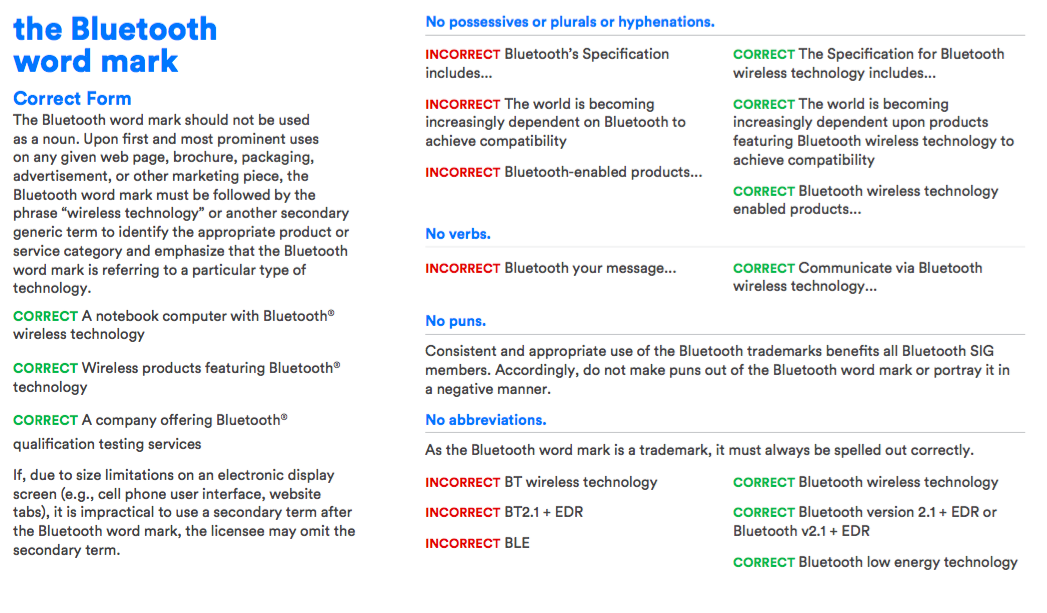
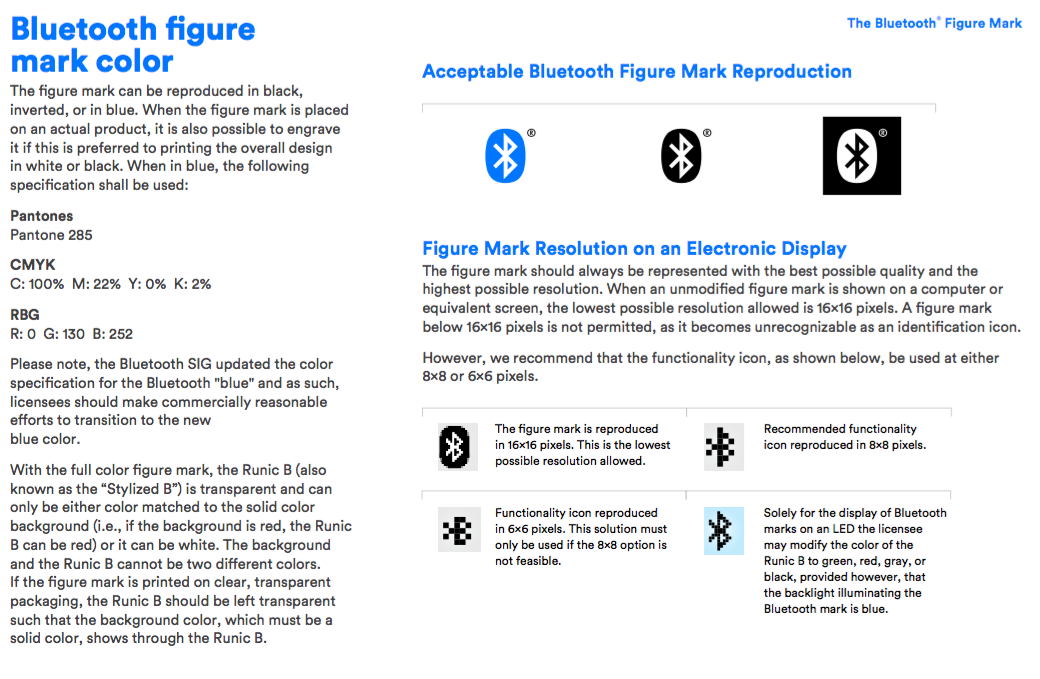
The Bluetooth Special Interest Group (SIG) owns and protects the Bluetooth brand. SIG provides following information that you need to know when using the Bluetooth trademarks.
  1. User must be a member of the Bluetooth SIG
  2. User’s product must be fully qualified and list in order to use the brand
  3. Below pictures are an easy-to-follow guide available that must be followed when applying the trademarks to packaging, products, websites, and other marketing materials:
  4. The Bluetooth SIG does enforce the brand guidelines

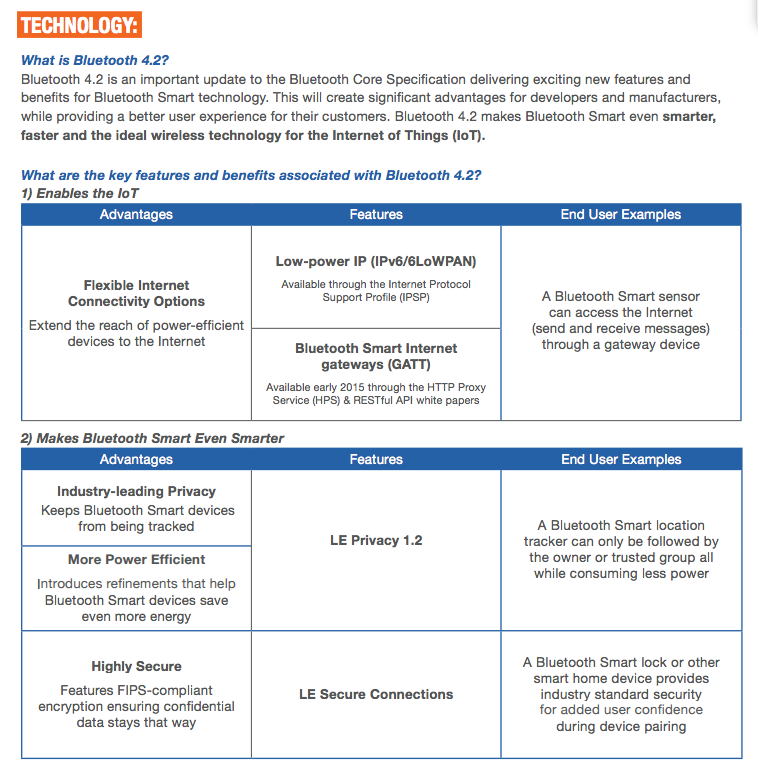
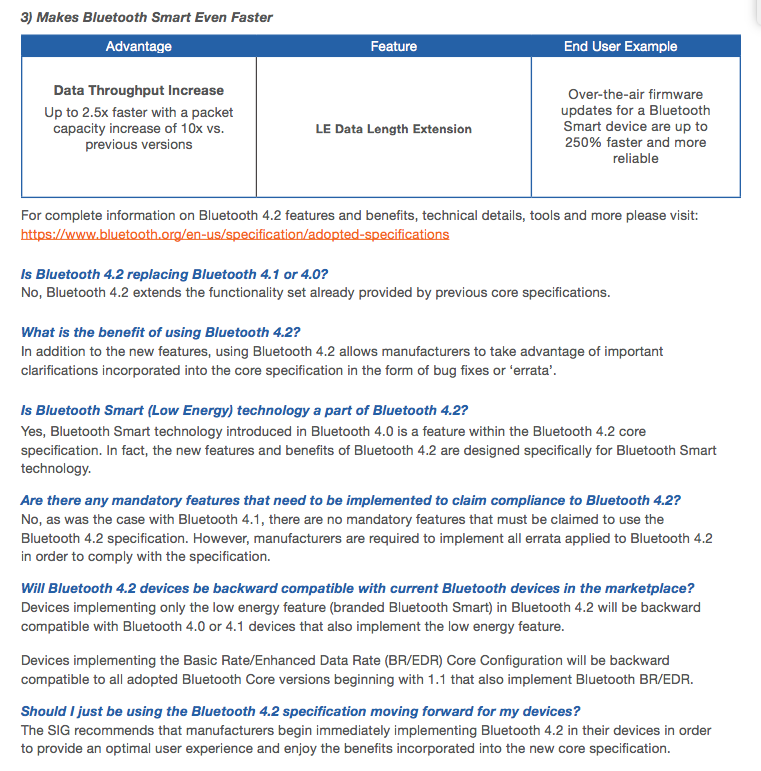
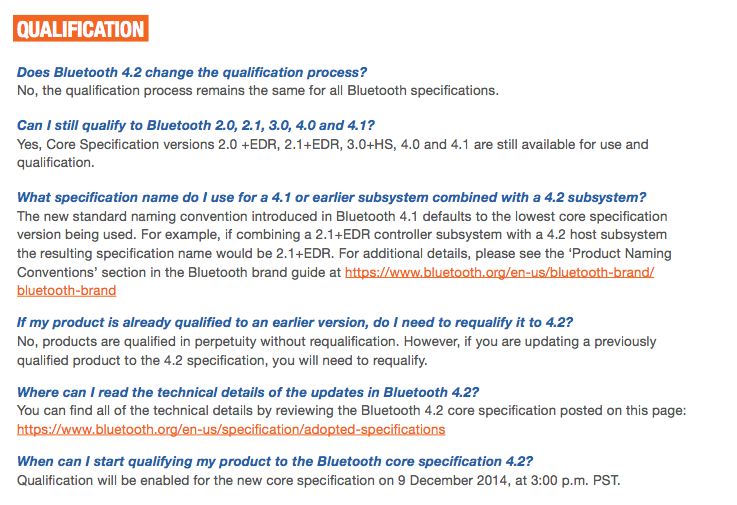
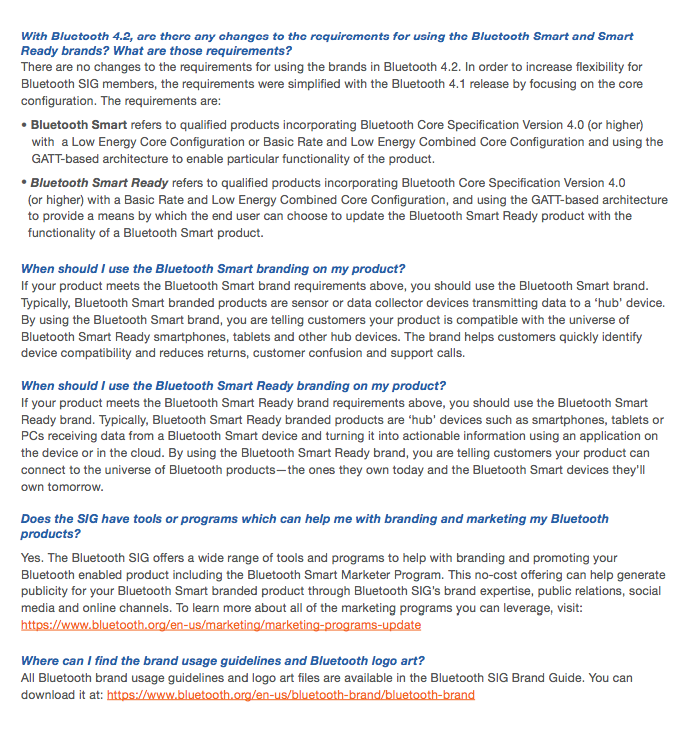
Bluetooth 4.2 (BT4.2) Frequently Asked Question

Raytac Corporation
A BT4.1 & BT4.2 module maker based on Nordic nRF51 & nRF52 solution 
(nRF51822 & nRF51422 & nRF52832 & nRF51802)
Tel: +886.2.3234.0208
With recent coming up solution and updated Bluetooth technology, customers recently pay attention about Bluetooth 4.2 (BT4.2)
Raytac has received many query about the difference between BT4.1 and BT4.2.
Here, SIG has provide a comprehensive introduction to clarify all issues related in BT4.2.
To service readers have a quick and easy review, we quoted from SIG and provided for easy reading.

Development

Bluetooth Power Classes VS Working Range

Raytac Corporation
A BT4.1 & BT4.2 module maker based on Nordic nRF51 & nRF52 solution 
(nRF51822 & nRF51422 & nRF52832 & nRF51802)
Tel: +886.2.3234.0208
There is a frequent question comes up from people!
What is the Bluetooth Power Classes? What is Class 1 and what is Class 2?
What the relationship Power Classes related to working range?
Here, there is a simple chart can help everyone to have an easy understanding!
Information quoted form Bluetooth Organization (SIG)
Now, it is obviously to know why Raytac’s module is superior!

Raytac Module Family MDBT40 VS MDBT42 (Nordic nRF51 VS nRF52)

Raytac Corporation
A BT4.1 & BT4.2 module maker based on Nordic nRF51 & nRF52 solution 
(nRF51822 & nRF51422 & nRF52832 & nRF51802)
Tel: +886.2.3234.0208
Here, we are glad to announce 2016 Raytac Module Family have been all well planned.
nRF51 series, MDBT40 modules all have been released and have widely implements done in the market.
nRF52 series, MDBT42Q modules will proceed mass production in April 2016 and MDBT42 is expected to be available by Q3 2016

Sorting by Solution:

Nordic nRF51
MDBT40 (Available Now)
MDBT40-P (Available Now)
MDBT40nano (Available Now)
Nordic nRF52
MDBT42Q (Mass Production Schedule in 2016 April)
MDBT42Q-P (Mass Production Schedule in 2016 April)

MDBT42 (Expected Mass Production in 2016 Q3)
MDBT42-P (Expected Mass Production in 2016 Q3)

Sorting by Antenna

Chip Antenna:
MDBT40 (nRF51): Available Now
MDBT42Q (nRF52): Mass Production Schedule in 2016 April
MDBT42 (nRF52): Expected Mass Production in 2016 Q3
PCB Antenna
MDBT40-P (nRF51): Available Now
MDBT42Q-P (nRF52): : Mass Production Schedule in 2016 April
MDBT42-P (nRF52): Expected Mass Production in 2016 Q3

Nordic nRF52832 Module (MDBT42Q-512K) By Raytac Corporation

Raytac Corporation
A BT4.1 & BT4.2 module maker based on Nordic nRF51 & nRF52 solution 
(nRF51822 & nRF51422 & nRF52832 & nRF51802)
Tel: +886.2.3234.0208
Raytac announced Nordic nRF52832 Module is planning in mass production.
Customer who is interested in nRF52 module may contact with service@raytac.com to request the Specification Sheet for hardware design purpose!
fullsizerender-14