Based on Nordic Semiconductor’s latest nRF54L15 SoC, this board offers a cutting-edge platform for developing Bluetooth® Low Energy and other 802.15.4 protocol-related applications. The features include:
– Module Demo Board built by AN54LQ-15 module – Built-in debug interface for streamlined development and testing – Compatibility with Zephyr’s device tree and board configuration system – Antenna variants: Ceramic Chip / PCB Trace / u.FL Connector – Nordic nRF54L15 Solution – A recommended 3rd-party module by Nordic Semiconductor. – Intended for BT specification BT6, including Channel Sounding features – Pre-certified with FCC, IC, CE, Telec (MIC), KC, SRRC, NCC, RCM, WPC – Intended for EU new Cyber Security Standard: EN 18031 – RoHS & Reach Compliant. – 128 MHz ARM® Cortex™-M33 processor with TrustZone® technology – 128 MHz RISC-V co-processor with TrustZone® technology – 1.5MB Flash Memory / 256KB RAM – 31 GPIO – Interfaces: QSPI(Software), SPI, UART, I2C, I2S, PDM, PWM, ADC, and NFC – Highly flexible multiprotocol, ideally suited for Bluetooth® Low Energy, ANT+, Zigbee, Thread (802.15.4), and Matter ultra low-power wireless applications.
By being integrated into the Zephyr ecosystem, developers gain direct access to well-maintained upstream code, continuous integration support, and community-driven updates. Whether you’re building IoT sensors, connected medical devices, or industrial automation systems, using the AN54LQ-DB-15 with Zephyr ensures a modern, scalable, and open-source-ready development experience.
Start building faster—with less setup and more confidence—thanks to this powerful combination of Raytac hardware and the Zephyr real-time operating system!
Our other Demo boards that are also listed on Zephyr: MDBT50Q-DB-33 (nRF52833 module Demo Board) MDBT50Q-DB-40 (nRF52840 module Demo Board) MDBT53-DB-40 (nRF5340 module Demo Board) MDBT53V-DB-40 (nRF5340 module Demo Board)
Edited by Business Development Manager: Mr. Tony Yin
Raytac Corporation 勁達國際電子股份有限公司 / Raytac Corporation (USA) A Bluetooth, Wi-Fi, and LoRa Module Maker/ODM & OEM Manufacturer based on Nordic nRF54; nRF53: nRF52; nRF51; nRF7002 Semtech Specification: SX1262
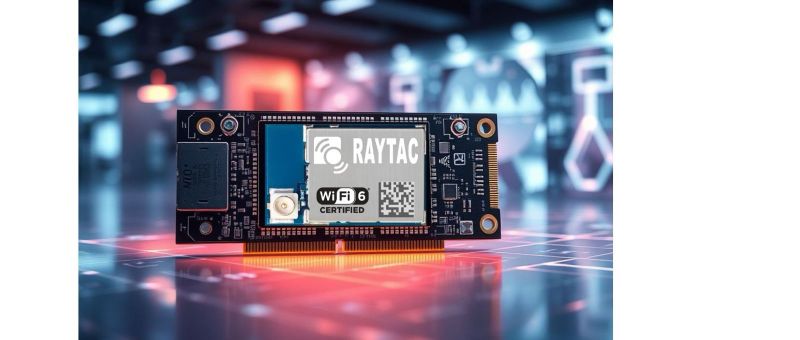
[2025.02.19] Raytac Corporation is proud to announce that our application for Wi-Fi Alliance (WFA) certification on the AN7002Q series(based on Nordic’s nRF7002 IC) has been successfully approved. This achievement reinforces our commitment to providing high-quality, reliable, and standard-compliant wireless solutions. By leveraging this certification, our modules ensure seamless interoperability, enhanced security, and superior performance for a wide range of IoT applications.
Advantages of Using Raytac Modules with WFA Certification:
Reliable and Secure Connectivity – Ensures seamless communication with other Wi-Fi-certified devices while meeting industry-leading security standards for stable and secure data transmission. Faster Time-to-Market – Pre-certified modules simplify compliance processes, reducing development time. Global Market Access – Certification helps meet regulatory requirements in multiple regions, expanding business opportunities. Significant Cost-Saving – Compared to the chip-on-board approach, using Raytac’s Wi-Fi module allows direct access to the Derivative programs(please click here for more descriptions), leveraging Raytac’s CID to minimize certification costs and save time-to-market.
To learn more about Wi-Fi certifications and Wi-Fi + BLE applications, feel free to contact us anytime at sales@raytac.com.
Edited by Account Manager: Ms. Mandy Chao
Raytac Corporation 勁達國際電子股份有限公司 A Bluetooth, Wi-Fi, and LoRa Module Maker based on Nordic nRF54; nRF53: nRF52; nRF51; nRF7002 Semtech Specification: SX1262
Uncertainties in Bluetooth Application Development Bluetooth’s growing popularity comes with challenges during development. Common issues include hardware instability, software incompatibilities, and environmental interference. Accurate issue identification and resolution are keys to successful development.
Common Uncertainties Unstable Connections: Disruptions from wireless signals or physical obstacles. Pairing Failures: Devices unable to establish connections. Data Errors: Packet loss or corruption during transmission. Compatibility Problems: Protocol version mismatches affecting interoperability.
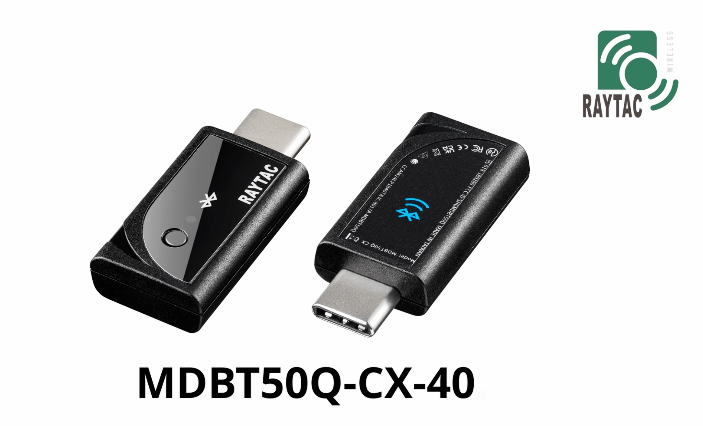
Efficient Bluetooth Issue Analysis Challenges like transmission speed limitations, data loss, connection failures, or protocol violations can arise. As Bluetooth signals travel wirelessly, precise analysis requires specialized tools. Nordic offers firmware integrated with Wireshark, flashable onto the Raytac MDBT50Q-CX-40 Dongle, enabling engineers to capture and analyze Bluetooth broadcast signals via USB. This setup streamlines issue identification and resolution. Below’s how to configure the Dongle for Wireshark reception.
Step 3: Press and hold the button on MDBT50Q-CX-40 and plug it into a PC USB port. Bootloader mode will be activated after the LED light is turned on. Then flash the firmware using nRF Programmer.
Step 4: Open the nRF Programmer and follow the below steps: Select the Device:
The device will appear as the name shown in below:
Add Firmware File:
Load sniffer_nrf52840dongle_nrf52840_4.1.1.hex into the Programmer:
Press “Write" to flash the firmware. After flashing, press “Select Device" again. If the Device name appears as nRF Sniffer for Bluetooth, the flashing is successful.
Set Up Wireshark Software Environment Step 1: Download & install nRF-Util: https://www.nordicsemi.com/Products/Development-tools/nRF-Util Step 2: Open MS-DOS and use the command nrfutil list to check if the ble-sniffer item is available. If not, install it using nrfutil install ble-sniffer.
Step 3: Download and Install Wireshark: https://www.wireshark.org/download.html. Step 4: Open Wireshark and navigate to: Help → About Wireshark → Folders. Step 5: Locate the string under Personal Extcap Path for the extcap directory, which will be an empty folder.
Step 6: Copy the files from nrf_sniffer_for_bluetooth_le_4.1.1\extcap (downloaded earlier) into Wireshark\extcap directory.
Step 7: After reopening, you should see an interface with a configurable icon next to the dongle.
Step 8: Edit → Configuration Profiles → Import → From Directory → Navigate to the directory nrf_sniffer_for_bluetooth_le_4.1.1\Profile_nRF_Sniffer_Bluetooth_LE and click “Select Folder".
Step 9: The profile will be imported. Click OK to confirm.
After all the above is done, the setup shall be completed.
Capturing and analyzing Bluetooth packets After launching the program, you can see the following devices and Dongle settings. Double-click to start the packet capture process:
If you want to capture packets with PHY=125K, you can use the following settings:
Packet Analysis Method In Wireshark, select the device from the “Device" menu to capture and analyze broadcast packets.
User Cases – What sniffer can offer 1. Disconnection when transmitting over 20 bytes between Tablet and Raytac’s AT-Command Module: Through sniffer analysis, it was discovered that Raytac’s module requested a packet length of 251 bytes, but the tablet’s TX setting was limited to 27 bytes.
2. Broadcast Device Name containing invisible characters: The device could connect using a mobile app but failed to connect using Central’s code. From the sniffer interface shown below, the device name length is 11, but the Length field shows 13. The actual data length (Type length + Device Name) = 1 + 11 = 12, indicating an issue with the program’s broadcast name length.
3. Incorrect parameter settings causing issues with throughput or packet reception: Improper settings can lead to reduced throughput, incorrect data reception, or disconnections. The diagram below shows a correct setup with high-volume data transmission. The Protocol Length is 251, and the data transmission intervals are consistent, achieving optimal throughput.
Summary Mastering hardware and software setups and effectively using packet analysis tools can boost development efficiency and enable high-performance Bluetooth applications.
B. Comparison among nRF54L15/ nRF5340/ nRF52840/ nRF52832 SoC modules
If you are familiar with Nordic nRF52, nRF53 module series, you will have better idea to tell the difference heading to NRF54L series by referring to the chart as below. (Click on the picture to zoom in)
C. Get started with nRF54L15 development (NCS 2.8.0)
Preparation of Hardware: 1. 1x Nordic NRF54L15 DK (PCA10156-0.9.1) (Note: If you have PDK (PCA10156-0.8.1) on hand, it can be done in trial phase) 2. 1x Raytac AN54LQ-DB-15 3. 1x IDC Ribbon wire 4. 2x USB-C connector wires (for powering the kit up)
Note: Using Nordic nRF54L15DK / nRF54L15PDK as debugging tool and Raytac Demo board-AN54LQ-DB-15 as simulated carrier board(main board) to proceed the program of nRF54L15 for code compiling and development.
Tips: Please align the red edge of Ribbon at side of 1 in connector J1.
Step 1 —- Connected NRF54L15 DK and AN54LQ-DB-15 by IDC Ribbon wire Step 2 —- Powering on both NRF54L15 DK and AN54LQ-DB-15 by USB-C connector
<< Schematic of AN54LQ-DB-15(Updated on 21-Jan-2025) >>(Click on the picture to zoom in)
Preparation 1. Prepared with the latest version of nRF Connect for Desktop and Select version Windows 64-bit – 5.1.0 2. Prepared with the latest version of nRF Command Line Tools and Select version Windows x86 64-10.24.2 **Note: SEGGER J-LINK Upgrade message might pop up while you’re doing above download.
3. Locate all the necessary kits for programming in PC (Check Software/Application list)
Get started with building your program
Intro: The development tool of nRF Connect SDK(NCS) equipped with free VS (Visual Studio) Code IDE for firmware compile and programming. Note: it is highly recommended to apply NCS 2.8.0 for advanced features of nRF54L15.
Step 1 —- Activate your “nRF Connect for Desktop” >> “Toolchain Manager” >> “Open” >> “Install”
Step 2 —- You will find multiple options of NCS V x.x.x in the tool, we’re using NCS v2.8.0 as example to run sample code of nRF54L15.
Step 3 —- Make sure the NCS v2.8.0 is installed at same directory with compiling system. (the root of Open VS Code) (This is using C:\ncs as example.)
In case to organize the files, do “Select directory’” and “Confirm”.
Step 4 —- After nRF Connect SDK v2.8.0 Download ready , go “Open VS Code”.
Step 5 —- Go “Open Existing Application” , and activate example code: Bluetooth > peripheral_uart
Step 6 —- Moving to program build & compiling by selecting dev kit: nrf54l15dk/nrf54l15/cpuapp
Step 7 —- You will get a .hex file after the above programming compiling process.
Step 8 —- Functions are available for during the code compiling process under “ACTIONS” in VS Code IDE << Build >>
<< Debug >>
<< Flash >>
Firmware Programming It is feasible to do the firmware programming using nRFConnect SDK (NCS) tool. Developer may use “Programmer” to do the firmware flashing with the candidate .hex file.
Step 1 —- Execute nRF Connect for Desktop >> Programmer >> Open
“Select Device”
Select ”nRF54L15 DK”
“Add File”
Step 2 —- Select the candidate .hex file
Select “Erase & Write”
It indicates the programming process is on the way↓
The firmware programming process is done after seeing “Completed” in system Log field.
Step 3 —- Use the mobile App to make sure the Bluetooth broadcasting is functioning after the firmware flashing process is successfully done to the module.
D. Channel Sounding Preview
What is Channel Sounding? —- Advance the “Find My” feature into next level accuracy Have you ever concerned about the distance accuracy when you’re using RSSI to get the distance between devices and to evaluate the transmission distance with legacy Bluetooth module? Nordic NRF54 solution has taken us into next level with Channel Sounding feature that achieves the “centimeter-level” distance accuracy. Early implement achieves 10-20cm in the record.
Credit: Bluetooth Alliance
How does Bluetooth Channel Sounding work? Bluetooth Channel Sounding implemented with Phased-Based Ranging (PBR) & Round-trip time (RTT)(the concept idea of TOF time of flight) algorithm to achieve a higher precision of measuring distance between 2 devices.
Phased-Based Ranging (PBR): Signal has been sent between initiator and reflector with multiple frequency to increase measuring accuracy.
Credit: Bluetooth Alliance
Round-trip time (RTT): It’s the concept of utilizing TOA (Time of arrival). Using TOD(Time of departure) & TOA to measure the timing during the packet transmission between devices.
Credit: Bluetooth Alliance
Potential applications: Personal item finding Secure access control Smart lock system Digital Key Asset Tracking
Step 1. Execute the combine batch file in bootloader (nrf52832_bootloader_setting_merge.bat) and generate file ofnrf52832_bootloader_secure_combin_settings.hex :
@echo off title = [ J-Link Tool ] %CD% set nrfDir=C:\Program Files (x86)\Nordic Semiconductor\nrf5x\bin set BS= nrf52832_bootloader_secure_settings.hex set BL= nrf52832_xxaa_s132.hex set BSBLCombind= nrf52832_bootloader_secure_combin_settings.hex set path=%nrfDir%;%path% pause echo ———–merge image file——————- mergehex.exe -m %BS% %BL% -o %BSBLCombind% pause
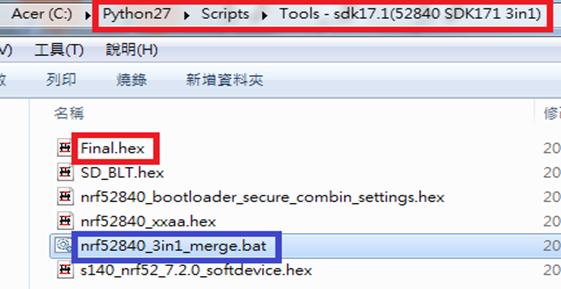
Step 2. Create a Final.hex file by 3-in-1 batch file(nrf52832_3in1_merge.bat) ※Note : This hex file is created for the production line to pre-load firmware into modules prior to shipment.
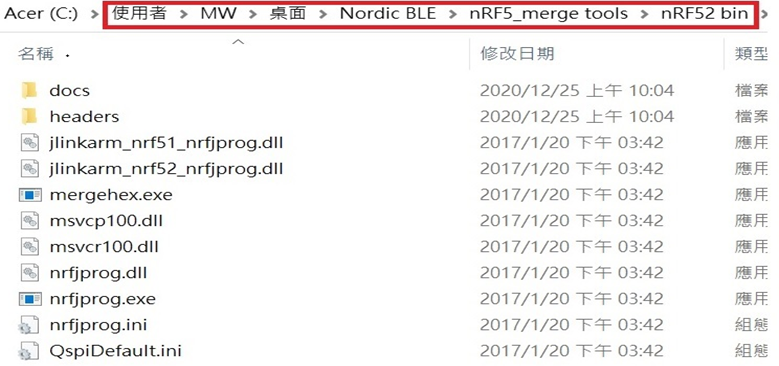
@echo off title = [ J-Link Tool ] %CD% set nrfDir=C:UsersuserDesktopNordic BLEnRF5_merge toolsnRF52 bin set SD= s140_nrf52_7.2.0_softdevice.hex set BLT= nrf52832_bootloader_secure_combin_settings.hex set APP= nrf52832_xxaa.hex set SD_BLT=SD_BLT.hex set Finalfile=Final.hex set path=%nrfDir%;%path% pause echo ———–merge image file——————- mergehex.exe -m %SD% %BLT% -o %SD_BLT% pause mergehex.exe -m %SD_BLT% %APP% -o %Finalfile% pause
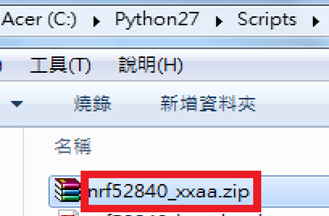
Step 3. Create a DFU(OTA).zip file of nrf52832_xxaa.zip ※Note : This zip file is created for end device DFU(OTA) implementation.
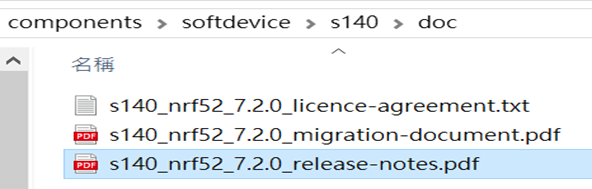
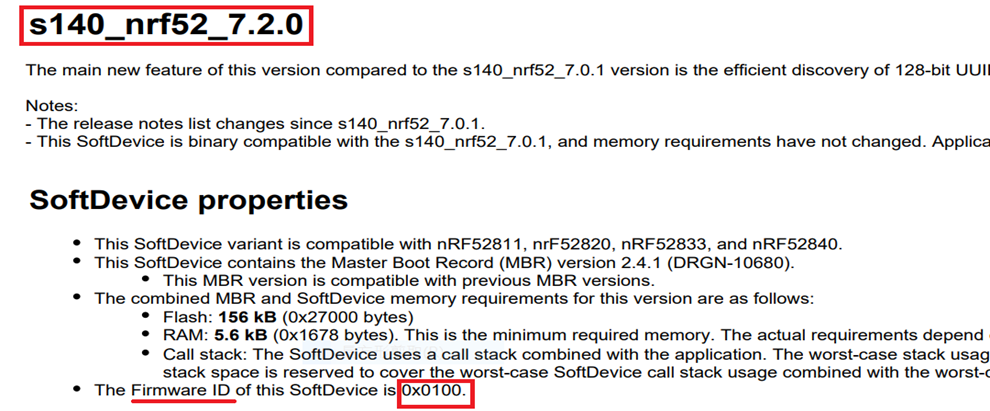
※Note : The “0xCB" appeared in the above DOS code(in red font) is the FWID(Firmware ID) for s140_nrf52_7.2.0_softdevice.hex; FWID can be found from the soft device documents on the Nordic website.
Step 4: Run DFU OTA (On mobile in this example)
4A. Install the nRF Connect APP on mobile, with DFU OTA file: nrf52832_xxaa.zip.(Download link)
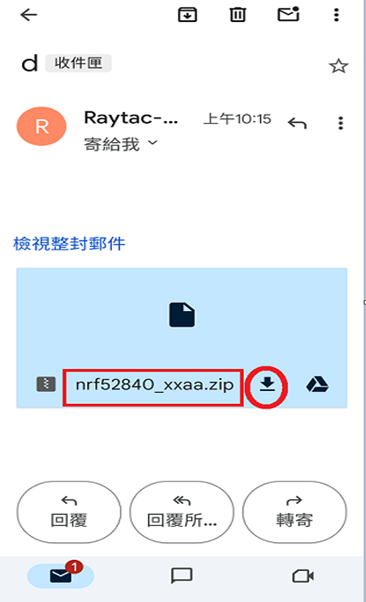
4B. Send nrf52832_xxaa.zip via email to mobile device after combination is done on PC, then download it.
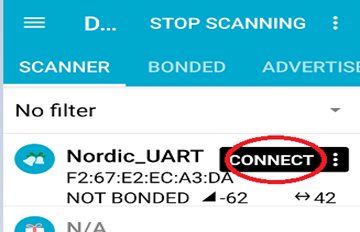
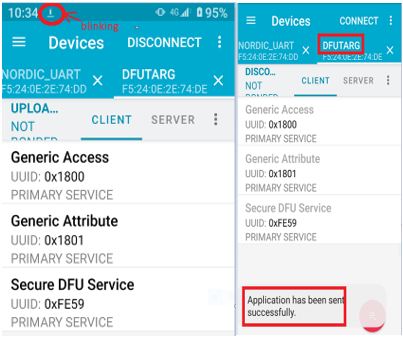
4C. Open nRF Connect APP and run connection;
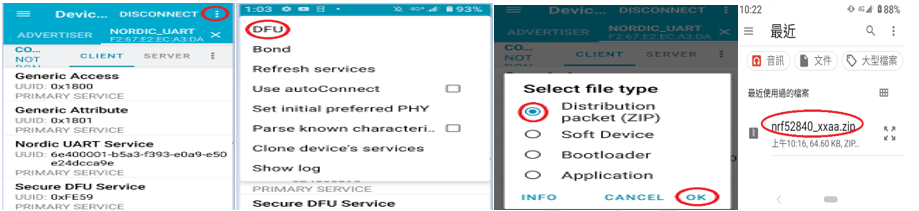
4D. Execute DFU and select “Distribution packet(ZIP)", thus starting the DFU OTA process.
4E. Start DFU OTA → exit the APP after DFU OTA is completed → restart the mobile device.
Secure DFU OTA for nRF52832 solution modules: Guide to create hex/zip file for implementation Detailed links of articles: Part 1: Bootloader & Application (Click for article link) Part 2: Combining & merging built files
Technical guidelines provided by R&D Manager: Mr. MW Lee Edited by Sales Manager: Ms. Mandy Chao
Raytac Corporation 勁達國際電子股份有限公司 Raytac Corporation: A Bluetooth, Wi-Fi, and LoRa Module Maker based on Nordic nRF54; nRF53: nRF52; nRF51; nRF7002 Semtech Specification: SX1262
Here are the guidelines for users to implement Secure DFU OTA(over-the-air) while using nRF52832 Solution modules. (Click on link for Raytac nRF52832 module series)
In this article, we will be focusing on Part 1: Bootloader & Application.
Bootloader
Path: ..\nRF5_SDK_16.0.0_98a08e2\examples\dfu\secure_bootloader\pca10040_s132_ble\arm5_no_packs Specifically for nRF52832, programmers need to embed ECC(Elliptic Curve Cryptography) into the bootloader.
Step 1. ’micro_ecc_lib_nrf52.lib’ library can be found in the path below, but we need to boot it up first.
Step 2. Unzip ’micro-ecc-master.zip’ to the below path(create a new “micro-ecc” file first).
Step 3. Run ’gcc-arm-none-eabi-7-2018-q2-update-win32.exe’.
Step 4. Make sure the Environment variables in Win10 are set as below.(Follow the steps 1 to 6)
Step 5. Open DOS → run the “make” command under armgcc path → generate’micro_ecc_lib_nrf52.lib’
Step 6. Add ’micro_ecc_lib_nrf52.lib’ into folder: nRF_micro-ecc
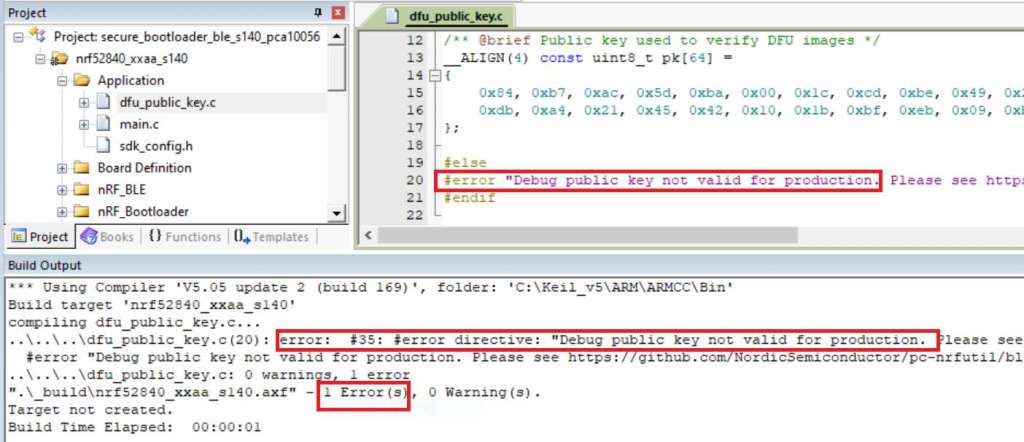
Step 7. An error may occur while building bootloader without a public key: (Shown in red frames in below screenshot)
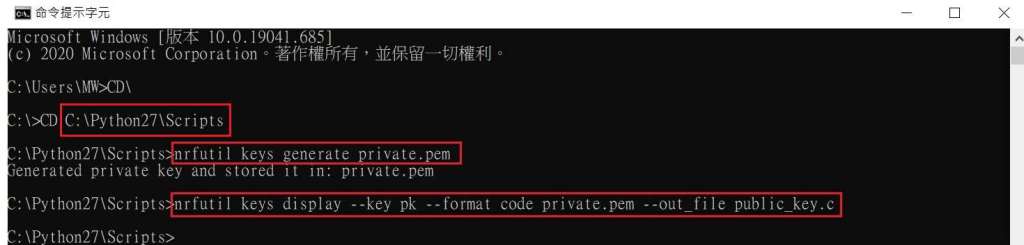
Step 8. How to generate the public key file in Bootloader? A. Visit DOS at path: ..\Python27\Scripts B. Then execute:
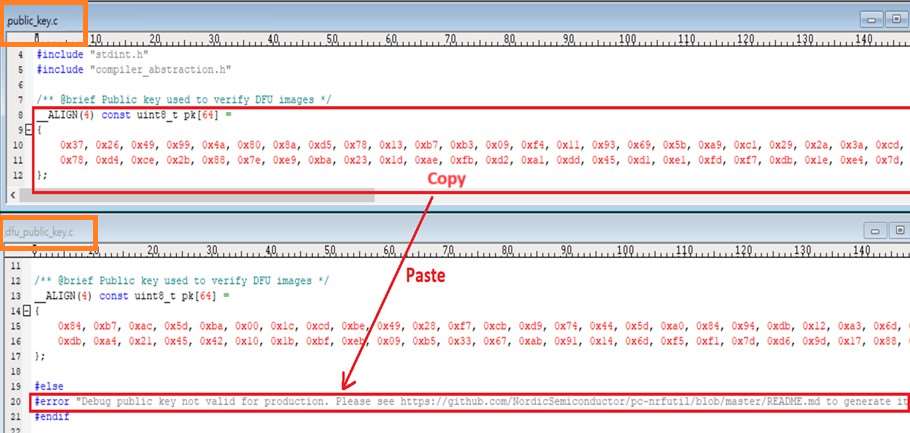
Step 9. Copy the pk[64] code from (public_key.c) into (dfu_public_key.c) (Shown in red frames in below screenshot)
※Note: Make sure to save the 3 generated files: private.pem public_key.c dfu_public_key.c
Step 10. Generate the bootloader file:nrf52832_xxaa_s132.hex after re-compiling the code files.
Application
Path: ..\nRF5_SDK_16.0.0_98a08e2\examples\ble_peripheral\ble_app_uart\pca10040\s132\arm5_no_packs Before building Application code , some amendments need to be made regarding DFU-related settings and code inside Application:
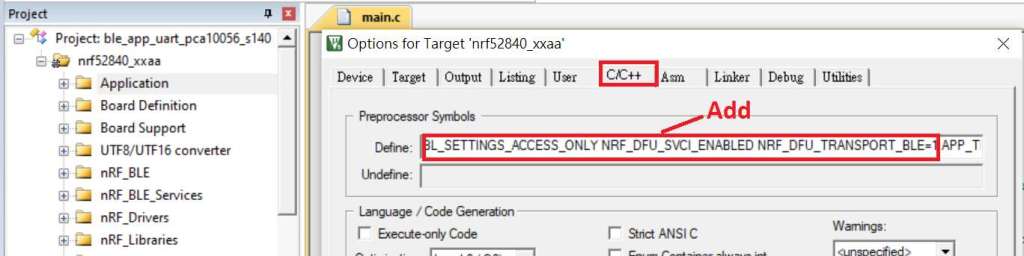
Step 1.Add code in definition in C/C++ : BL_SETTINGS_ACCESS_ONLY NRF_DFU_SVCI_ENABLED NRF_DFU_TRANSPORT_BLE=1 (Total 3 steps definitions need to be set up)
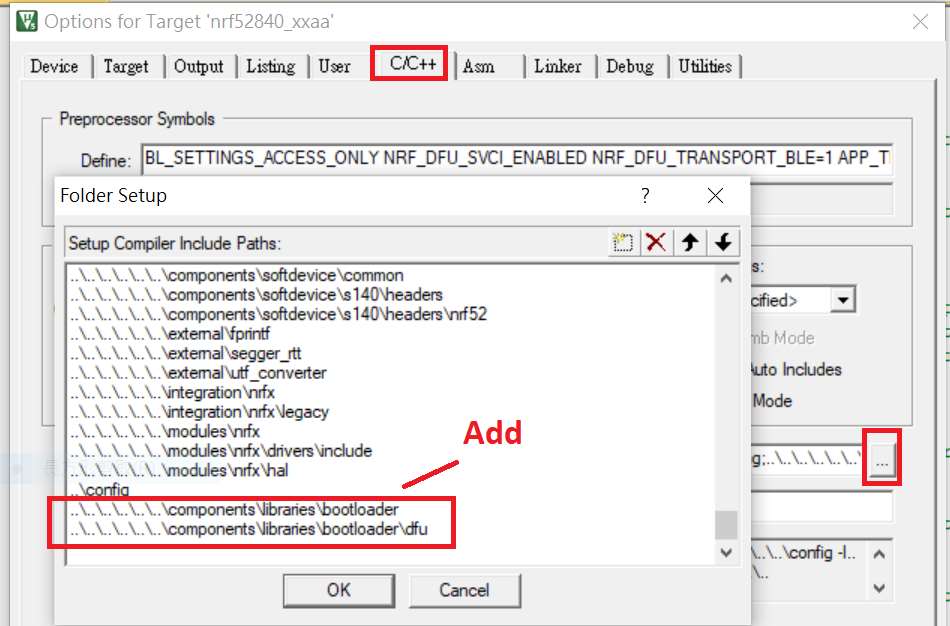
Step 2. Add the 3 paths shown below in C/C++ to make DFU work.
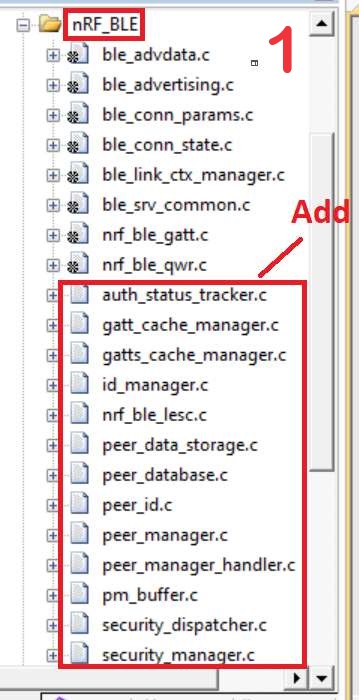
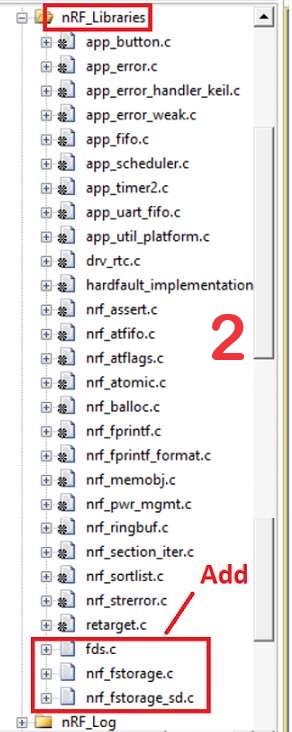
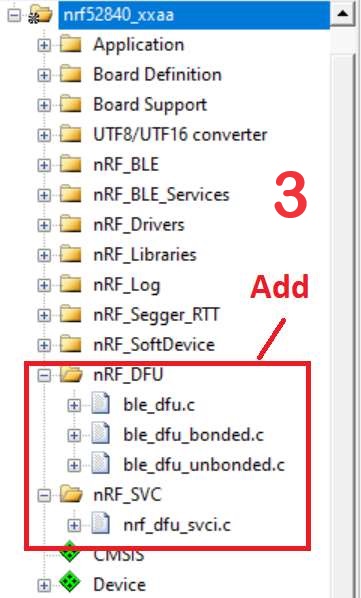
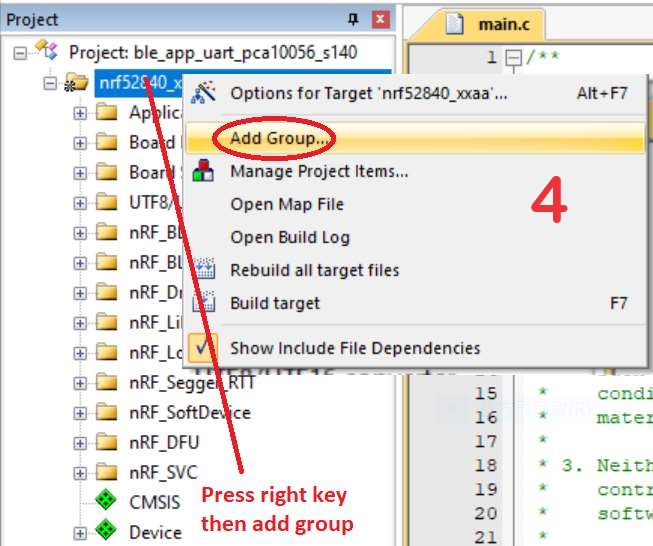
Step 3. Add the .c files inside red frame in (Screenshots 1 & 2) and add the 2 groups of (nRF_DFU & nRF_SVC)(Screenshot 4) under Project(Screenshot 3)
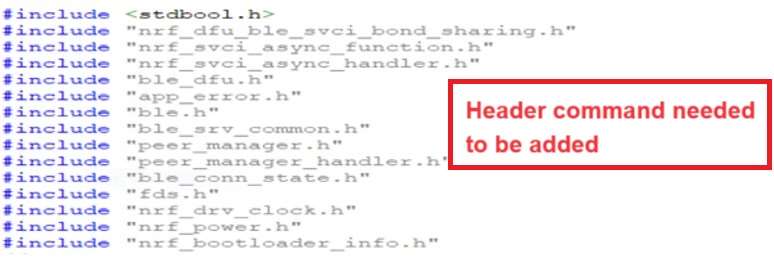
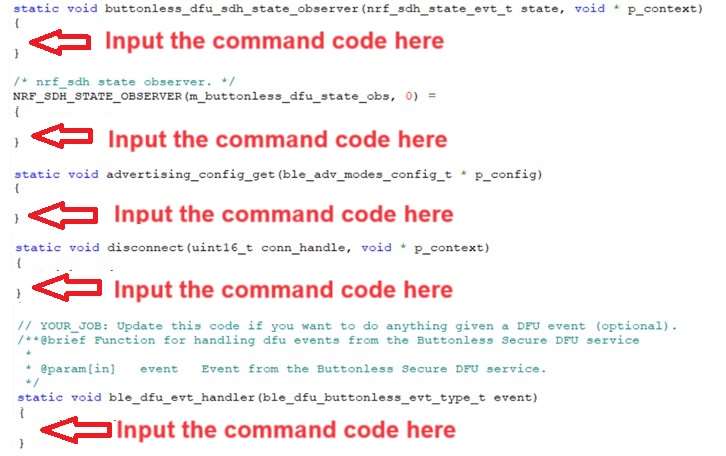
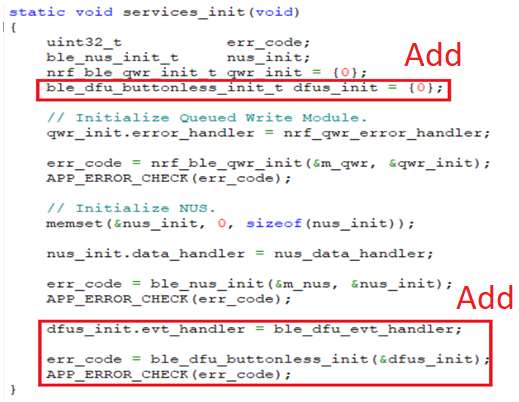
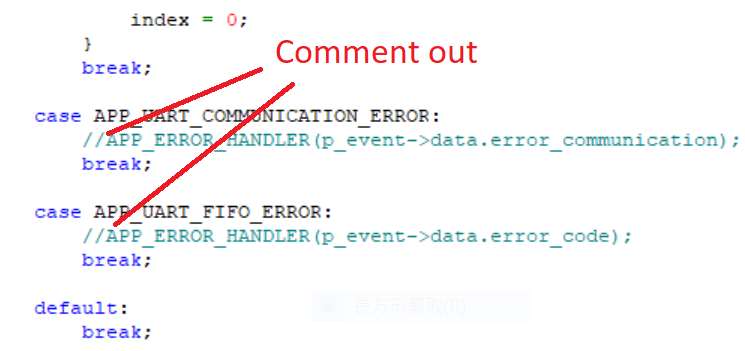
Step 4.Add code into main.c file in Application (..\examples\ble_peripheral\ble_app_uart\main.c) (Please refer to: main.c file at: ..\examples\ble_peripheral\ ble_app_buttonless_dfu)
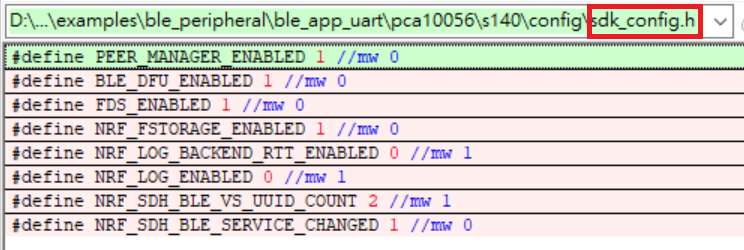
Step 5. The code of file: sdk_config.h (..\examples\ble_peripheral\ble_app_uart\pca10040\s132\config\sdk_config.h) inside Application needs to be modified.
Step 6. Adjust the IRAM1 value in Target after implementing DFU service: Make sure the IRAM1 Value of *p_app_ram_start is modified from default: 0x20002AD8 0xD528 to 0x20002AE8 0xD518, as shown in the red frame in the bottom right corner. In this case, the program should run/advertise successfully.
Step 7. Create a file of: nrf52832_xxaa.hex after building application code files.
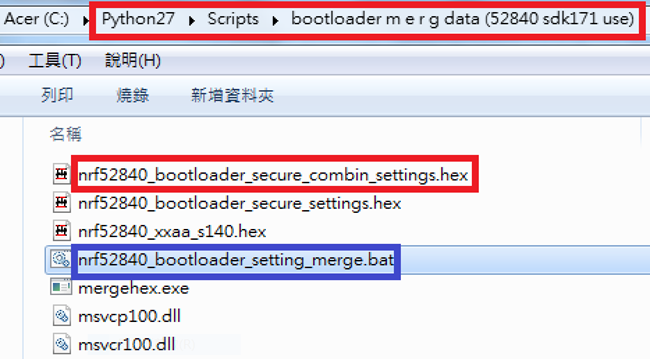
Step 1. Execute the combine batch file in bootloader (nrf52840_bootloader_setting_merge.bat) and generate file ofnrf52840_bootloader_secure_combin_settings.hex :
@echo off title = [ J-Link Tool ] %CD% set nrfDir=C:\Program Files (x86)\Nordic Semiconductor\nrf5x\bin set BS= nrf52840_bootloader_secure_settings.hex set BL= nrf52840_xxaa_s140.hex set BSBLCombind= nrf52840_bootloader_secure_combin_settings.hex set path=%nrfDir%;%path% pause echo ———–merge image file——————- mergehex.exe -m %BS% %BL% -o %BSBLCombind% pause
Step 2. Create a Final.hex file by 3-in-1 batch file(nrf52840_3in1_merge.bat) ※Note : This hex file is created for the production line to pre-load firmware into modules prior to shipment.
@echo off title = [ J-Link Tool ] %CD% set nrfDir=C:\Users\user\Desktop\Nordic BLE\nRF5_merge tools\nRF52 bin set SD= s140_nrf52_7.2.0_softdevice.hex set BLT= nrf52840_bootloader_secure_combin_settings.hex set APP= nrf52840_xxaa.hex set SD_BLT=SD_BLT.hex set Finalfile=Final.hex set path=%nrfDir%;%path% pause echo ———–merge image file——————- mergehex.exe -m %SD% %BLT% -o %SD_BLT% pause mergehex.exe -m %SD_BLT% %APP% -o %Finalfile% pause
Step 3. Create a DFU(OTA).zip file of nrf52840_xxaa.zip ※Note : This zip file is created for end device DFU(OTA) implementation.
※Note : The “0x100" appeared in the above DOS code(in red font) is the FWID(Firmware ID) for s140_nrf52_7.2.0_softdevice.hex; FWID can be found from the soft device documents on the Nordic website.
Step 4: Run DFU OTA (On mobile in this example)
4A. Install the nRF Connect APP on mobile, with DFU OTA file: nrf52840_xxaa.zip.(Download link)
4B. Send nrf52840_xxaa.zip via email to mobile device after combination is done on PC, then download it.
4C. Open nRF Connect APP and run connection;
4D. Execute DFU and select “Distribution packet(ZIP)", thus starting the DFU OTA process.
4E. Start DFU OTA → exit the APP after DFU OTA is completed → restart the mobile device.
Before building Application code , some amendments need to be made regarding DFU-related settings and code inside Application:
Step 1.
1A. Add code in definition in C/C++ : BL_SETTINGS_ACCESS_ONLY NRF_DFU_SVCI_ENABLED NRF_DFU_TRANSPORT_BLE=1 (Total 3 steps definitions need to be set up)
1B. Add “include path” in C/C++
1C. Add the .c files inside red frame in (Screenshots 1 & 2) and the 2 groups of (nRF_DFU & nRF_SVC)(Screenshot 3) under Project(Screenshot 4)
1D. Add code into main.c file in Application (..\examples\ble_peripheral\ble_app_uart\main.c) (Please refer to: main.c file at: ..\examples\ble_peripheral\ ble_app_buttonless_dfu)
1E. The code of file: sdk_config.h (..\examples\ble_peripheral\ble_app_uart\pca10056\s140\config\ sdk_config.h) inside Application needs to be modified.
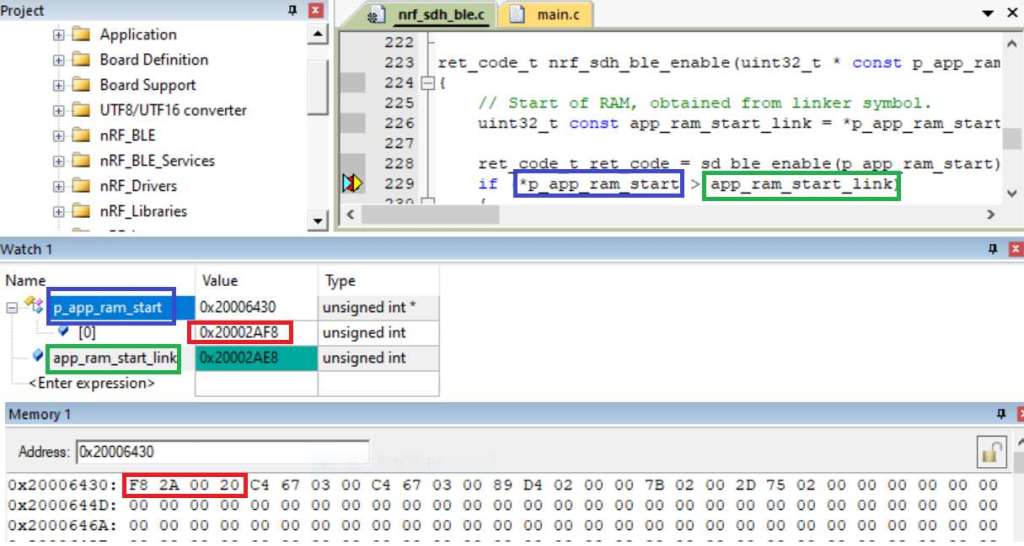
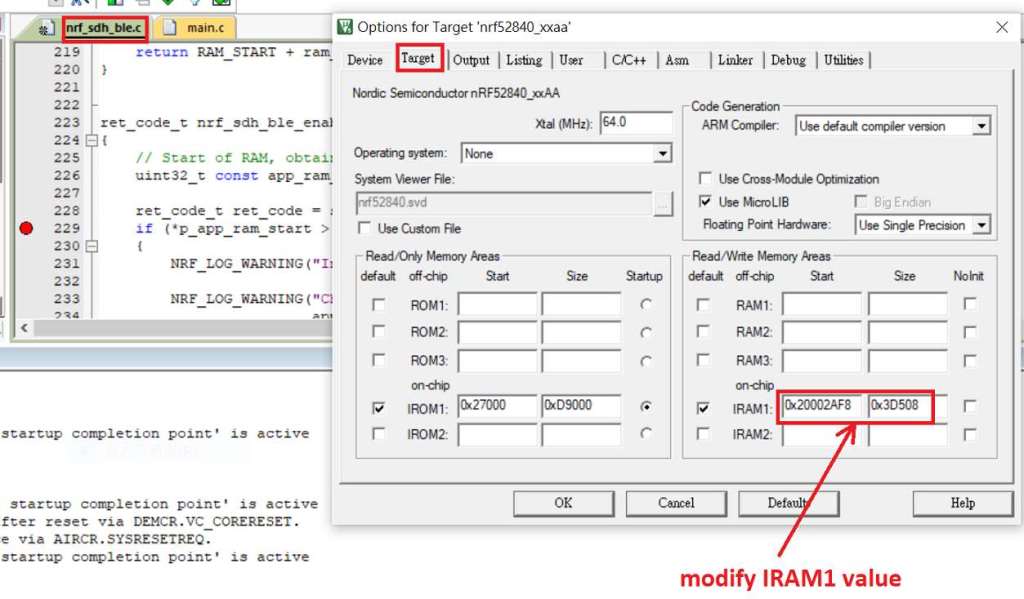
1F. Adjust the IRAM1 value in Target after implementing DFU service: Check on the IRAM1 Value of *p_app_ram_start to be modified from default: 0x20002AE8 0x3D518 to 0x20002AF8 0x3D508, as shown in the red frame in the bottom right corner. In this case, the program should run successfully.
1G: Create a file of:nrf52840_xxaa.hex after building application code files.
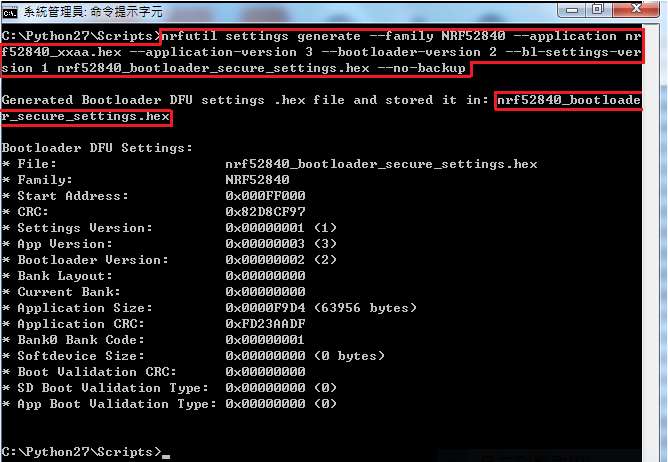
Step 2. Create a bootloader setting file of nrf52840_bootloader_secure_settings.hex :(via DOS)
Here are the guidelines for users to implement Secure DFU OTA(over-the-air) while compiling using nRF52840 Solution modules. (Click on link for Raytac nRF52840 module series)
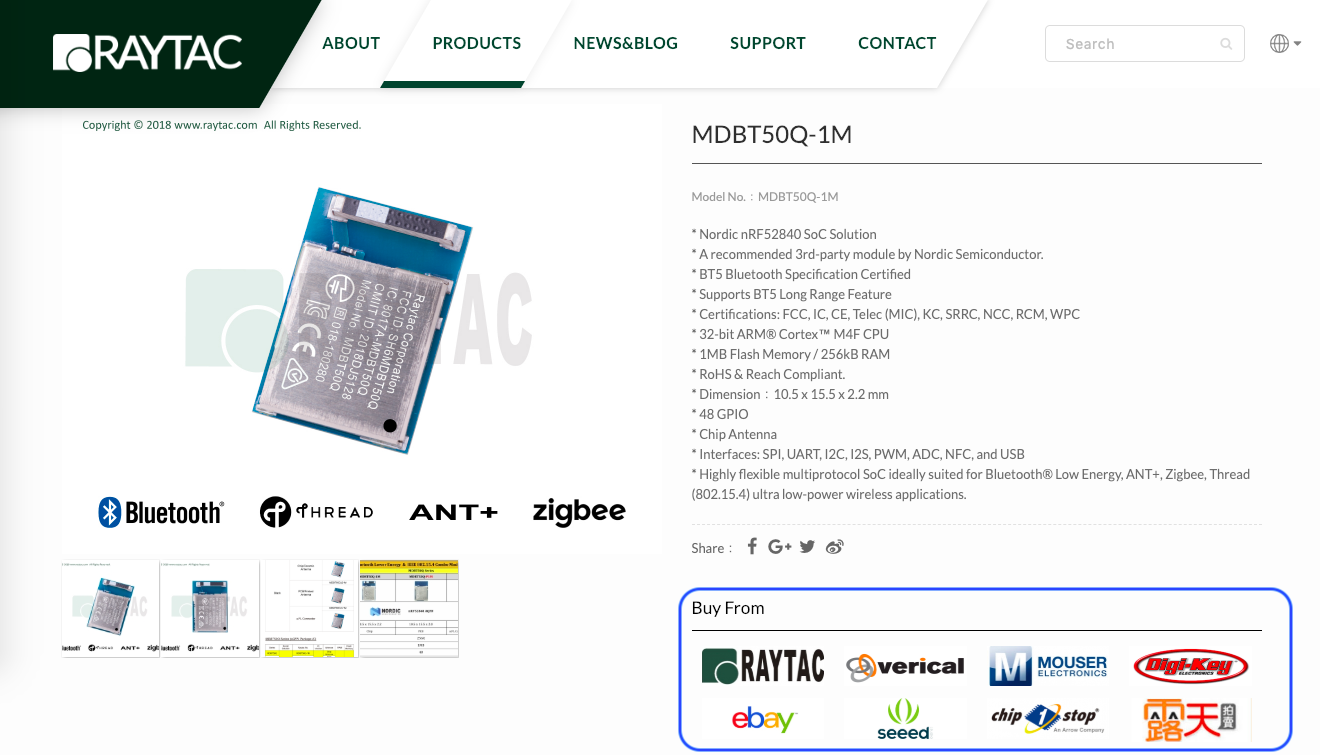
To enhance the accessibility to Raytac BLE module sample for evaluation and development, Raytac has put effort to corporate with several channels.
Differ channels may carry various items, we encourage developers firstly visiting Raytac official site. The easy link options listed in each product may help customers to select the friendly channel to approach.








 Raytac Corporation