Criteria for Choosing Internal or External Oscillator (Crystal)

Bluetooth modules typically have options for a 32MHz Internal Oscillator (or some called internal crystal oscillator) and a 32.768KHz External Oscillator. The choice between the two is often influenced by specific application requirements, power consumption, accuracy, and cost considerations. Here are some basic differences between Internal and External Oscillators:

  • Internal Oscillator: (32MHz)
  • Function: The internal oscillator is embedded within the module and generates the clock signal for the Bluetooth module. This internal oscillator is typically smaller, lightweight, and reduces dependence on external components.
  • Advantages: Simplifies design, saves space, and reduces costs.
  • Disadvantages: Some applications may require higher clock stability, which the internal oscillator may not provide to the desired level of precision.
  • External Oscillator: (32.768KHz)
  • Function: An external oscillator is an independent oscillator externally connected to the module, offering higher clock stability and accuracy.
  • Advantages: Provides higher clock stability, suitable for applications with stricter timing requirements.
  • Disadvantages: Requires additional components, may occupy more space, and increases costs.

Criteria for choosing Internal or External Oscillator:

  • If the application has modest clock precision requirements, and cost and space are critical factors, choosing the internal oscillator may be suitable.
  • If the application demands higher timing precision, an external oscillator should be considered for its enhanced clock stability.

Benefits from switching between external and internal oscillator:

  • Increased Performance Requirements: If the application’s performance requirements increase, a higher-precision oscillator, such as an external oscillator, may be needed.
  • Insufficient Clock Stability: If timing stability issues arise during Bluetooth communication, upgrading to an external oscillator can provide better clock stability.

Followings are the instructions we can use to switch between internal oscillator and external oscillator for nRF5 SDK (v17.10) and NCS SDK (v2.5.2).

Keil (Keil μVision) and SES (Segger Embedded Studio) are another method commonly used Integrated Development Environments (IDEs) in the field of embedded systems development.

Choosing to use the internal crystal oscillator requires program modifications. Please refer to the following instructions for making these changes in the Keil and SES development environments.


Keil

SES


Edited by Sales Manager: Ms. Mandy Chao

Raytac Corporation 勁達國際電子股份有限公司
Bluetooth & WiFi module maker based on Nordic nRF54, nRF53, nRF52, nRF7002 solution
BT5.4 &BT5.3 & BT5.2 & BT5.1 Qualified, FCC/IC/CE/Telec/KC/RCM/SRRC/NCC Pre-Certified. Bluetooth Solution: nRF54, nRF5340, nRF52840, nRF52833, nRF52832, nRF52820, nRF52811, nRF52810, nRF52805, nRF51822 WiFi Solution: nRF7002
www.raytac.com
email:service@raytac.com
Tel: +886.2.3234.0208

Bluetooth Project: How to get your firmware development started!

Setting up Nordic’s IDE (Integrated Development Environment) is the first step into Bluetooth product development, and it’s also where most developers need support.

In order for developers to be able to smoothly set up their IDE, Raytac hereby provide you with a few easy steps.

First and foremost – In terms of IDEs, there are currently four different ones that are all viable; Segger Embedded Studio (SES), Keil C, IAR and GCC. Among these, SES and GCC are IDEs free of charge while Keil C and IAR both require the developer to pay a license fee to their respective company.

We at Raytac generally recommend SES, as it is an IDE brought forth by both Nordic and Segger together and it uses Segger J-Link. Although GCC is a free IDE, it only builds code and is impractical editting make file or debugging firmware. Thus, it’s not our primary choice.

Therefore, we will hereby provide you a step-by-step guide on how to set up your IDE when using SES.

  1. Where to download SES?

https://www.segger.com/downloads/embedded-studio/

圖片 1.png

  1. Where to Nordic SDK ( Use SDK v15.0.0 as an example)

https://developer.nordicsemi.com/nRF5_SDK/nRF5_SDK_v15.x.x/

  1. Install SES V3.34 and unzip SDK v15.0.0
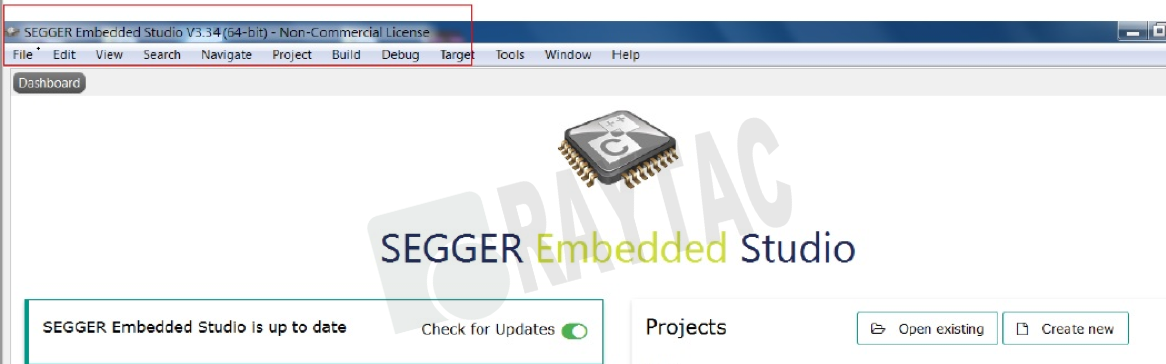
After SES installed, you may find “Non-Commercial License" 

圖片 4.png

  1. SES License Key? http://license.segger.com/Nordic.cgi
  2. How to get free License Key?

Key in Name, Company name, Address and PC’s MAC address. Then press “Request License", the “License key" will send to your mail box automatically.

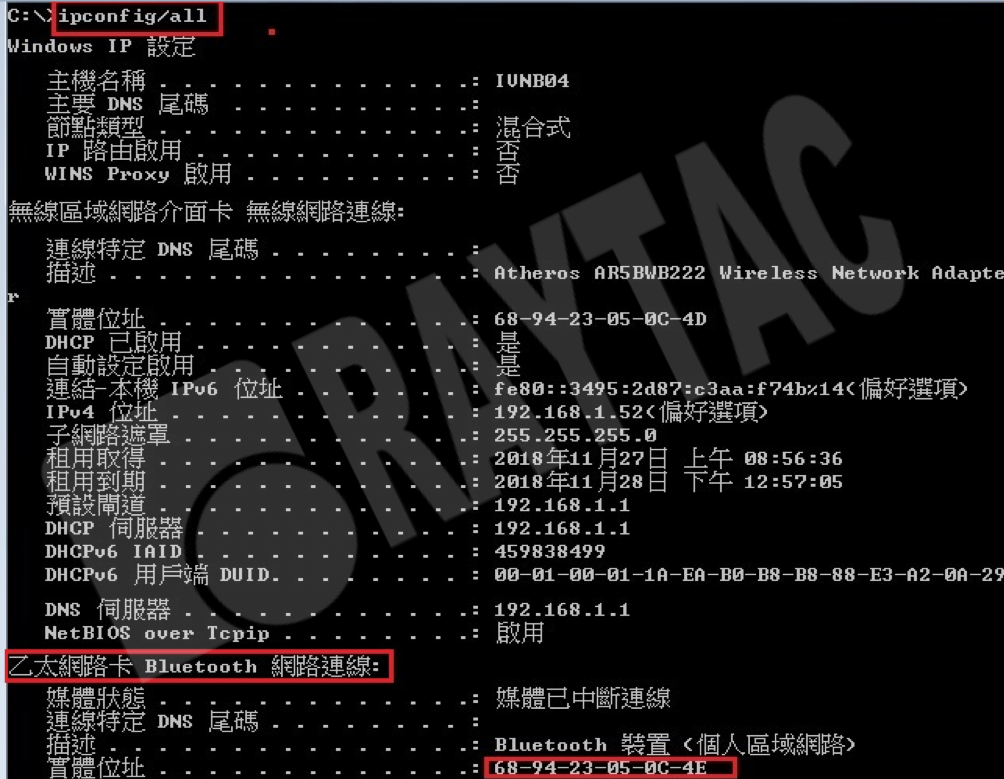
Tips: How look up PC’s Mac address: Pls enter DOS mode, 

Key in ipconfig/all,

The Mac address will be found in Ethernet card.

圖片 7.png

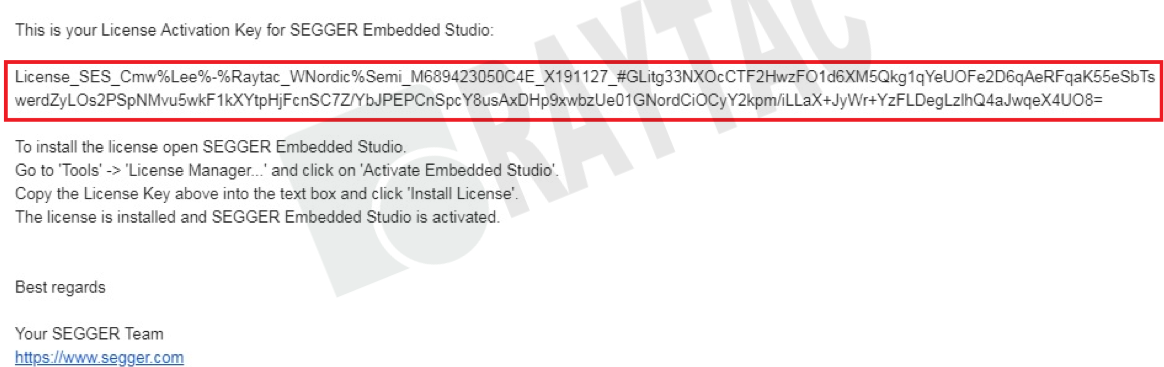
  1. Copy the license key from mail

圖片 8

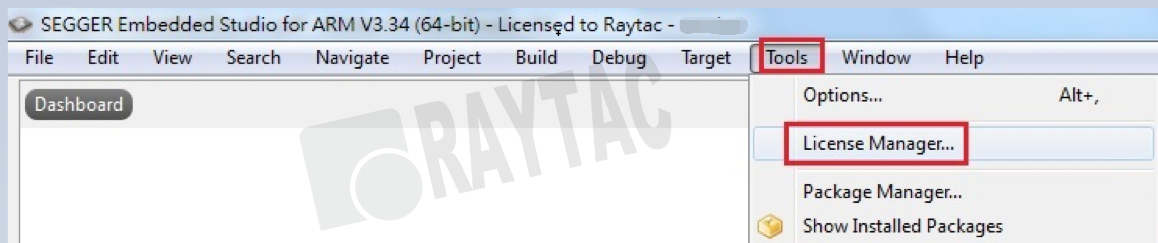
  1. Execute SES and find out the “License Manager" in “Tools" option

圖片 9

  1. Select “Activate Embedded Studio", Paste the “License Key", Click “Install License"

圖片 10.png

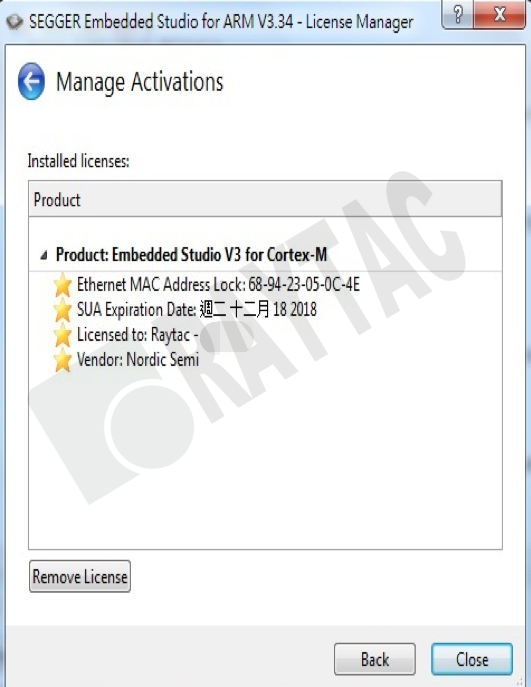
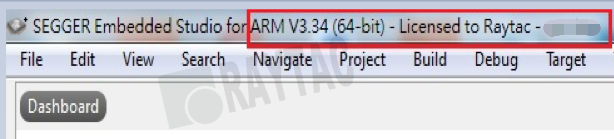
  1. When completed, click"Manage Activation",shown “License key" well installed.

圖片 11

圖片 12.png

CMSIS Configuration Wizard,

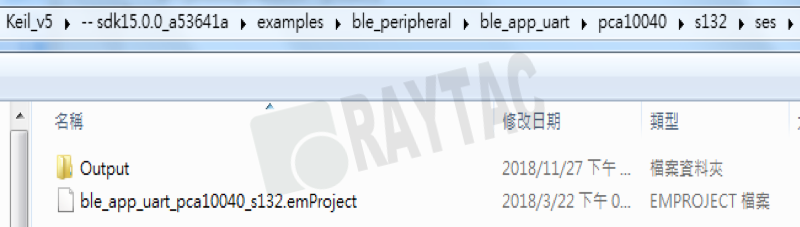
  1. Select “Open Solution" in SES’s File option to open SDK v15.0.0 project

..\examples\ble_peripheral\ble_app_uart\pca10040\s132\ses\ble_app_uart_pca10040_s132.emProject 

圖片 13圖片 14

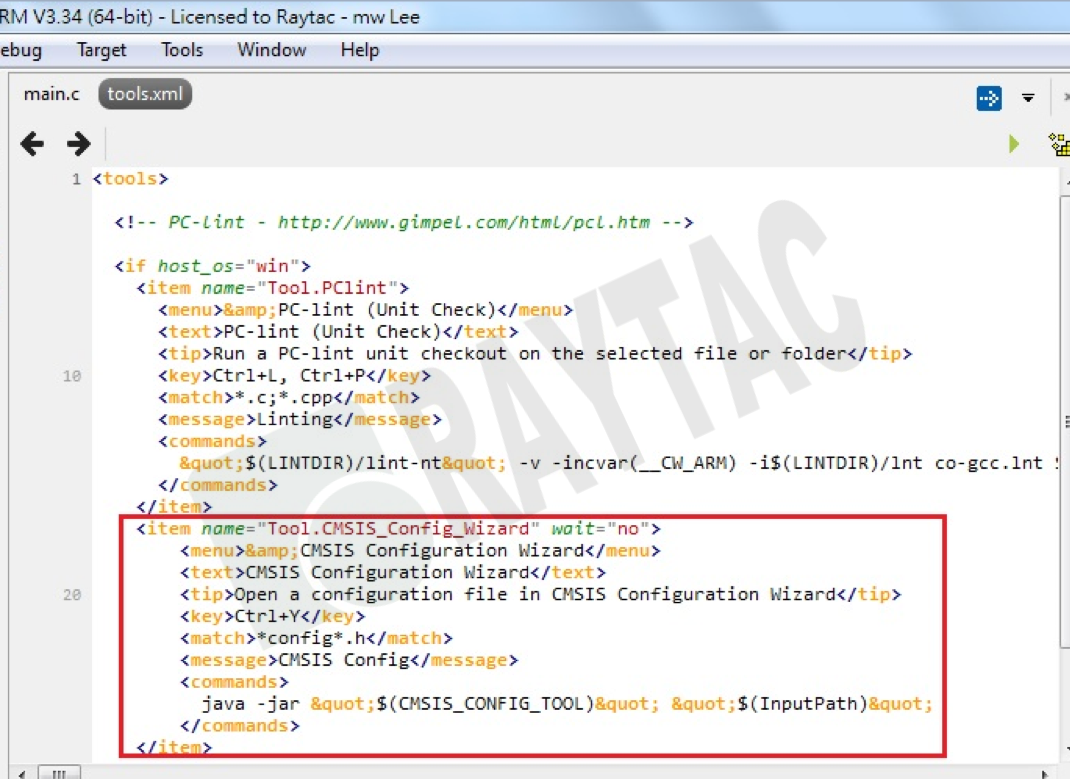
  1. Select “Open Studio Folder" in SES’s File option, then select “External Tools Configuration". You may find the display as below screen shot. Pls paste the below command. (The command can also be found in below link)

https://infocenter.nordicsemi.com/index.jsp?topic=%2Fcom.nordic.infocenter.sdk5.v15.0.0%2Fsdk_config.html&cp=4_0_0_1_6

圖片 15.png

圖片 16

  1. Please save the “tools.xml". Afterward, developers may able start over build code and debug works.

Build Code & Debug

Raytac Corporation 勁達國際電子股份有限公司
A company of Abietec
Bluetooth & WiFi module maker based on Nordic nRF54, nRF53, nRF52, nRF7002 solution
BT5.4 &BT5.3 & BT5.2 & BT5.1 Qualified, FCC/IC/CE/Telec/KC/RCM/SRRC/NCC Pre-Certified. Bluetooth Solution: nRF54, nRF5340, nRF52840, nRF52833, nRF52832, nRF52820, nRF52811, nRF52810, nRF52805, nRF51822 WiFi Solution: nRF7002
www.raytac.com
email:service@raytac.com
Tel: +886.2.3234.0208