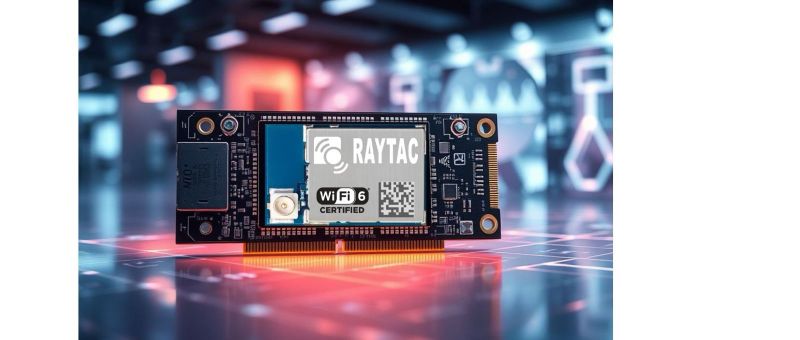
[2025.02.19] Raytac Corporation is proud to announce that our application for Wi-Fi Alliance (WFA) certification on the AN7002Q series(based on Nordic’s nRF7002 IC) has been successfully approved. This achievement reinforces our commitment to providing high-quality, reliable, and standard-compliant wireless solutions. By leveraging this certification, our modules ensure seamless interoperability, enhanced security, and superior performance for a wide range of IoT applications.
Advantages of Using Raytac Modules with WFA Certification:
Reliable and Secure Connectivity – Ensures seamless communication with other Wi-Fi-certified devices while meeting industry-leading security standards for stable and secure data transmission. Faster Time-to-Market – Pre-certified modules simplify compliance processes, reducing development time. Global Market Access – Certification helps meet regulatory requirements in multiple regions, expanding business opportunities. Significant Cost-Saving – Compared to the chip-on-board approach, using Raytac’s Wi-Fi module allows direct access to the Derivative programs(please click here for more descriptions), leveraging Raytac’s CID to minimize certification costs and save time-to-market.
To learn more about Wi-Fi certifications and Wi-Fi + BLE applications, feel free to contact us anytime at sales@raytac.com.
Edited by Account Manager: Ms. Mandy Chao
Raytac Corporation 勁達國際電子股份有限公司 A Bluetooth, Wi-Fi, and LoRa Module Maker based on Nordic nRF54; nRF53: nRF52; nRF51; nRF7002 Semtech Specification: SX1262
By obtaining wireless (Bluetooth) certification, manufacturers can demonstrate that their products comply with the required technical reliability. In another words, these certifications are like products’ passes, allow them legally entering the market and be able to import or export specific countries. Modular approval and Non-modular approval are two different approaches to the certification and regulatory processes for wireless communication devices.
Modular approval is a process in which a wireless device is certified as a modular component, such as a Bluetooth module, that can be integrated into multiple host devices without additional testing for each host device. Once certified, the module can be used in various host devices without undergo the same level of testing.
Non-modular approval is also known as end-product approval, is the traditional certification process for wireless devices, where the entire device needs to be tested and certified for compliance with wireless (Bluetooth) standards and regulations.
Countries follow and under modular approval such as FCC (USA), IC (Canada), Telec (Japan), KC (South Korea), NCC(Taiwan), SRRC(China)…etc.Meanwhile, countries are under non-modular approval, we have CE (Europe), RCM (Australia and New Zealand)…etc.
The elaboration and the easy steps on how the process we go through as you choose Raytac, detail for each as following:
Modular Approval:
FCC (USA) FCC ID Search | Federal Communications Commission 1. Part 15C –> Simply use our module FCC ID on product label 2. Part 15B (EMC) –> request lab to test on EMC, SDoc* *Definition: SDoc(Supplier’s Declaration of conformity) One way to show that a product, process or service to comply with a standard or technical regulation, in which a supplier provides written assurance of conformity to the specified requirements.
IC (Canada) IndustryCanda Wireless ID Database (industrycanada.co) 1.Similar to FCC –> Simply use our module IC ID on product label. 2.–> request lab to test finished good on EMC (IC ES003). Recommend combining test with FCC Part 15B
Telec (MIC)(Japan) MIC ICT Policy (soumu.go.jp) 1.–> Simply use our module Telec ID on product label 2.Different from the USA and Canada –> EMC is optional in Japan, upon on end customer’s request.
KC (South Korea) South Korea – Labeling/Marking Requirements (trade.gov) 1. Wireless test can be continued to use module report, new test is not required. 2. EMC KN301489(same rule as CE EN301489) –> to be tested based on final goods under EMC test policy. Same rules as FCC and IC. Recommend combining test with FCC Part 15B. 3. If product obtain additional cable IO port, test on KN3235 is required. 4. To be KC certified, the new test is required, certification no. cannot be continued to use from other policy. And the test must be done locally.
NCC (Taiwan) NATIONAL COMMUNICATIONS COMMISSION (ncc.gov.tw) 1. Products is compliant with platform policy –> lab submit photo and add product under Raytac NCC no. 2. Products is not compliant with platform policy –> product must be tested as final goods at the lab to be certified. *Definition: platform policy: product itself has it’s own function before Bluetooth was installed. For example, a Bluetooth installed pen has a new function; it vibrates when the switch is on. In this scenario, pen originally has it’s own function, and now the addition function; vibration has been added to this device. We say this product is compliant with platform policy.
SRRC (China) State Radio Regulation of China (srrc.org.cn) 1. –>Simply use our module SRRC ID on product label. 2. Products doesn’t under the category of home electronics / office supplies, SRRC test must be implemented.
Non-Modular Approval:
CE (Europe) CE Marking (trade.gov) 1. Wireless test: EN300328 –> Conducted test could continue to use Raytac ‘s CE report. –> Radiated test is required to be tested based on final goods under wireless regulation. 2. EN301489 (EMC) –> Same rules as FCC and IC. Recommend combining test with FCC Part 15B 3. Safety test: EN60950 (EN62368)–> safety test is required to be tested based on final goods under regulation.
RCM (Australia and New Zealand) The Regulatory Compliance Mark (RCM) (General) – EESS 1. Products is CE certified –>lab can copy CE report to apply RCM 2. Products is not CE certified –> go through the same test as CE regulations.
Overall, it’s important to note that the certification process and requirements may vary across different regions. Manufacturers should consult the relevant certification authorities to determine the specific requirements for their wireless devices. Raytac already took a step ahead gone through complex procedures of obtaining certifications, and we also have strong IT team to support for best solutions.Choosing Raytac would allow you to work more efficient and it will be your key in success for all the projects.
Edited by Sales Manager: Mandy Chao
Raytac Corporation 勁達國際電子有限公司 A Bluetooth & WiFi module maker based on Nordic nRF54, nRF53, nRF52, nRF7002 solution www.raytac.com email: service@raytac.com Tel: +886.2.3234.0208
Raytac’s pre-certified module for your convenience – but how?So, in this post, we would like to take you on a little journey through most of the important certifications that Raytac has pre-certified their modules with.
The exact topic is actually what you need to know and what that means to you as a Raytac customer.Obviously, each and every certification has their own rules, so that’s how we’re going to do this – one by one.
FCC – (U.S.A.)
Most people in the industry have heard of FCC, but for you who really don’t know what it is, it’s the Federal Communications Commission in the United States of America. Although considered as a center for these regulations, you will soon realize that they’re not really the center of these regulations and laws at all.
So for the FCC certification, you can as a Raytac customer:
Use Raytac’s certification ID directly on your finished product’s label
But you need to:
Test FCC Part 15B EMC for your finished products
IC – (Canada)
When it comes to the Industry Canada (yes, that’s what IC stands for), the regulations and procedures are much like their sibling FCC.
Use Raytac’s certification ID on your finished product’s label (same as FCC)
But, just like FCC, you need to:
Test IC ES003 (EMC)
This can be combined together with the FCC Part 15B test
TELEC – (Japan)
TELEC, sometimes referred to as MIC, is surprisingly simple.
What you will need to do is:
Use Raytac’s certification ID on your finished product’s label
Yes – you can actually just go right ahead and implement and/or commercialize your product after its parts are all proven TELEC certified which is pretty neat. However, there is another test that you as a customer can do if you wish, and that is VCCI which is just like the EMC tests mentioned above with the only difference (in terms of regulation) is that it’s NOT mandatory. Thus, you can choose not to do it as well.
KC – (South Korea)
As for the Korean regulation, these are the things you will have to do:
Test EMC for wireless (KN301489 – same as CE’s EN301489)
Test EMC for wire (IO port) (KN3235)
If, and only if, your final product is equipped with IO ports, that is.
These two tests needs to be done locally (Korean test lab) and depending on which test it is, you’ll have to deal with them differently.
Firstly, for the wireless test, you can refer to Raytac’s own certification report so that the lab knows the module itself has passed although it still needs to be tested.
Secondly, the for wire (IO port) test, you will have to do from scratch essentially.
Thus, even though we have applied for KC for our modules, you will still have to test them locally.
CE (Radio Equipment Directive 2014/53/EU (RED)) – (EEA, Europe)
Although CE is considered as strict regulation, the procedure is pretty simple. Simply put, you will have to conduct tests on a few different samples, and the procedure goes:
Test on Conducted engineering sample (EN300328)
You can refer to Raytac’s test report, if the test lab accepts it, that is.
To ensure that they do, you can choose to conduct your tests at the same lab as Raytac – SGS.
Test on Radiated engineering sample (EN300328)
Test EMC (EN301489)
Test Safety (EN60950)
Subject to change to EN62368 in 2021
SRRC
Simply put, you will have 2 scenarios:
Your end product can either be defined as a “Home Appliances" or an “Office Utilities" product
Then you can simply refer Raytac’s SRRC ID (module policy just like FCC/IC/TELEC)
Your end product is neither of the above
You have to apply for your own SRRC ID by testing everything required by the regulation
NCC
They go by a “Platform policy" which basically means that as long as you are just adding functionality onto an already existing feature, then you can leverage Raytac’s NCC ID on your product’s label directly (module policy just like FCC/IC/TELEC/SRRC). Otherwise, you will have to apply for a new one.
Thus, the procedure becomes:
Adding functionality of an already existing feature (a.k.a. platform)?
Then you can simply refer Raytac’s NCC ID on your product (module policy just like FCC/IC/TELEC/SRRC)
New ideas/features?
Sorry, you have to apply for your own NCC ID by conducting all tests necessary
RCM
Australia’s RCM (Regulatory Compliance Mark) is a lot like CE, much like IC is similar to FCC.
When applying to this certification, you will be in either of these two circumstances:
CE already done.
You can refer to your own CE certification and ask your test lab to copy the report to your RCM application.
CE NOT done.
You must conduct the test from scratch. But it is a whole lot like CE, meaning:
Test on Conducted engineering sample
Test on Radiated engineering sample
Test EMC
Test Safety
Bluetooth Certification
Last, but definitely not least, is the Bluetooth Certification. For this one, choosing Raytac’s modules will bring you great benefits. But first, you need to:
Apply for Bluetooth SIG’s “Adopter Membership" (free)
For your first product, that is all you will have to do. But what if you come up with a new model of the product? Before you ask, I will answer “No – you don’t necessarily have to purchase another DID." In order for this to be true though, your new product cannot have either of these things changed:
Hardware
Unless you are still using Raytac’s module
Feature
Unless you are still using Raytac’s module
Brand Name
Brand name remains unchanged.
Although you might be able to apply for these certifications all on your own without trouble whatsoever, we always encourage customers using Raytac’s BLE modules to contact us before hand so that we can provide you valuable information. This way, you will get unbiased guidance which will save you time and money.



 Obviously, each and every certification has their own rules, so that’s how we’re going to do this – one by one.
 Raytac Corporation